 Add to Chrome
 Add to Firefox
 Add to Edge
RAW-Domain Degradation Models for Realistic Smartphone Super-Resolution
Mar 12, 2026
Digital zoom on smartphones relies on learning-based super-resolution (SR) models that operate on RAW sensor images, but obtaining sensor-specific training data is challenging due to the lack of ground-truth images. Synthetic data generation via ``unprocessing'' pipelines offers a potential solution by simulating the degradations that transform high-resolution (HR) images into their low-resolution (LR) counterparts. However, these pipelines can introduce domain gaps due to incomplete or unrealistic degradation modeling. In this paper, we demonstrate that principled and carefully designed degradation modeling can enhance SR performance in real-world conditions. Instead of relying on generic priors for camera blur and noise, we model device-specific degradations through calibration and unprocess publicly available rendered images into the RAW domain of different smartphones. Using these image pairs, we train a single-image RAW-to-RGB SR model and evaluate it on real data from a held-out device. Our experiments show that accurate degradation modeling leads to noticeable improvements, with our SR model outperforming baselines trained on large pools of arbitrarily chosen degradations.

From Graphs to Gates: DNS-HyXNet, A Lightweight and Deployable Sequential Model for Real-Time DNS Tunnel Detection
Dec 10, 2025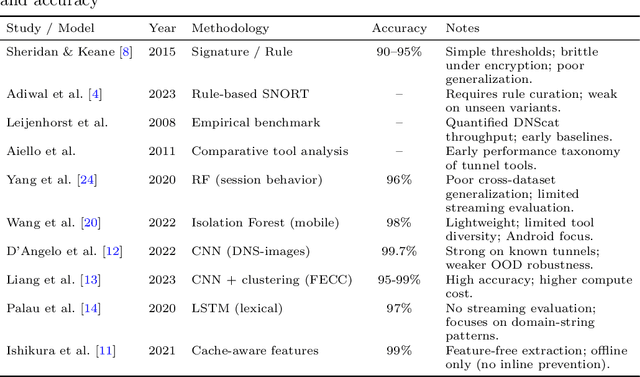
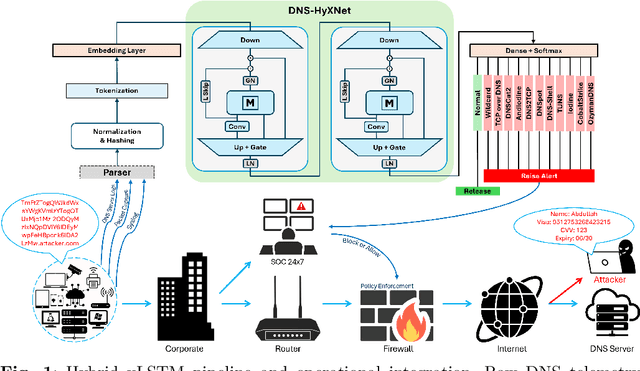
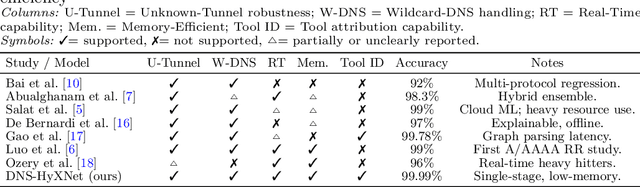
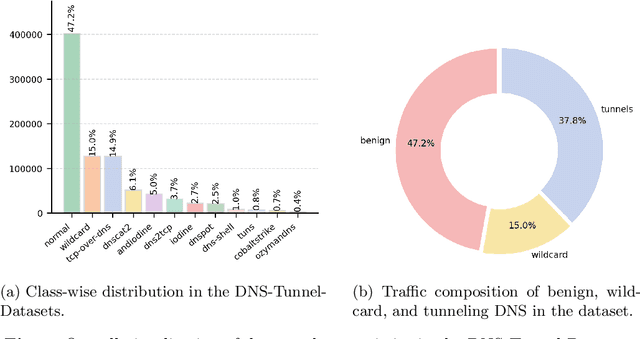
Domain Name System (DNS) tunneling remains a covert channel for data exfiltration and command-and-control communication. Although graph-based methods such as GraphTunnel achieve strong accuracy, they introduce significant latency and computational overhead due to recursive parsing and graph construction, limiting their suitability for real-time deployment. This work presents DNS-HyXNet, a lightweight extended Long Short-Term Memory (xLSTM) hybrid framework designed for efficient sequence-based DNS tunnel detection. DNS-HyXNet integrates tokenized domain embeddings with normalized numerical DNS features and processes them through a two-layer xLSTM network that directly learns temporal dependencies from packet sequences, eliminating the need for graph reconstruction and enabling single-stage multi-class classification. The model was trained and evaluated on two public benchmark datasets with carefully tuned hyperparameters to ensure low memory consumption and fast inference. Across all experimental splits of the DNS-Tunnel-Datasets, DNS-HyXNet achieved up to 99.99% accuracy, with macro-averaged precision, recall, and F1-scores exceeding 99.96%, and demonstrated a per-sample detection latency of just 0.041 ms, confirming its scalability and real-time readiness. These results show that sequential modeling with xLSTM can effectively replace computationally expensive recursive graph generation, offering a deployable and energy-efficient alternative for real-time DNS tunnel detection on commodity hardware.