 Add to Chrome
 Add to Firefox
 Add to Edge
TRUST-SQL: Tool-Integrated Multi-Turn Reinforcement Learning for Text-to-SQL over Unknown Schemas
Mar 17, 2026
Text-to-SQL parsing has achieved remarkable progress under the Full Schema Assumption. However, this premise fails in real-world enterprise environments where databases contain hundreds of tables with massive noisy metadata. Rather than injecting the full schema upfront, an agent must actively identify and verify only the relevant subset, giving rise to the Unknown Schema scenario we study in this work. To address this, we propose TRUST-SQL (Truthful Reasoning with Unknown Schema via Tools). We formulate the task as a Partially Observable Markov Decision Process where our autonomous agent employs a structured four-phase protocol to ground reasoning in verified metadata. Crucially, this protocol provides a structural boundary for our novel Dual-Track GRPO strategy. By applying token-level masked advantages, this strategy isolates exploration rewards from execution outcomes to resolve credit assignment, yielding a 9.9% relative improvement over standard GRPO. Extensive experiments across five benchmarks demonstrate that TRUST-SQL achieves an average absolute improvement of 30.6% and 16.6% for the 4B and 8B variants respectively over their base models. Remarkably, despite operating entirely without pre-loaded metadata, our framework consistently matches or surpasses strong baselines that rely on schema prefilling.

Do Protein Transformers Have Biological Intelligence?
Jun 07, 2025Deep neural networks, particularly Transformers, have been widely adopted for predicting the functional properties of proteins. In this work, we focus on exploring whether Protein Transformers can capture biological intelligence among protein sequences. To achieve our goal, we first introduce a protein function dataset, namely Protein-FN, providing over 9000 protein data with meaningful labels. Second, we devise a new Transformer architecture, namely Sequence Protein Transformers (SPT), for computationally efficient protein function predictions. Third, we develop a novel Explainable Artificial Intelligence (XAI) technique called Sequence Score, which can efficiently interpret the decision-making processes of protein models, thereby overcoming the difficulty of deciphering biological intelligence bided in Protein Transformers. Remarkably, even our smallest SPT-Tiny model, which contains only 5.4M parameters, demonstrates impressive predictive accuracy, achieving 94.3% on the Antibiotic Resistance (AR) dataset and 99.6% on the Protein-FN dataset, all accomplished by training from scratch. Besides, our Sequence Score technique helps reveal that our SPT models can discover several meaningful patterns underlying the sequence structures of protein data, with these patterns aligning closely with the domain knowledge in the biology community. We have officially released our Protein-FN dataset on Hugging Face Datasets https://huggingface.co/datasets/Protein-FN/Protein-FN. Our code is available at https://github.com/fudong03/BioIntelligence.
Budget-Adaptive Adapter Tuning in Orthogonal Subspaces for Continual Learning in LLMs
May 28, 2025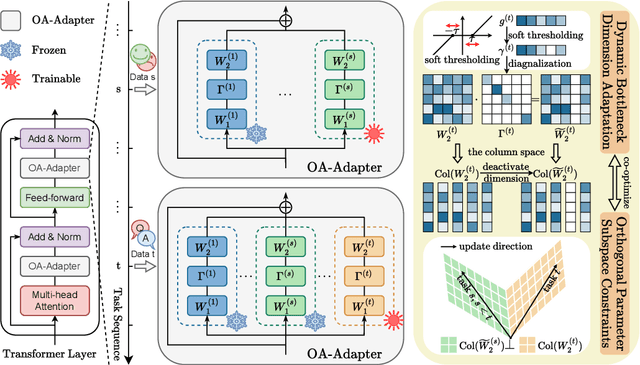
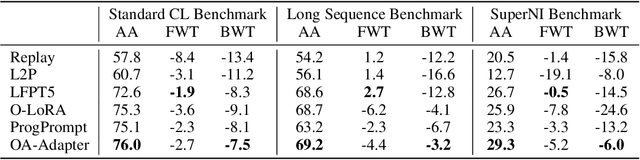
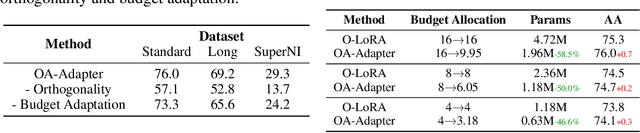
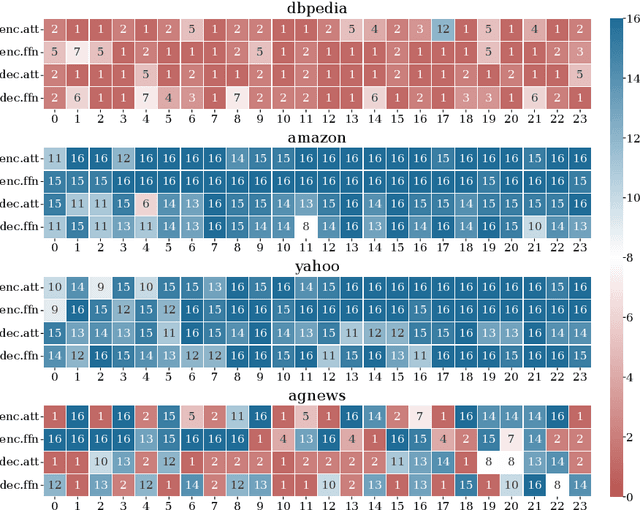
Large language models (LLMs) often suffer from catastrophic forgetting in continual learning (CL) scenarios, where performance on previously learned tasks degrades severely while training on sequentially arriving tasks. Although pioneering CL approaches using orthogonal subspaces can mitigate task interference, they typically employ fixed budget allocation, neglecting the varying complexity across tasks and layers. Besides, recent budget-adaptive tuning methods for LLMs often adopt multi-stage paradigms that decouple optimization and budget allocation. Such decoupling results in potential misalignment, which hinders those approaches' practical application in CL scenarios. To address these limitations, we propose OA-Adapter, a novel parameter-efficient approach for continual learning in LLMs that unifies dynamic budget adaptation with orthogonal subspace learning in a single end-to-end training stage. Specifically, OA-Adapter introduces a dynamic bottleneck dimension adaptation mechanism that simultaneously allocates an efficient parameter budget and optimizes task objectives without misalignment. To effectively preserve previously acquired knowledge while coordinating with the dynamic budget allocation, orthogonal constraints are applied specifically between the parameter subspace of the current task and the dynamically allocated parameter subspaces of historical tasks. Experimental results on continual learning benchmarks demonstrate that OA-Adapter outperforms state-of-the-art methods in both accuracy and parameter efficiency, achieving higher average accuracy while using 58.5% fewer parameters on the standard CL benchmark.