 Add to Chrome
 Add to Firefox
 Add to Edge
A 32-Channel 3.53-μW Per Channel Brain-Machine Interface SoC Featuring Dual-Threshold Delta-modulation, In-Memory Spike Detection and Bi-SNN Based Motor Decoding
Jun 01, 2026
With the scaling of sensor channel counts, systems confront challenges in frontend data sensing and on-implant data processing. This work presents a 32-channel fully event-based iBMI SoC in 65nm CMOS for an efficient neuromorphic signal processing pipeline. The SoC integrates a 32-channel dual-threshold delta modulation (DTDM) frontend array that provides up to 26x data compression at the frontend, an in-memory computing (IMC) spike detector (SPD) for efficient in-pixel spike detection, and a bipolar LIF-based spiking neural network (Bi-SNN) decoder for on-chip motor intention decoding (MID). Consuming only 3.53 μW per channel and achieving ~0.62 decoding R2 with a compact 0.034 mm2 per-channel area, the chip enables high-efficiency signal recording, processing, and decoding for implantable devices.

Thinking Beyond Tokens: From Brain-Inspired Intelligence to Cognitive Foundations for Artificial General Intelligence and its Societal Impact
Jul 01, 2025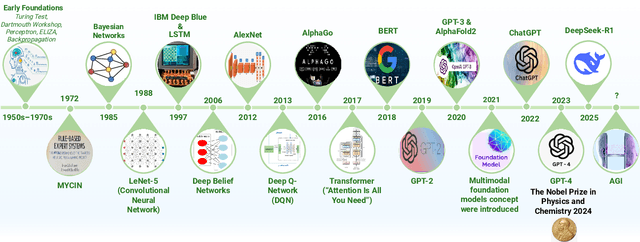
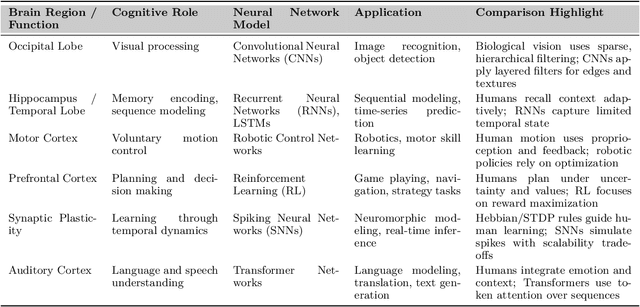
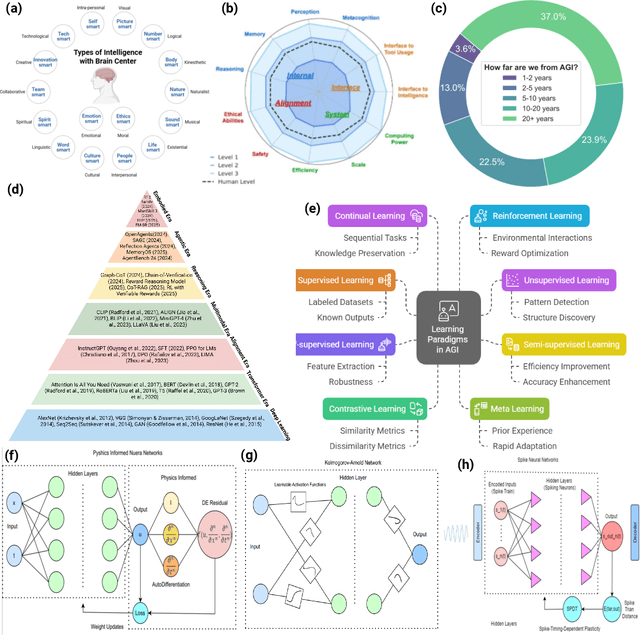
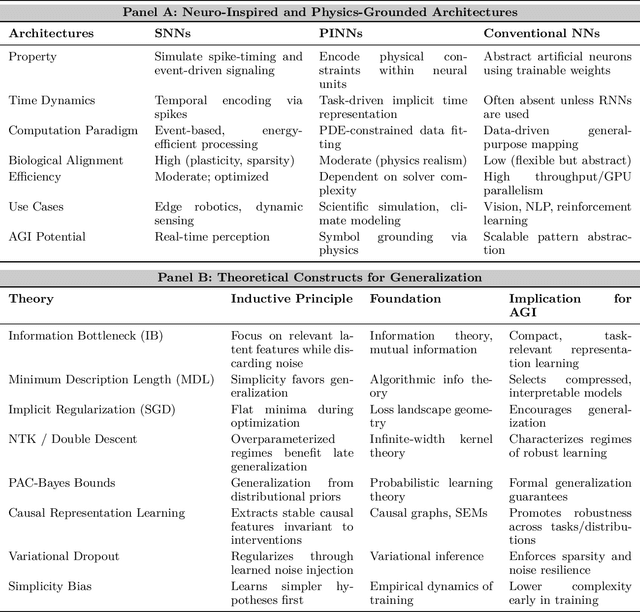
Can machines truly think, reason and act in domains like humans? This enduring question continues to shape the pursuit of Artificial General Intelligence (AGI). Despite the growing capabilities of models such as GPT-4.5, DeepSeek, Claude 3.5 Sonnet, Phi-4, and Grok 3, which exhibit multimodal fluency and partial reasoning, these systems remain fundamentally limited by their reliance on token-level prediction and lack of grounded agency. This paper offers a cross-disciplinary synthesis of AGI development, spanning artificial intelligence, cognitive neuroscience, psychology, generative models, and agent-based systems. We analyze the architectural and cognitive foundations of general intelligence, highlighting the role of modular reasoning, persistent memory, and multi-agent coordination. In particular, we emphasize the rise of Agentic RAG frameworks that combine retrieval, planning, and dynamic tool use to enable more adaptive behavior. We discuss generalization strategies, including information compression, test-time adaptation, and training-free methods, as critical pathways toward flexible, domain-agnostic intelligence. Vision-Language Models (VLMs) are reexamined not just as perception modules but as evolving interfaces for embodied understanding and collaborative task completion. We also argue that true intelligence arises not from scale alone but from the integration of memory and reasoning: an orchestration of modular, interactive, and self-improving components where compression enables adaptive behavior. Drawing on advances in neurosymbolic systems, reinforcement learning, and cognitive scaffolding, we explore how recent architectures begin to bridge the gap between statistical learning and goal-directed cognition. Finally, we identify key scientific, technical, and ethical challenges on the path to AGI.