 Add to Chrome
 Add to Firefox
 Add to Edge
Managing multiple agents by automatically adjusting incentives
Sep 03, 2024
In the coming years, AI agents will be used for making more complex decisions, including in situations involving many different groups of people. One big challenge is that AI agent tends to act in its own interest, unlike humans who often think about what will be the best for everyone in the long run. In this paper, we explore a method to get self-interested agents to work towards goals that benefit society as a whole. We propose a method to add a manager agent to mediate agent interactions by assigning incentives to certain actions. We tested our method with a supply-chain management problem and showed that this framework (1) increases the raw reward by 22.2%, (2) increases the agents' reward by 23.8%, and (3) increases the manager's reward by 20.1%.

SAFT: Towards Out-of-Distribution Generalization in Fine-Tuning
Jul 03, 2024
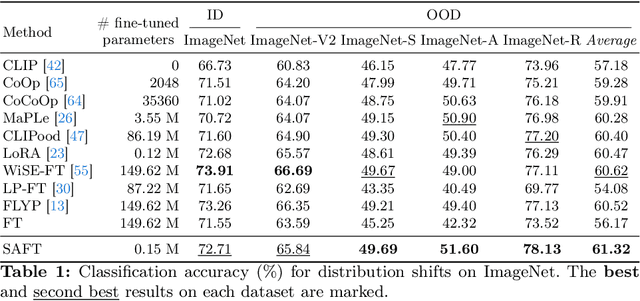

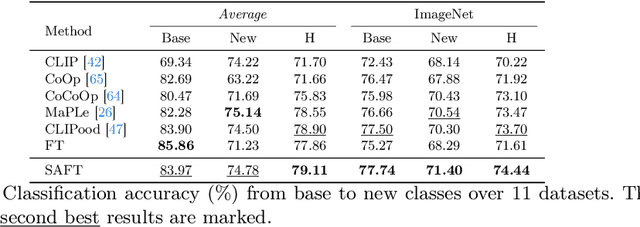
Handling distribution shifts from training data, known as out-of-distribution (OOD) generalization, poses a significant challenge in the field of machine learning. While a pre-trained vision-language model like CLIP has demonstrated remarkable zero-shot performance, further adaptation of the model to downstream tasks leads to undesirable degradation for OOD data. In this work, we introduce Sparse Adaptation for Fine-Tuning (SAFT), a method that prevents fine-tuning from forgetting the general knowledge in the pre-trained model. SAFT only updates a small subset of important parameters whose gradient magnitude is large, while keeping the other parameters frozen. SAFT is straightforward to implement and conceptually simple. Extensive experiments show that with only 0.1% of the model parameters, SAFT can significantly improve the performance of CLIP. It consistently outperforms baseline methods across several benchmarks. On the few-shot learning benchmark of ImageNet and its variants, SAFT gives a gain of 5.15% on average over the conventional fine-tuning method in OOD settings.
Multimodal foundation world models for generalist embodied agents
Jun 26, 2024Learning generalist embodied agents, able to solve multitudes of tasks in different domains is a long-standing problem. Reinforcement learning (RL) is hard to scale up as it requires a complex reward design for each task. In contrast, language can specify tasks in a more natural way. Current foundation vision-language models (VLMs) generally require fine-tuning or other adaptations to be functional, due to the significant domain gap. However, the lack of multimodal data in such domains represents an obstacle toward developing foundation models for embodied applications. In this work, we overcome these problems by presenting multimodal foundation world models, able to connect and align the representation of foundation VLMs with the latent space of generative world models for RL, without any language annotations. The resulting agent learning framework, GenRL, allows one to specify tasks through vision and/or language prompts, ground them in the embodied domain's dynamics, and learns the corresponding behaviors in imagination. As assessed through large-scale multi-task benchmarking, GenRL exhibits strong multi-task generalization performance in several locomotion and manipulation domains. Furthermore, by introducing a data-free RL strategy, it lays the groundwork for foundation model-based RL for generalist embodied agents.
On the consistency of hyper-parameter selection in value-based deep reinforcement learning
Jun 25, 2024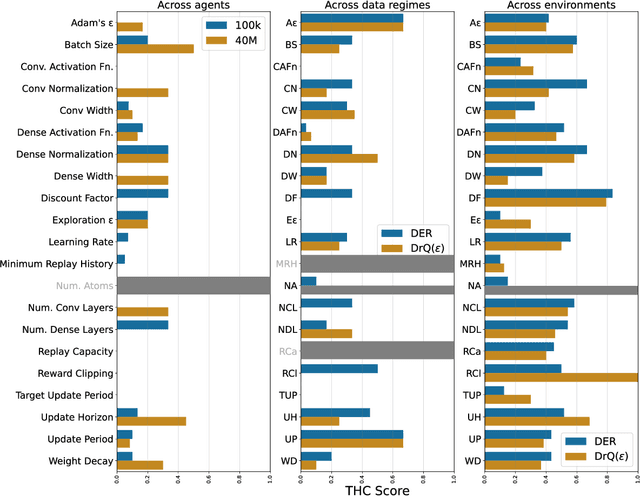
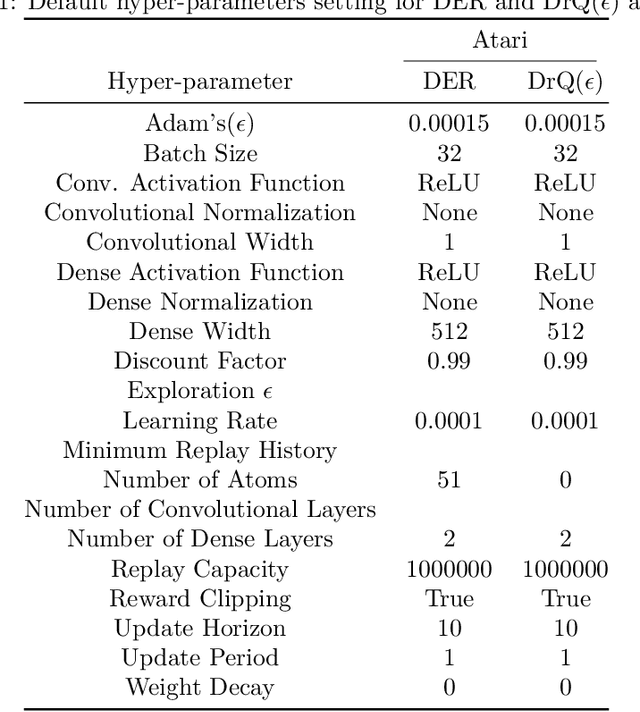
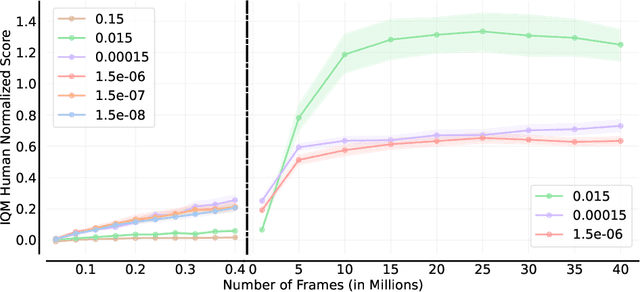
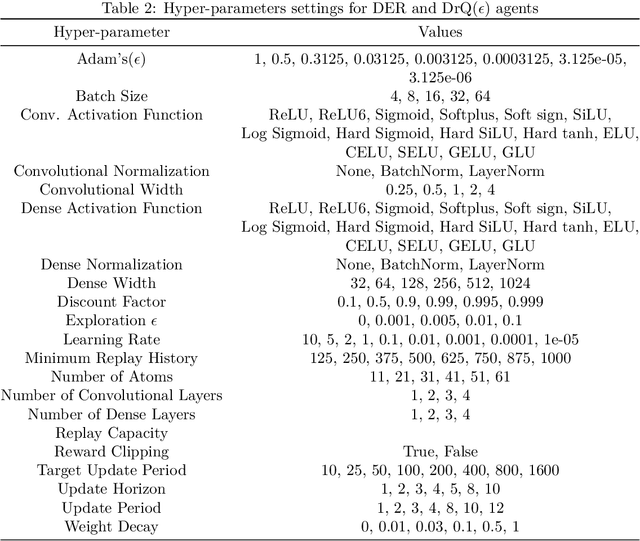
Deep reinforcement learning (deep RL) has achieved tremendous success on various domains through a combination of algorithmic design and careful selection of hyper-parameters. Algorithmic improvements are often the result of iterative enhancements built upon prior approaches, while hyper-parameter choices are typically inherited from previous methods or fine-tuned specifically for the proposed technique. Despite their crucial impact on performance, hyper-parameter choices are frequently overshadowed by algorithmic advancements. This paper conducts an extensive empirical study focusing on the reliability of hyper-parameter selection for value-based deep reinforcement learning agents, including the introduction of a new score to quantify the consistency and reliability of various hyper-parameters. Our findings not only help establish which hyper-parameters are most critical to tune, but also help clarify which tunings remain consistent across different training regimes.
Advantage Alignment Algorithms
Jun 20, 2024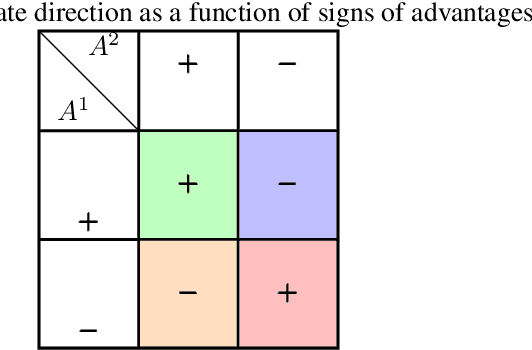
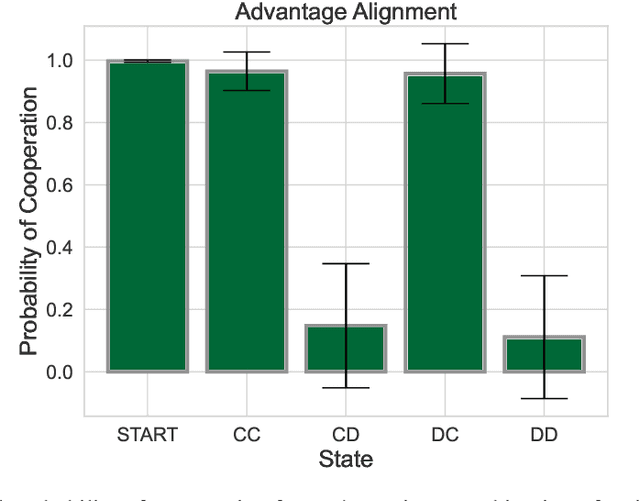
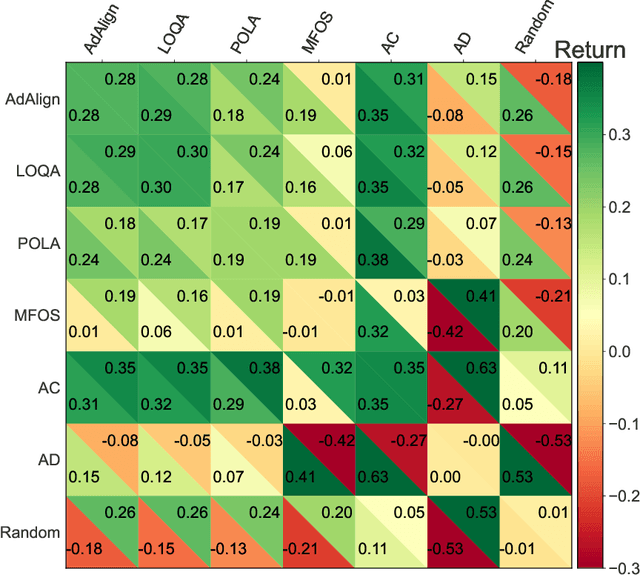
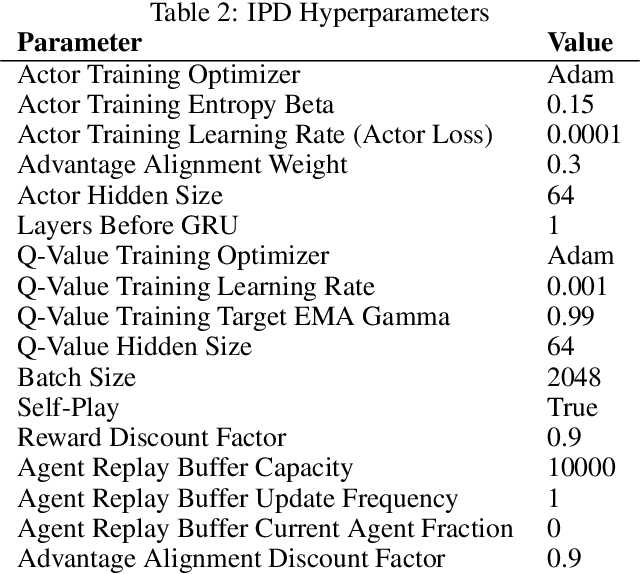
The growing presence of artificially intelligent agents in everyday decision-making, from LLM assistants to autonomous vehicles, hints at a future in which conflicts may arise from each agent optimizing individual interests. In general-sum games these conflicts are apparent, where naive Reinforcement Learning agents get stuck in Pareto-suboptimal Nash equilibria. Consequently, opponent shaping has been introduced as a method with success at finding socially beneficial equilibria in social dilemmas. In this work, we introduce Advantage Alignment, a family of algorithms derived from first principles that perform opponent shaping efficiently and intuitively. This is achieved by aligning the advantages of conflicting agents in a given game by increasing the probability of mutually-benefiting actions. We prove that existing opponent shaping methods, including LOLA and LOQA, implicitly perform Advantage Alignment. Compared to these works, Advantage Alignment mathematically simplifies the formulation of opponent shaping and seamlessly works for continuous action domains. We also demonstrate the effectiveness of our algorithm in a wide range of social dilemmas, achieving state of the art results in each case, including a social dilemma version of the Negotiation Game.
The Curse of Diversity in Ensemble-Based Exploration
May 07, 2024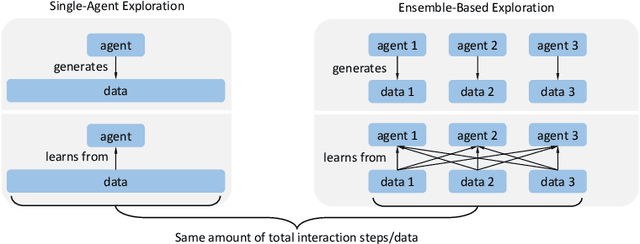
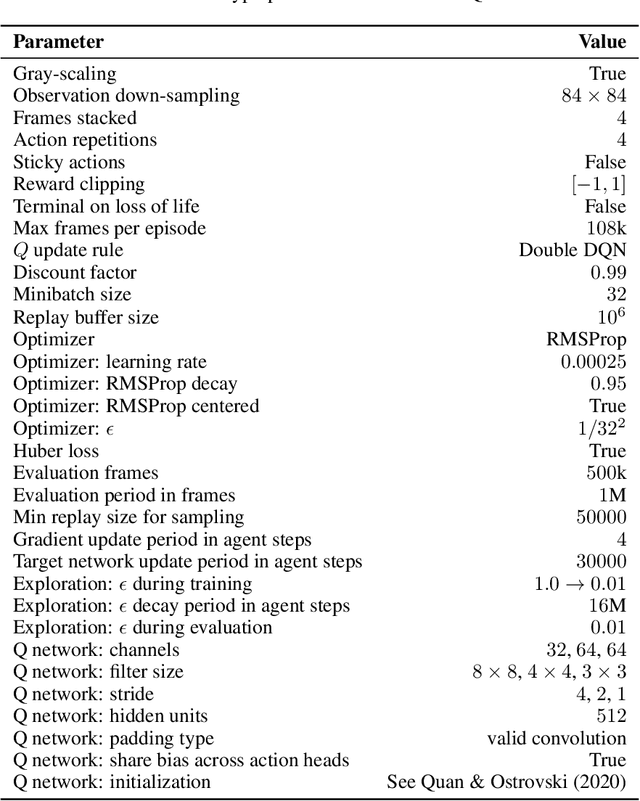
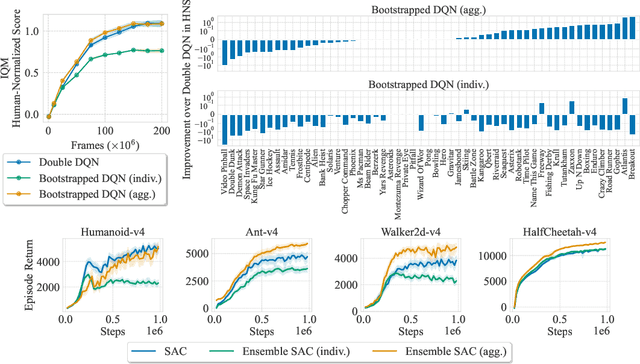
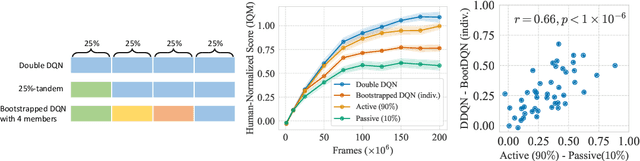
We uncover a surprising phenomenon in deep reinforcement learning: training a diverse ensemble of data-sharing agents -- a well-established exploration strategy -- can significantly impair the performance of the individual ensemble members when compared to standard single-agent training. Through careful analysis, we attribute the degradation in performance to the low proportion of self-generated data in the shared training data for each ensemble member, as well as the inefficiency of the individual ensemble members to learn from such highly off-policy data. We thus name this phenomenon the curse of diversity. We find that several intuitive solutions -- such as a larger replay buffer or a smaller ensemble size -- either fail to consistently mitigate the performance loss or undermine the advantages of ensembling. Finally, we demonstrate the potential of representation learning to counteract the curse of diversity with a novel method named Cross-Ensemble Representation Learning (CERL) in both discrete and continuous control domains. Our work offers valuable insights into an unexpected pitfall in ensemble-based exploration and raises important caveats for future applications of similar approaches.
LOQA: Learning with Opponent Q-Learning Awareness
May 02, 2024



In various real-world scenarios, interactions among agents often resemble the dynamics of general-sum games, where each agent strives to optimize its own utility. Despite the ubiquitous relevance of such settings, decentralized machine learning algorithms have struggled to find equilibria that maximize individual utility while preserving social welfare. In this paper we introduce Learning with Opponent Q-Learning Awareness (LOQA), a novel, decentralized reinforcement learning algorithm tailored to optimizing an agent's individual utility while fostering cooperation among adversaries in partially competitive environments. LOQA assumes the opponent samples actions proportionally to their action-value function Q. Experimental results demonstrate the effectiveness of LOQA at achieving state-of-the-art performance in benchmark scenarios such as the Iterated Prisoner's Dilemma and the Coin Game. LOQA achieves these outcomes with a significantly reduced computational footprint, making it a promising approach for practical multi-agent applications.
Modeling Caption Diversity in Contrastive Vision-Language Pretraining
Apr 30, 2024

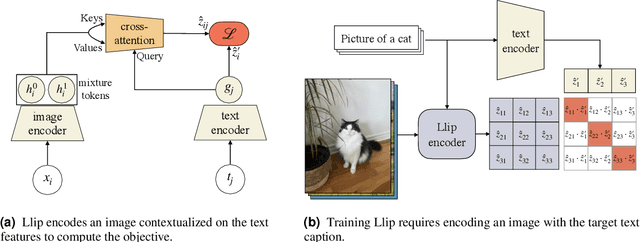

There are a thousand ways to caption an image. Contrastive Language Pretraining (CLIP) on the other hand, works by mapping an image and its caption to a single vector -- limiting how well CLIP-like models can represent the diverse ways to describe an image. In this work, we introduce Llip, Latent Language Image Pretraining, which models the diversity of captions that could match an image. Llip's vision encoder outputs a set of visual features that are mixed into a final representation by conditioning on information derived from the text. We show that Llip outperforms non-contextualized baselines like CLIP and SigLIP on a variety of tasks even with large-scale encoders. Llip improves zero-shot classification by an average of 2.9% zero-shot classification benchmarks with a ViT-G/14 encoder. Specifically, Llip attains a zero-shot top-1 accuracy of 83.5% on ImageNet outperforming a similarly sized CLIP by 1.4%. We also demonstrate improvement on zero-shot retrieval on MS-COCO by 6.0%. We provide a comprehensive analysis of the components introduced by the method and demonstrate that Llip leads to richer visual representations.
SPARO: Selective Attention for Robust and Compositional Transformer Encodings for Vision
Apr 24, 2024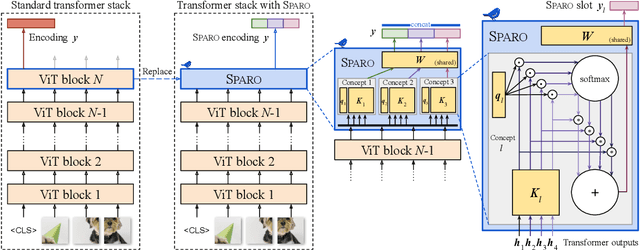
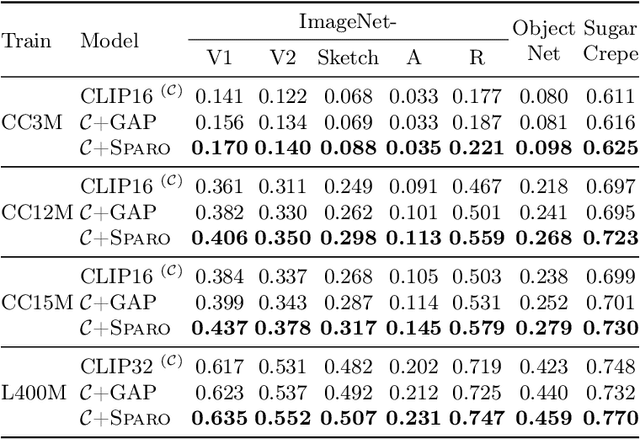
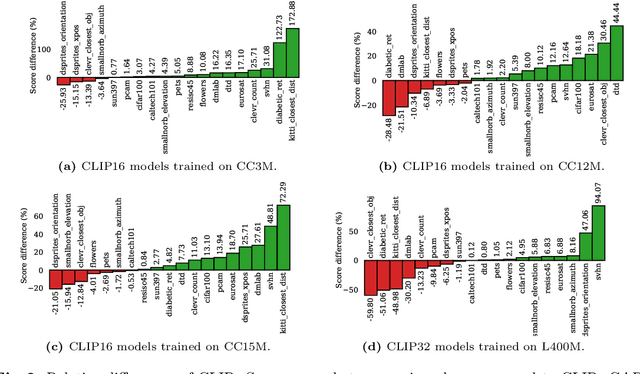
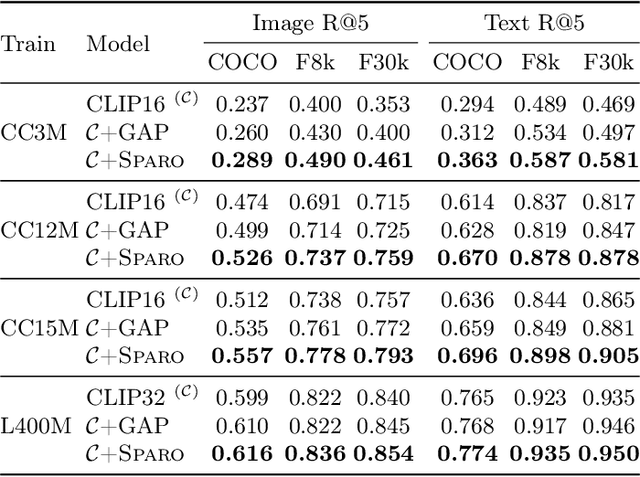
Selective attention helps us focus on task-relevant aspects in the constant flood of our sensory input. This constraint in our perception allows us to robustly generalize under distractions and to new compositions of perceivable concepts. Transformers employ a similar notion of attention in their architecture, but representation learning models with transformer backbones like CLIP and DINO often fail to demonstrate robustness and compositionality. We highlight a missing architectural prior: unlike human perception, transformer encodings do not separately attend over individual concepts. In response, we propose SPARO, a read-out mechanism that partitions encodings into separately-attended slots, each produced by a single attention head. Using SPARO with CLIP imparts an inductive bias that the vision and text modalities are different views of a shared compositional world with the same corresponding concepts. Using SPARO, we demonstrate improvements on downstream recognition, robustness, retrieval, and compositionality benchmarks with CLIP (up to +14% for ImageNet, +4% for SugarCrepe), and on nearest neighbors and linear probe for ImageNet with DINO (+3% each). We also showcase a powerful ability to intervene and select individual SPARO concepts to further improve downstream task performance (up from +4% to +9% for SugarCrepe) and use this ability to study the robustness of SPARO's representation structure. Finally, we provide insights through ablation experiments and visualization of learned concepts.
Best Response Shaping
Apr 05, 2024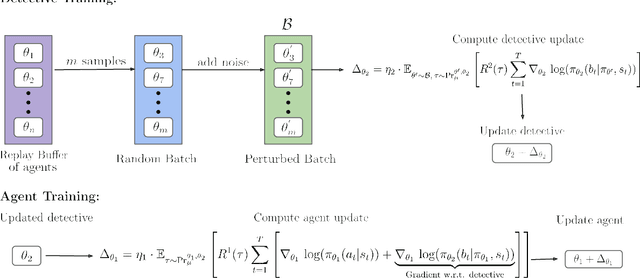
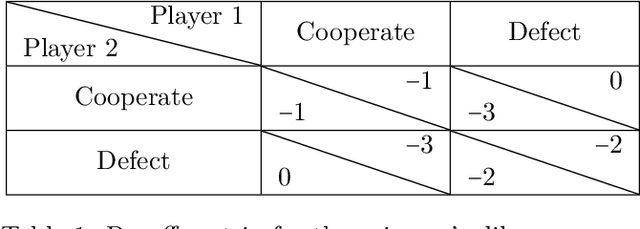
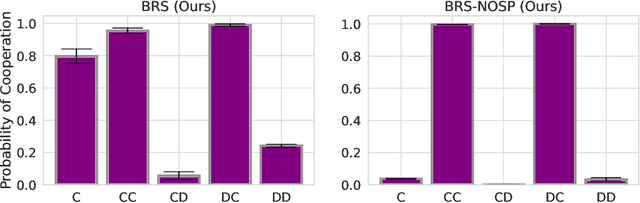
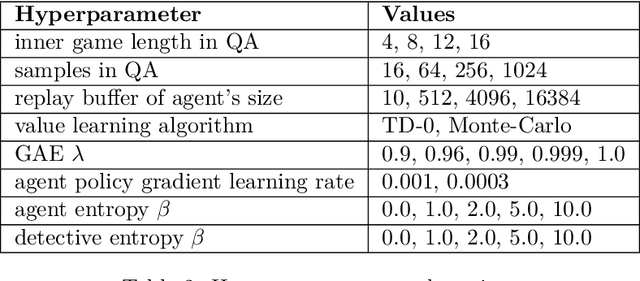
We investigate the challenge of multi-agent deep reinforcement learning in partially competitive environments, where traditional methods struggle to foster reciprocity-based cooperation. LOLA and POLA agents learn reciprocity-based cooperative policies by differentiation through a few look-ahead optimization steps of their opponent. However, there is a key limitation in these techniques. Because they consider a few optimization steps, a learning opponent that takes many steps to optimize its return may exploit them. In response, we introduce a novel approach, Best Response Shaping (BRS), which differentiates through an opponent approximating the best response, termed the "detective." To condition the detective on the agent's policy for complex games we propose a state-aware differentiable conditioning mechanism, facilitated by a question answering (QA) method that extracts a representation of the agent based on its behaviour on specific environment states. To empirically validate our method, we showcase its enhanced performance against a Monte Carlo Tree Search (MCTS) opponent, which serves as an approximation to the best response in the Coin Game. This work expands the applicability of multi-agent RL in partially competitive environments and provides a new pathway towards achieving improved social welfare in general sum games.