 Add to Chrome
 Add to Firefox
 Add to Edge
music generation
Music generation is the task of generating music or music-like sounds from a model or algorithm.
Papers and Code
SyMuPe: Affective and Controllable Symbolic Music Performance
Nov 05, 2025
Emotions are fundamental to the creation and perception of music performances. However, achieving human-like expression and emotion through machine learning models for performance rendering remains a challenging task. In this work, we present SyMuPe, a novel framework for developing and training affective and controllable symbolic piano performance models. Our flagship model, PianoFlow, uses conditional flow matching trained to solve diverse multi-mask performance inpainting tasks. By design, it supports both unconditional generation and infilling of music performance features. For training, we use a curated, cleaned dataset of 2,968 hours of aligned musical scores and expressive MIDI performances. For text and emotion control, we integrate a piano performance emotion classifier and tune PianoFlow with the emotion-weighted Flan-T5 text embeddings provided as conditional inputs. Objective and subjective evaluations against transformer-based baselines and existing models show that PianoFlow not only outperforms other approaches, but also achieves performance quality comparable to that of human-recorded and transcribed MIDI samples. For emotion control, we present and analyze samples generated under different text conditioning scenarios. The developed model can be integrated into interactive applications, contributing to the creation of more accessible and engaging music performance systems.
* ACM Multimedia 2025. Extended version with supplementary material

AI as intermediary in modern-day ritual: An immersive, interactive production of the roller disco musical Xanadu at UCLA
Nov 09, 2025Interfaces for contemporary large language, generative media, and perception AI models are often engineered for single user interaction. We investigate ritual as a design scaffold for developing collaborative, multi-user human-AI engagement. We consider the specific case of an immersive staging of the musical Xanadu performed at UCLA in Spring 2025. During a two-week run, over five hundred audience members contributed sketches and jazzercise moves that vision language models translated to virtual scenery elements and from choreographic prompts. This paper discusses four facets of interaction-as-ritual within the show: audience input as offerings that AI transforms into components of the ritual; performers as ritual guides, demonstrating how to interact with technology and sorting audience members into cohorts; AI systems as instruments "played" by the humans, in which sensing, generative components, and stagecraft create systems that can be mastered over time; and reciprocity of interaction, in which the show's AI machinery guides human behavior as well as being guided by humans, completing a human-AI feedback loop that visibly reshapes the virtual world. Ritual served as a frame for integrating linear narrative, character identity, music and interaction. The production explored how AI systems can support group creativity and play, addressing a critical gap in prevailing single user AI design paradigms.
Artificial Intelligence Agents in Music Analysis: An Integrative Perspective Based on Two Use Cases
Nov 17, 2025This paper presents an integrative review and experimental validation of artificial intelligence (AI) agents applied to music analysis and education. We synthesize the historical evolution from rule-based models to contemporary approaches involving deep learning, multi-agent architectures, and retrieval-augmented generation (RAG) frameworks. The pedagogical implications are evaluated through a dual-case methodology: (1) the use of generative AI platforms in secondary education to foster analytical and creative skills; (2) the design of a multiagent system for symbolic music analysis, enabling modular, scalable, and explainable workflows. Experimental results demonstrate that AI agents effectively enhance musical pattern recognition, compositional parameterization, and educational feedback, outperforming traditional automated methods in terms of interpretability and adaptability. The findings highlight key challenges concerning transparency, cultural bias, and the definition of hybrid evaluation metrics, emphasizing the need for responsible deployment of AI in educational environments. This research contributes to a unified framework that bridges technical, pedagogical, and ethical considerations, offering evidence-based guidance for the design and application of intelligent agents in computational musicology and music education.
Music Flamingo: Scaling Music Understanding in Audio Language Models
Nov 13, 2025We introduce Music Flamingo, a novel large audio-language model designed to advance music (including song) understanding in foundational audio models. While audio-language research has progressed rapidly, music remains challenging due to its dynamic, layered, and information-dense nature. Progress has been further limited by the difficulty of scaling open audio understanding models, primarily because of the scarcity of high-quality music data and annotations. As a result, prior models are restricted to producing short, high-level captions, answering only surface-level questions, and showing limited generalization across diverse musical cultures. To address these challenges, we curate MF-Skills, a large-scale dataset labeled through a multi-stage pipeline that yields rich captions and question-answer pairs covering harmony, structure, timbre, lyrics, and cultural context. We fine-tune an enhanced Audio Flamingo 3 backbone on MF-Skills and further strengthen multiple skills relevant to music understanding. To improve the model's reasoning abilities, we introduce a post-training recipe: we first cold-start with MF-Think, a novel chain-of-thought dataset grounded in music theory, followed by GRPO-based reinforcement learning with custom rewards. Music Flamingo achieves state-of-the-art results across 10+ benchmarks for music understanding and reasoning, establishing itself as a generalist and musically intelligent audio-language model. Beyond strong empirical results, Music Flamingo sets a new standard for advanced music understanding by demonstrating how models can move from surface-level recognition toward layered, human-like perception of songs. We believe this work provides both a benchmark and a foundation for the community to build the next generation of models that engage with music as meaningfully as humans do.
Do Joint Language-Audio Embeddings Encode Perceptual Timbre Semantics?
Oct 16, 2025Understanding and modeling the relationship between language and sound is critical for applications such as music information retrieval,text-guided music generation, and audio captioning. Central to these tasks is the use of joint language-audio embedding spaces, which map textual descriptions and auditory content into a shared embedding space. While multimodal embedding models such as MS-CLAP, LAION-CLAP, and MuQ-MuLan have shown strong performance in aligning language and audio, their correspondence to human perception of timbre, a multifaceted attribute encompassing qualities such as brightness, roughness, and warmth, remains underexplored. In this paper, we evaluate the above three joint language-audio embedding models on their ability to capture perceptual dimensions of timbre. Our findings show that LAION-CLAP consistently provides the most reliable alignment with human-perceived timbre semantics across both instrumental sounds and audio effects.
Zero-Effort Image-to-Music Generation: An Interpretable RAG-based VLM Approach
Sep 26, 2025Recently, Image-to-Music (I2M) generation has garnered significant attention, with potential applications in fields such as gaming, advertising, and multi-modal art creation. However, due to the ambiguous and subjective nature of I2M tasks, most end-to-end methods lack interpretability, leaving users puzzled about the generation results. Even methods based on emotion mapping face controversy, as emotion represents only a singular aspect of art. Additionally, most learning-based methods require substantial computational resources and large datasets for training, hindering accessibility for common users. To address these challenges, we propose the first Vision Language Model (VLM)-based I2M framework that offers high interpretability and low computational cost. Specifically, we utilize ABC notation to bridge the text and music modalities, enabling the VLM to generate music using natural language. We then apply multi-modal Retrieval-Augmented Generation (RAG) and self-refinement techniques to allow the VLM to produce high-quality music without external training. Furthermore, we leverage the generated motivations in text and the attention maps from the VLM to provide explanations for the generated results in both text and image modalities. To validate our method, we conduct both human studies and machine evaluations, where our method outperforms others in terms of music quality and music-image consistency, indicating promising results. Our code is available at https://github.com/RS2002/Image2Music .
Segment Transformer: AI-Generated Music Detection via Music Structural Analysis
Sep 10, 2025Audio and music generation systems have been remarkably developed in the music information retrieval (MIR) research field. The advancement of these technologies raises copyright concerns, as ownership and authorship of AI-generated music (AIGM) remain unclear. Also, it can be difficult to determine whether a piece was generated by AI or composed by humans clearly. To address these challenges, we aim to improve the accuracy of AIGM detection by analyzing the structural patterns of music segments. Specifically, to extract musical features from short audio clips, we integrated various pre-trained models, including self-supervised learning (SSL) models or an audio effect encoder, each within our suggested transformer-based framework. Furthermore, for long audio, we developed a segment transformer that divides music into segments and learns inter-segment relationships. We used the FakeMusicCaps and SONICS datasets, achieving high accuracy in both the short-audio and full-audio detection experiments. These findings suggest that integrating segment-level musical features into long-range temporal analysis can effectively enhance both the performance and robustness of AIGM detection systems.
Expressive Range Characterization of Open Text-to-Audio Models
Oct 31, 2025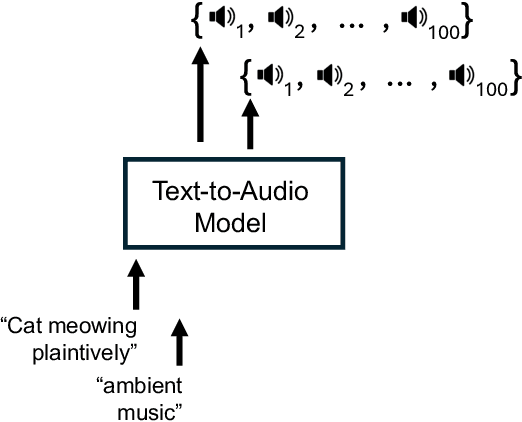
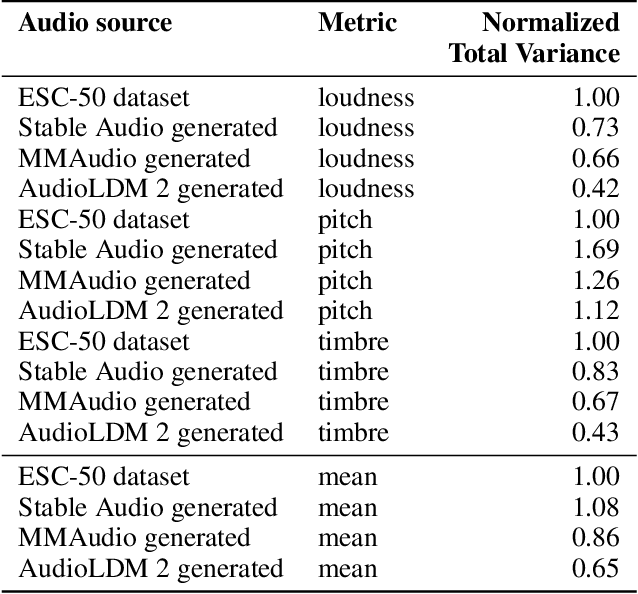

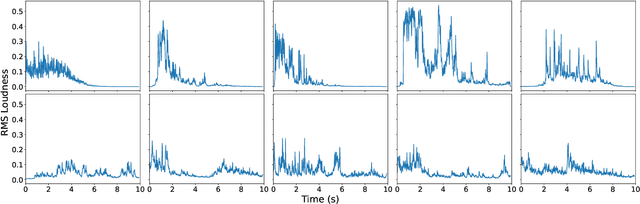
Text-to-audio models are a type of generative model that produces audio output in response to a given textual prompt. Although level generators and the properties of the functional content that they create (e.g., playability) dominate most discourse in procedurally generated content (PCG), games that emotionally resonate with players tend to weave together a range of creative and multimodal content (e.g., music, sounds, visuals, narrative tone), and multimodal models have begun seeing at least experimental use for this purpose. However, it remains unclear what exactly such models generate, and with what degree of variability and fidelity: audio is an extremely broad class of output for a generative system to target. Within the PCG community, expressive range analysis (ERA) has been used as a quantitative way to characterize generators' output space, especially for level generators. This paper adapts ERA to text-to-audio models, making the analysis tractable by looking at the expressive range of outputs for specific, fixed prompts. Experiments are conducted by prompting the models with several standardized prompts derived from the Environmental Sound Classification (ESC-50) dataset. The resulting audio is analyzed along key acoustic dimensions (e.g., pitch, loudness, and timbre). More broadly, this paper offers a framework for ERA-based exploratory evaluation of generative audio models.
Preference-Based Learning in Audio Applications: A Systematic Analysis
Nov 17, 2025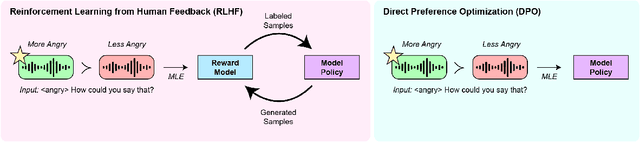
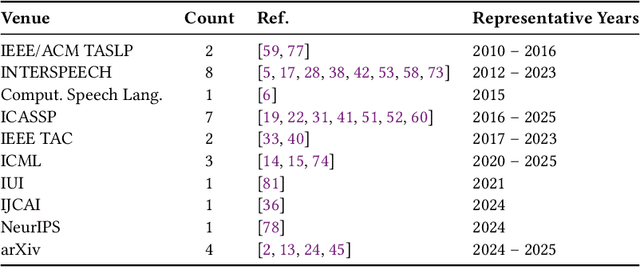
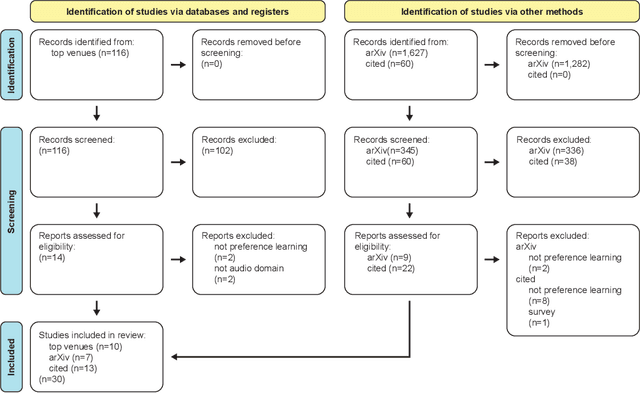
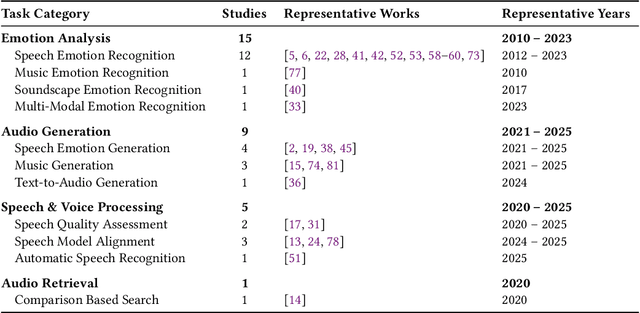
Despite the parallel challenges that audio and text domains face in evaluating generative model outputs, preference learning remains remarkably underexplored in audio applications. Through a PRISMA-guided systematic review of approximately 500 papers, we find that only 30 (6%) apply preference learning to audio tasks. Our analysis reveals a field in transition: pre-2021 works focused on emotion recognition using traditional ranking methods (rankSVM), while post-2021 studies have pivoted toward generation tasks employing modern RLHF frameworks. We identify three critical patterns: (1) the emergence of multi-dimensional evaluation strategies combining synthetic, automated, and human preferences; (2) inconsistent alignment between traditional metrics (WER, PESQ) and human judgments across different contexts; and (3) convergence on multi-stage training pipelines that combine reward signals. Our findings suggest that while preference learning shows promise for audio, particularly in capturing subjective qualities like naturalness and musicality, the field requires standardized benchmarks, higher-quality datasets, and systematic investigation of how temporal factors unique to audio impact preference learning frameworks.
DiffRhythm 2: Efficient and High Fidelity Song Generation via Block Flow Matching
Oct 27, 2025Generating full-length, high-quality songs is challenging, as it requires maintaining long-term coherence both across text and music modalities and within the music modality itself. Existing non-autoregressive (NAR) frameworks, while capable of producing high-quality songs, often struggle with the alignment between lyrics and vocal. Concurrently, catering to diverse musical preferences necessitates reinforcement learning from human feedback (RLHF). However, existing methods often rely on merging multiple models during multi-preference optimization, which results in significant performance degradation. To address these challenges, we introduce DiffRhythm 2, an end-to-end framework designed for high-fidelity, controllable song generation. To tackle the lyric alignment problem, DiffRhythm 2 employs a semi-autoregressive architecture based on block flow matching. This design enables faithful alignment of lyrics to singing vocals without relying on external labels and constraints, all while preserving the high generation quality and efficiency of NAR models. To make this framework computationally tractable for long sequences, we implement a music variational autoencoder (VAE) that achieves a low frame rate of 5 Hz while still enabling high-fidelity audio reconstruction. In addition, to overcome the limitations of multi-preference optimization in RLHF, we propose cross-pair preference optimization. This method effectively mitigates the performance drop typically associated with model merging, allowing for more robust optimization across diverse human preferences. We further enhance musicality and structural coherence by introducing stochastic block representation alignment loss.