 Add to Chrome
 Add to Firefox
 Add to Edge
Zero Shot Sentiment Classification
Papers and Code
Learning to Aggregate Zero-Shot LLM Agents for Corporate Disclosure Classification
Mar 21, 2026
This paper studies whether a lightweight trained aggregator can combine diverse zero-shot large language model judgments into a stronger downstream signal for corporate disclosure classification. Zero-shot LLMs can read disclosures without task-specific fine-tuning, but their predictions often vary across prompts, reasoning styles, and model families. I address this problem with a multi-agent framework in which three zero-shot agents independently read each disclosure and output a sentiment label, a confidence score, and a short rationale. A logistic meta-classifier then aggregates these signals to predict next-day stock return direction. I use a sample of 18,420 U.S. corporate disclosures issued by Nasdaq and S&P 500 firms between 2018 and 2024, matched to next-day stock returns. Results show that the trained aggregator outperforms all single agents, majority vote, confidence-weighted voting, and a FinBERT baseline. Balanced accuracy rises from 0.561 for the best single agent to 0.612 for the trained aggregator, with the largest gains in disclosures combining strong current performance with weak guidance or elevated risk. The results suggest that zero-shot LLM agents capture complementary financial signals and that supervised aggregation can turn cross-agent disagreement into a more useful classification target.

BTZSC: A Benchmark for Zero-Shot Text Classification Across Cross-Encoders, Embedding Models, Rerankers and LLMs
Mar 12, 2026Zero-shot text classification (ZSC) offers the promise of eliminating costly task-specific annotation by matching texts directly to human-readable label descriptions. While early approaches have predominantly relied on cross-encoder models fine-tuned for natural language inference (NLI), recent advances in text-embedding models, rerankers, and instruction-tuned large language models (LLMs) have challenged the dominance of NLI-based architectures. Yet, systematically comparing these diverse approaches remains difficult. Existing evaluations, such as MTEB, often incorporate labeled examples through supervised probes or fine-tuning, leaving genuine zero-shot capabilities underexplored. To address this, we introduce BTZSC, a comprehensive benchmark of 22 public datasets spanning sentiment, topic, intent, and emotion classification, capturing diverse domains, class cardinalities, and document lengths. Leveraging BTZSC, we conduct a systematic comparison across four major model families, NLI cross-encoders, embedding models, rerankers and instruction-tuned LLMs, encompassing 38 public and custom checkpoints. Our results show that: (i) modern rerankers, exemplified by Qwen3-Reranker-8B, set a new state-of-the-art with macro F1 = 0.72; (ii) strong embedding models such as GTE-large-en-v1.5 substantially close the accuracy gap while offering the best trade-off between accuracy and latency; (iii) instruction-tuned LLMs at 4--12B parameters achieve competitive performance (macro F1 up to 0.67), excelling particularly on topic classification but trailing specialized rerankers; (iv) NLI cross-encoders plateau even as backbone size increases; and (v) scaling primarily benefits rerankers and LLMs over embedding models. BTZSC and accompanying evaluation code are publicly released to support fair and reproducible progress in zero-shot text understanding.
Task Complexity Matters: An Empirical Study of Reasoning in LLMs for Sentiment Analysis
Feb 27, 2026Large language models (LLMs) with reasoning capabilities have fueled a compelling narrative that reasoning universally improves performance across language tasks. We test this claim through a comprehensive evaluation of 504 configurations across seven model families--including adaptive, conditional, and reinforcement learning-based reasoning architectures--on sentiment analysis datasets of varying granularity (binary, five-class, and 27-class emotion). Our findings reveal that reasoning effectiveness is strongly task-dependent, challenging prevailing assumptions: (1) Reasoning shows task-complexity dependence--binary classification degrades up to -19.9 F1 percentage points (pp), while 27-class emotion recognition gains up to +16.0pp; (2) Distilled reasoning variants underperform base models by 3-18 pp on simpler tasks, though few-shot prompting enables partial recovery; (3) Few-shot learning improves over zero-shot in most cases regardless of model type, with gains varying by architecture and task complexity; (4) Pareto frontier analysis shows base models dominate efficiency-performance trade-offs, with reasoning justified only for complex emotion recognition despite 2.1x-54x computational overhead. We complement these quantitative findings with qualitative error analysis revealing that reasoning degrades simpler tasks through systematic over-deliberation, offering mechanistic insight beyond the high-level overthinking hypothesis.
Text2Graph: Combining Lightweight LLMs and GNNs for Efficient Text Classification in Label-Scarce Scenarios
Dec 12, 2025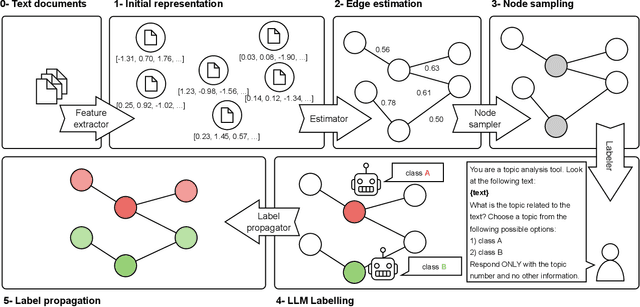
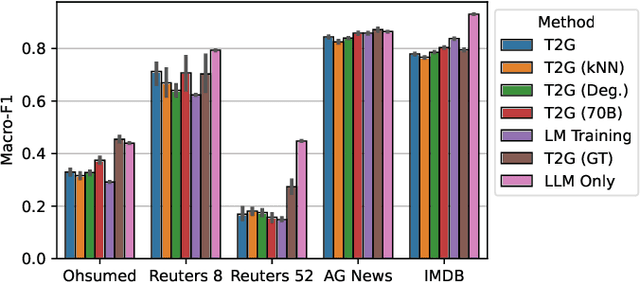
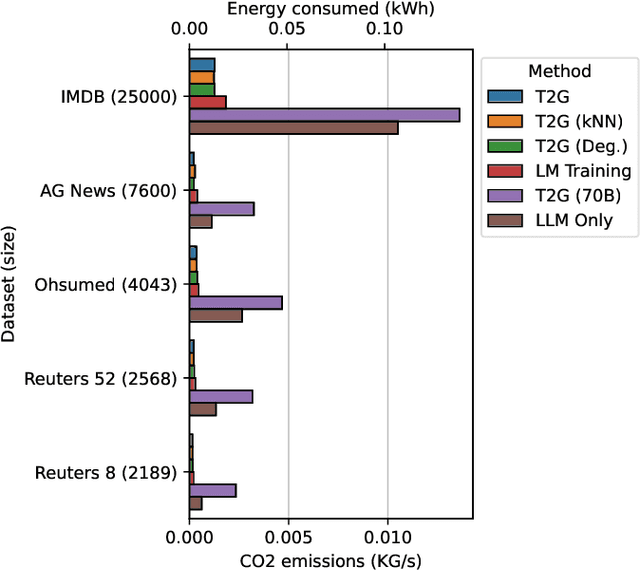
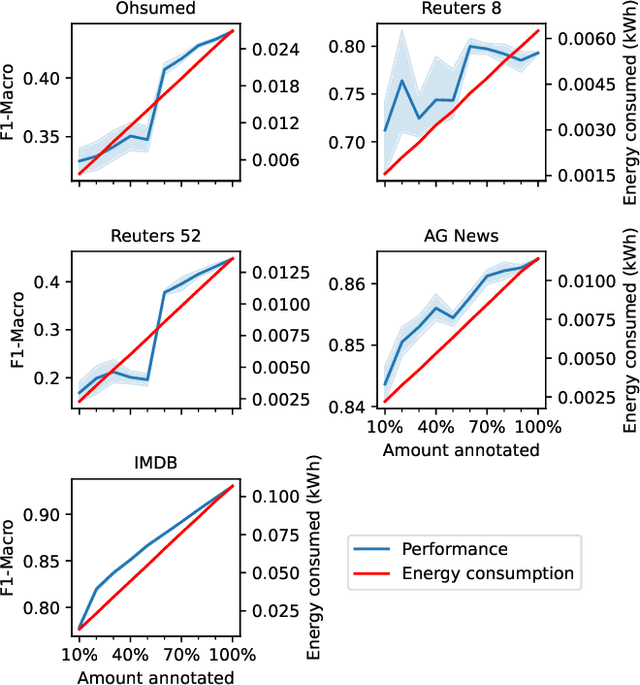
Large Language Models (LLMs) have become effective zero-shot classifiers, but their high computational requirements and environmental costs limit their practicality for large-scale annotation in high-performance computing (HPC) environments. To support more sustainable workflows, we present Text2Graph, an open-source Python package that provides a modular implementation of existing text-to-graph classification approaches. The framework enables users to combine LLM-based partial annotation with Graph Neural Network (GNN) label propagation in a flexible manner, making it straightforward to swap components such as feature extractors, edge construction methods, and sampling strategies. We benchmark Text2Graph on a zero-shot setting using five datasets spanning topic classification and sentiment analysis tasks, comparing multiple variants against other zero-shot approaches for text classification. In addition to reporting performance, we provide detailed estimates of energy consumption and carbon emissions, showing that graph-based propagation achieves competitive results at a fraction of the energy and environmental cost.
State of the Art in Text Classification for South Slavic Languages: Fine-Tuning or Prompting?
Nov 11, 2025Until recently, fine-tuned BERT-like models provided state-of-the-art performance on text classification tasks. With the rise of instruction-tuned decoder-only models, commonly known as large language models (LLMs), the field has increasingly moved toward zero-shot and few-shot prompting. However, the performance of LLMs on text classification, particularly on less-resourced languages, remains under-explored. In this paper, we evaluate the performance of current language models on text classification tasks across several South Slavic languages. We compare openly available fine-tuned BERT-like models with a selection of open-source and closed-source LLMs across three tasks in three domains: sentiment classification in parliamentary speeches, topic classification in news articles and parliamentary speeches, and genre identification in web texts. Our results show that LLMs demonstrate strong zero-shot performance, often matching or surpassing fine-tuned BERT-like models. Moreover, when used in a zero-shot setup, LLMs perform comparably in South Slavic languages and English. However, we also point out key drawbacks of LLMs, including less predictable outputs, significantly slower inference, and higher computational costs. Due to these limitations, fine-tuned BERT-like models remain a more practical choice for large-scale automatic text annotation.
Divide, Cache, Conquer: Dichotomic Prompting for Efficient Multi-Label LLM-Based Classification
Nov 05, 2025We introduce a method for efficient multi-label text classification with large language models (LLMs), built on reformulating classification tasks as sequences of dichotomic (yes/no) decisions. Instead of generating all labels in a single structured response, each target dimension is queried independently, which, combined with a prefix caching mechanism, yields substantial efficiency gains for short-text inference without loss of accuracy. To demonstrate the approach, we focus on affective text analysis, covering 24 dimensions including emotions and sentiment. Using LLM-to-SLM distillation, a powerful annotator model (DeepSeek-V3) provides multiple annotations per text, which are aggregated to fine-tune smaller models (HerBERT-Large, CLARIN-1B, PLLuM-8B, Gemma3-1B). The fine-tuned models show significant improvements over zero-shot baselines, particularly on the dimensions seen during training. Our findings suggest that decomposing multi-label classification into dichotomic queries, combined with distillation and cache-aware inference, offers a scalable and effective framework for LLM-based classification. While we validate the method on affective states, the approach is general and applicable across domains.
Prompt-Based Approach for Czech Sentiment Analysis
Aug 12, 2025This paper introduces the first prompt-based methods for aspect-based sentiment analysis and sentiment classification in Czech. We employ the sequence-to-sequence models to solve the aspect-based tasks simultaneously and demonstrate the superiority of our prompt-based approach over traditional fine-tuning. In addition, we conduct zero-shot and few-shot learning experiments for sentiment classification and show that prompting yields significantly better results with limited training examples compared to traditional fine-tuning. We also demonstrate that pre-training on data from the target domain can lead to significant improvements in a zero-shot scenario.
Learning Interpretable Representations Leads to Semantically Faithful EEG-to-Text Generation
May 21, 2025Pretrained generative models have opened new frontiers in brain decoding by enabling the synthesis of realistic texts and images from non-invasive brain recordings. However, the reliability of such outputs remains questionable--whether they truly reflect semantic activation in the brain, or are merely hallucinated by the powerful generative models. In this paper, we focus on EEG-to-text decoding and address its hallucination issue through the lens of posterior collapse. Acknowledging the underlying mismatch in information capacity between EEG and text, we reframe the decoding task as semantic summarization of core meanings rather than previously verbatim reconstruction of stimulus texts. To this end, we propose the Generative Language Inspection Model (GLIM), which emphasizes learning informative and interpretable EEG representations to improve semantic grounding under heterogeneous and small-scale data conditions. Experiments on the public ZuCo dataset demonstrate that GLIM consistently generates fluent, EEG-grounded sentences without teacher forcing. Moreover, it supports more robust evaluation beyond text similarity, through EEG-text retrieval and zero-shot semantic classification across sentiment categories, relation types, and corpus topics. Together, our architecture and evaluation protocols lay the foundation for reliable and scalable benchmarking in generative brain decoding.
AraReasoner: Evaluating Reasoning-Based LLMs for Arabic NLP
Jun 11, 2025Large language models (LLMs) have shown remarkable progress in reasoning abilities and general natural language processing (NLP) tasks, yet their performance on Arabic data, characterized by rich morphology, diverse dialects, and complex script, remains underexplored. This paper presents a comprehensive benchmarking study of multiple reasoning-focused LLMs, with a special emphasis on the newly introduced DeepSeek models, across a suite of fifteen Arabic NLP tasks. We experiment with various strategies, including zero-shot, few-shot, and fine-tuning. This allows us to systematically evaluate performance on datasets covering a range of applications to examine their capacity for linguistic reasoning under different levels of complexity. Our experiments reveal several key findings. First, carefully selecting just three in-context examples delivers an average uplift of over 13 F1 points on classification tasks-boosting sentiment analysis from 35.3% to 87.5% and paraphrase detection from 56.1% to 87.0%. Second, reasoning-focused DeepSeek architectures outperform a strong GPT o4-mini baseline by an average of 12 F1 points on complex inference tasks in the zero-shot setting. Third, LoRA-based fine-tuning yields up to an additional 8 points in F1 and BLEU compared to equivalent increases in model scale. The code is available at https://anonymous.4open.science/r/AraReasoner41299
Text Classification in the LLM Era - Where do we stand?
Feb 17, 2025Large Language Models revolutionized NLP and showed dramatic performance improvements across several tasks. In this paper, we investigated the role of such language models in text classification and how they compare with other approaches relying on smaller pre-trained language models. Considering 32 datasets spanning 8 languages, we compared zero-shot classification, few-shot fine-tuning and synthetic data based classifiers with classifiers built using the complete human labeled dataset. Our results show that zero-shot approaches do well for sentiment classification, but are outperformed by other approaches for the rest of the tasks, and synthetic data sourced from multiple LLMs can build better classifiers than zero-shot open LLMs. We also see wide performance disparities across languages in all the classification scenarios. We expect that these findings would guide practitioners working on developing text classification systems across languages.