 Add to Chrome
 Add to Firefox
 Add to Edge
PLLuM: A Family of Polish Large Language Models
Nov 05, 2025
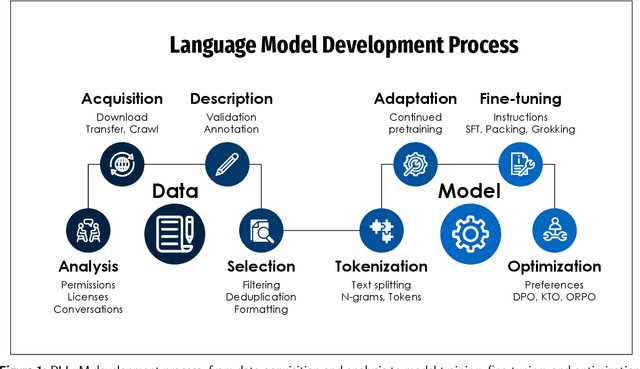
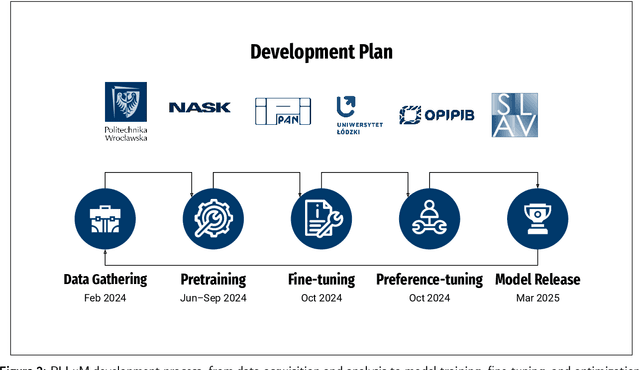

Large Language Models (LLMs) play a central role in modern artificial intelligence, yet their development has been primarily focused on English, resulting in limited support for other languages. We present PLLuM (Polish Large Language Model), the largest open-source family of foundation models tailored specifically for the Polish language. Developed by a consortium of major Polish research institutions, PLLuM addresses the need for high-quality, transparent, and culturally relevant language models beyond the English-centric commercial landscape. We describe the development process, including the construction of a new 140-billion-token Polish text corpus for pre-training, a 77k custom instructions dataset, and a 100k preference optimization dataset. A key component is a Responsible AI framework that incorporates strict data governance and a hybrid module for output correction and safety filtering. We detail the models' architecture, training procedures, and alignment techniques for both base and instruction-tuned variants, and demonstrate their utility in a downstream task within public administration. By releasing these models publicly, PLLuM aims to foster open research and strengthen sovereign AI technologies in Poland.

Divide, Cache, Conquer: Dichotomic Prompting for Efficient Multi-Label LLM-Based Classification
Nov 05, 2025We introduce a method for efficient multi-label text classification with large language models (LLMs), built on reformulating classification tasks as sequences of dichotomic (yes/no) decisions. Instead of generating all labels in a single structured response, each target dimension is queried independently, which, combined with a prefix caching mechanism, yields substantial efficiency gains for short-text inference without loss of accuracy. To demonstrate the approach, we focus on affective text analysis, covering 24 dimensions including emotions and sentiment. Using LLM-to-SLM distillation, a powerful annotator model (DeepSeek-V3) provides multiple annotations per text, which are aggregated to fine-tune smaller models (HerBERT-Large, CLARIN-1B, PLLuM-8B, Gemma3-1B). The fine-tuned models show significant improvements over zero-shot baselines, particularly on the dimensions seen during training. Our findings suggest that decomposing multi-label classification into dichotomic queries, combined with distillation and cache-aware inference, offers a scalable and effective framework for LLM-based classification. While we validate the method on affective states, the approach is general and applicable across domains.