 Add to Chrome
 Add to Firefox
 Add to Edge
Umm... With Transformers? Insights from Filled Pause Use across Four Slavic Parliaments
Jul 07, 2026
Filled pauses (FPs) are a universal feature of spontaneous speech, yet most studies rely on small, single-language corpora, limiting the generalisability of their findings. We analyse ~4,000 hours of parliamentary speech across four related Slavic languages (Croatian, Czech, Polish, Serbian). FP occurrence is obtained via transformer-based automatic detection, while FP rate is modelled using Generalised Estimating Equations (GEE) with Mundlak correction to distinguish within- from between- speaker effects. We replicate a negative association of age and speech rate with FP rate, but find that gender effects are language-specific and directionally opposite to most prior literature. Novel analyses of sentiment, political orientation, and power status reveal a consistent positive association between sentiment and FP rate, alongside parliament-specific modulation by orientation and power status, with opposition speakers tending toward lower FP rates than governing coalition speakers.

State of the Art in Text Classification for South Slavic Languages: Fine-Tuning or Prompting?
Nov 11, 2025Until recently, fine-tuned BERT-like models provided state-of-the-art performance on text classification tasks. With the rise of instruction-tuned decoder-only models, commonly known as large language models (LLMs), the field has increasingly moved toward zero-shot and few-shot prompting. However, the performance of LLMs on text classification, particularly on less-resourced languages, remains under-explored. In this paper, we evaluate the performance of current language models on text classification tasks across several South Slavic languages. We compare openly available fine-tuned BERT-like models with a selection of open-source and closed-source LLMs across three tasks in three domains: sentiment classification in parliamentary speeches, topic classification in news articles and parliamentary speeches, and genre identification in web texts. Our results show that LLMs demonstrate strong zero-shot performance, often matching or surpassing fine-tuned BERT-like models. Moreover, when used in a zero-shot setup, LLMs perform comparably in South Slavic languages and English. However, we also point out key drawbacks of LLMs, including less predictable outputs, significantly slower inference, and higher computational costs. Due to these limitations, fine-tuned BERT-like models remain a more practical choice for large-scale automatic text annotation.
Identifying Primary Stress Across Related Languages and Dialects with Transformer-based Speech Encoder Models
May 30, 2025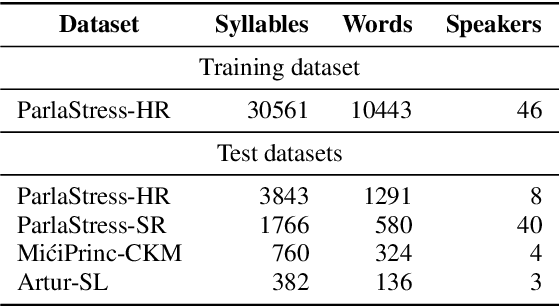
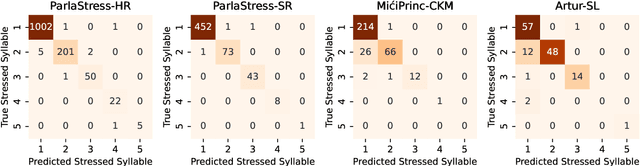
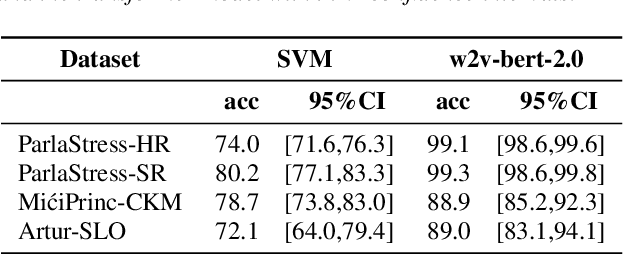
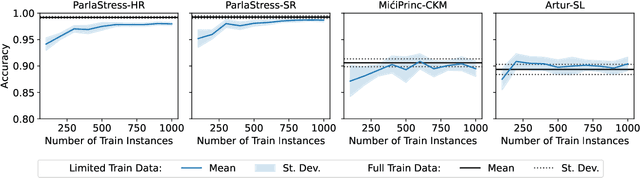
Automating primary stress identification has been an active research field due to the role of stress in encoding meaning and aiding speech comprehension. Previous studies relied mainly on traditional acoustic features and English datasets. In this paper, we investigate the approach of fine-tuning a pre-trained transformer model with an audio frame classification head. Our experiments use a new Croatian training dataset, with test sets in Croatian, Serbian, the Chakavian dialect, and Slovenian. By comparing an SVM classifier using traditional acoustic features with the fine-tuned speech transformer, we demonstrate the transformer's superiority across the board, achieving near-perfect results for Croatian and Serbian, with a 10-point performance drop for the more distant Chakavian and Slovenian. Finally, we show that only a few hundred multi-syllabic training words suffice for strong performance. We release our datasets and model under permissive licenses.