 Add to Chrome
 Add to Firefox
 Add to Edge
Stock Trend Prediction
Stock trend prediction is the process of forecasting the future price movements of stocks using historical data and other factors.
Papers and Code
Adaptive Financial Sentiment Analysis for NIFTY 50 via Instruction-Tuned LLMs , RAG and Reinforcement Learning Approaches
Dec 24, 2025
Financial sentiment analysis plays a crucial role in informing investment decisions, assessing market risk, and predicting stock price trends. Existing works in financial sentiment analysis have not considered the impact of stock prices or market feedback on sentiment analysis. In this paper, we propose an adaptive framework that integrates large language models (LLMs) with real-world stock market feedback to improve sentiment classification in the context of the Indian stock market. The proposed methodology fine-tunes the LLaMA 3.2 3B model using instruction-based learning on the SentiFin dataset. To enhance sentiment predictions, a retrieval-augmented generation (RAG) pipeline is employed that dynamically selects multi-source contextual information based on the cosine similarity of the sentence embeddings. Furthermore, a feedback-driven module is introduced that adjusts the reliability of the source by comparing predicted sentiment with actual next-day stock returns, allowing the system to iteratively adapt to market behavior. To generalize this adaptive mechanism across temporal data, a reinforcement learning agent trained using proximal policy optimization (PPO) is incorporated. The PPO agent learns to optimize source weighting policies based on cumulative reward signals from sentiment-return alignment. Experimental results on NIFTY 50 news headlines collected from 2024 to 2025 demonstrate that the proposed system significantly improves classification accuracy, F1-score, and market alignment over baseline models and static retrieval methods. The results validate the potential of combining instruction-tuned LLMs with dynamic feedback and reinforcement learning for robust, market-aware financial sentiment modeling.

Adaptive Weighted Genetic Algorithm-Optimized SVR for Robust Long-Term Forecasting of Global Stock Indices for investment decisions
Dec 17, 2025Long-term price forecasting remains a formidable challenge due to the inherent uncertainty over the long term, despite some success in short-term predictions. Nonetheless, accurate long-term forecasts are essential for high-net-worth individuals, institutional investors, and traders. The proposed improved genetic algorithm-optimized support vector regression (IGA-SVR) model is specifically designed for long-term price prediction of global indices. The performance of the IGA-SVR model is rigorously evaluated and compared against the state-of-the-art baseline models, the Long Short-Term Memory (LSTM), and the forward-validating genetic algorithm optimized support vector regression (OGA-SVR). Extensive testing was conducted on the five global indices, namely Nifty, Dow Jones Industrial Average (DJI), DAX Performance Index (DAX), Nikkei 225 (N225), and Shanghai Stock Exchange Composite Index (SSE) from 2021 to 2024 of daily price prediction up to a year. Overall, the proposed IGA-SVR model achieved a reduction in MAPE by 19.87% compared to LSTM and 50.03% compared to OGA-SVR, demonstrating its superior performance in long-term daily price forecasting of global indices. Further, the execution time for LSTM was approximately 20 times higher than that of IGA-SVR, highlighting the high accuracy and computational efficiency of the proposed model. The genetic algorithm selects the optimal hyperparameters of SVR by minimizing the arithmetic mean of the Mean Absolute Percentage Error (MAPE) calculated over the full training dataset and the most recent five years of training data. This purposefully designed training methodology adjusts for recent trends while retaining long-term trend information, thereby offering enhanced generalization compared to the LSTM and rolling-forward validation approach employed by OGA-SVR, which forgets long-term trends and suffers from recency bias.
From Local Patterns to Global Understanding: Cross-Stock Trend Integration for Enhanced Predictive Modeling
May 22, 2025Stock price prediction is a critical area of financial forecasting, traditionally approached by training models using the historical price data of individual stocks. While these models effectively capture single-stock patterns, they fail to leverage potential correlations among stock trends, which could improve predictive performance. Current single-stock learning methods are thus limited in their ability to provide a broader understanding of price dynamics across multiple stocks. To address this, we propose a novel method that merges local patterns into a global understanding through cross-stock pattern integration. Our strategy is inspired by Federated Learning (FL), a paradigm designed for decentralized model training. FL enables collaborative learning across distributed datasets without sharing raw data, facilitating the aggregation of global insights while preserving data privacy. In our adaptation, we train models on individual stock data and iteratively merge them to create a unified global model. This global model is subsequently fine-tuned on specific stock data to retain local relevance. The proposed strategy enables parallel training of individual stock models, facilitating efficient utilization of computational resources and reducing overall training time. We conducted extensive experiments to evaluate the proposed method, demonstrating that it outperforms benchmark models and enhances the predictive capabilities of state-of-the-art approaches. Our results highlight the efficacy of Cross-Stock Trend Integration (CSTI) in advancing stock price prediction, offering a robust alternative to traditional single-stock learning methodologies.
Orthogonal Factor-Based Biclustering Algorithm (BCBOF) for High-Dimensional Data and Its Application in Stock Trend Prediction
Apr 30, 2025Biclustering is an effective technique in data mining and pattern recognition. Biclustering algorithms based on traditional clustering face two fundamental limitations when processing high-dimensional data: (1) The distance concentration phenomenon in high-dimensional spaces leads to data sparsity, rendering similarity measures ineffective; (2) Mainstream linear dimensionality reduction methods disrupt critical local structural patterns. To apply biclustering to high-dimensional datasets, we propose an orthogonal factor-based biclustering algorithm (BCBOF). First, we constructed orthogonal factors in the vector space of the high-dimensional dataset. Then, we performed clustering using the coordinates of the original data in the orthogonal subspace as clustering targets. Finally, we obtained biclustering results of the original dataset. Since dimensionality reduction was applied before clustering, the proposed algorithm effectively mitigated the data sparsity problem caused by high dimensionality. Additionally, we applied this biclustering algorithm to stock technical indicator combinations and stock price trend prediction. Biclustering results were transformed into fuzzy rules, and we incorporated profit-preserving and stop-loss rules into the rule set, ultimately forming a fuzzy inference system for stock price trend predictions and trading signals. To evaluate the performance of BCBOF, we compared it with existing biclustering methods using multiple evaluation metrics. The results showed that our algorithm outperformed other biclustering techniques. To validate the effectiveness of the fuzzy inference system, we conducted virtual trading experiments using historical data from 10 A-share stocks. The experimental results showed that the generated trading strategies yielded higher returns for investors.
Transformer Encoder and Multi-features Time2Vec for Financial Prediction
Apr 18, 2025Financial prediction is a complex and challenging task of time series analysis and signal processing, expected to model both short-term fluctuations and long-term temporal dependencies. Transformers have remarkable success mostly in natural language processing using attention mechanism, which also influenced the time series community. The ability to capture both short and long-range dependencies helps to understand the financial market and to recognize price patterns, leading to successful applications of Transformers in stock prediction. Although, the previous research predominantly focuses on individual features and singular predictions, that limits the model's ability to understand broader market trends. In reality, within sectors such as finance and technology, companies belonging to the same industry often exhibit correlated stock price movements. In this paper, we develop a novel neural network architecture by integrating Time2Vec with the Encoder of the Transformer model. Based on the study of different markets, we propose a novel correlation feature selection method. Through a comprehensive fine-tuning of multiple hyperparameters, we conduct a comparative analysis of our results against benchmark models. We conclude that our method outperforms other state-of-the-art encoding methods such as positional encoding, and we also conclude that selecting correlation features enhance the accuracy of predicting multiple stock prices.
Predictive AI with External Knowledge Infusion for Stocks
Apr 14, 2025Fluctuations in stock prices are influenced by a complex interplay of factors that go beyond mere historical data. These factors, themselves influenced by external forces, encompass inter-stock dynamics, broader economic factors, various government policy decisions, outbreaks of wars, etc. Furthermore, all of these factors are dynamic and exhibit changes over time. In this paper, for the first time, we tackle the forecasting problem under external influence by proposing learning mechanisms that not only learn from historical trends but also incorporate external knowledge from temporal knowledge graphs. Since there are no such datasets or temporal knowledge graphs available, we study this problem with stock market data, and we construct comprehensive temporal knowledge graph datasets. In our proposed approach, we model relations on external temporal knowledge graphs as events of a Hawkes process on graphs. With extensive experiments, we show that learned dynamic representations effectively rank stocks based on returns across multiple holding periods, outperforming related baselines on relevant metrics.
HQNN-FSP: A Hybrid Classical-Quantum Neural Network for Regression-Based Financial Stock Market Prediction
Mar 19, 2025Financial time-series forecasting remains a challenging task due to complex temporal dependencies and market fluctuations. This study explores the potential of hybrid quantum-classical approaches to assist in financial trend prediction by leveraging quantum resources for improved feature representation and learning. A custom Quantum Neural Network (QNN) regressor is introduced, designed with a novel ansatz tailored for financial applications. Two hybrid optimization strategies are proposed: (1) a sequential approach where classical recurrent models (RNN/LSTM) extract temporal dependencies before quantum processing, and (2) a joint learning framework that optimizes classical and quantum parameters simultaneously. Systematic evaluation using TimeSeriesSplit, k-fold cross-validation, and predictive error analysis highlights the ability of these hybrid models to integrate quantum computing into financial forecasting workflows. The findings demonstrate how quantum-assisted learning can contribute to financial modeling, offering insights into the practical role of quantum resources in time-series analysis.
Cross-Modal Temporal Fusion for Financial Market Forecasting
Apr 18, 2025Accurate financial market forecasting requires diverse data sources, including historical price trends, macroeconomic indicators, and financial news, each contributing unique predictive signals. However, existing methods often process these modalities independently or fail to effectively model their interactions. In this paper, we introduce Cross-Modal Temporal Fusion (CMTF), a novel transformer-based framework that integrates heterogeneous financial data to improve predictive accuracy. Our approach employs attention mechanisms to dynamically weight the contribution of different modalities, along with a specialized tensor interpretation module for feature extraction. To facilitate rapid model iteration in industry applications, we incorporate a mature auto-training scheme that streamlines optimization. When applied to real-world financial datasets, CMTF demonstrates improvements over baseline models in forecasting stock price movements and provides a scalable and effective solution for cross-modal integration in financial market prediction.
Dynamic Graph Representation with Contrastive Learning for Financial Market Prediction: Integrating Temporal Evolution and Static Relations
Dec 05, 2024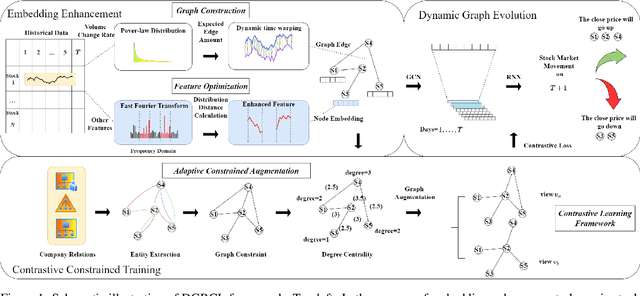


Temporal Graph Learning (TGL) is crucial for capturing the evolving nature of stock markets. Traditional methods often ignore the interplay between dynamic temporal changes and static relational structures between stocks. To address this issue, we propose the Dynamic Graph Representation with Contrastive Learning (DGRCL) framework, which integrates dynamic and static graph relations to improve the accuracy of stock trend prediction. Our framework introduces two key components: the Embedding Enhancement (EE) module and the Contrastive Constrained Training (CCT) module. The EE module focuses on dynamically capturing the temporal evolution of stock data, while the CCT module enforces static constraints based on stock relations, refined within contrastive learning. This dual-relation approach allows for a more comprehensive understanding of stock market dynamics. Our experiments on two major U.S. stock market datasets, NASDAQ and NYSE, demonstrate that DGRCL significantly outperforms state-of-the-art TGL baselines. Ablation studies indicate the importance of both modules. Overall, DGRCL not only enhances prediction ability but also provides a robust framework for integrating temporal and relational data in dynamic graphs. Code and data are available for public access.
Leveraging Fundamental Analysis for Stock Trend Prediction for Profit
Oct 04, 2024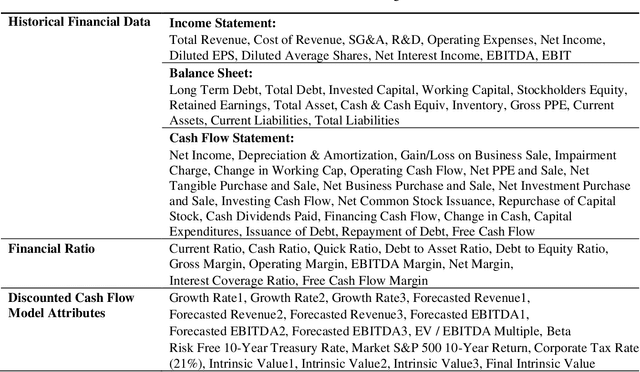
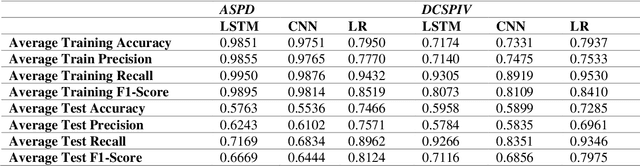
This paper investigates the application of machine learning models, Long Short-Term Memory (LSTM), one-dimensional Convolutional Neural Networks (1D CNN), and Logistic Regression (LR), for predicting stock trends based on fundamental analysis. Unlike most existing studies that predominantly utilize technical or sentiment analysis, we emphasize the use of a company's financial statements and intrinsic value for trend forecasting. Using a dataset of 269 data points from publicly traded companies across various sectors from 2019 to 2023, we employ key financial ratios and the Discounted Cash Flow (DCF) model to formulate two prediction tasks: Annual Stock Price Difference (ASPD) and Difference between Current Stock Price and Intrinsic Value (DCSPIV). These tasks assess the likelihood of annual profit and current profitability, respectively. Our results demonstrate that LR models outperform CNN and LSTM models, achieving an average test accuracy of 74.66% for ASPD and 72.85% for DCSPIV. This study contributes to the limited literature on integrating fundamental analysis into machine learning for stock prediction, offering valuable insights for both academic research and practical investment strategies. By leveraging fundamental data, our approach highlights the potential for long-term stock trend prediction, supporting portfolio managers in their decision-making processes.