 Add to Chrome
 Add to Firefox
 Add to Edge
StakeBench: Evaluating Language Understanding Grounded in Market Commitment
May 25, 2026
Existing financial NLP benchmarks often rely on labels supplied by outside observers, measuring how language is perceived rather than what speakers have committed to in the market. We introduce StakeBench, an evaluation framework for language understanding grounded in market commitment. StakeBench links 560,876 comments from 2,261 resolved markets to verified position, action, and market-odds records across Polymarket and Manifold. Supervision is derived from observable market behavior. Position sides, post-comment trading actions, and market-odds trajectories replace human annotation. Four diagnostic tasks test whether models detect market commitment, identify the revealed side, anticipate future action, and perform collective odds projection. Three commitment-aware metrics measure alignment with revealed preferences rather than perceived sentiment. Validity audits and explicit interpretation boundaries help distinguish observable commitment signals from latent belief and causal market-odds impact. Across 15 LLMs and 18 topics and platform settings, models partially recover position-side signals, with Directed Accuracy from 0.506 to 0.599, but show structural failures on later tasks. Ten of the fifteen models collapse to one or two action labels in future action anticipation, and no model consistently improves on the naive odds-direction baseline in collective odds projection. Model scale is not correlated with performance, finance-domain tuning does not improve revealed-side identification, and platform incentives strongly shape higher-order results. StakeBench is packaged with evaluation code and dataset under CC-BY 4.0.

Market Regime Council for Dynamic Credit Assignment in Multi-Agent LLM Decision Systems
May 23, 2026Multi-agent LLM decision systems for portfolio management still lack a principled way to assign credit across specialist agents, remain vulnerable to cold-start dominance under regime shifts, and offer limited transparency into how final allocations are formed. We propose Market Regime Council (MRC), a cooperative multi-agent decision system that computes exact Shapley credits across all single, pairwise, and Grand-coalition outputs for online agent weighting. Instantiated with N=3 specialist agents, at each trading period, MRC recomputes coalition-based Shapley weights from exponentially weighted performance histories, uses a Bayesian adaptive mixture to stabilize early periods, applies regime-dependent multipliers to adjust agent authority, and records each rebalance through a five-layer causal trace. Over 1,037 trading days across 13 crypto assets and five seeds, MRC achieves a Sharpe ratio of 1.51 and a cumulative return of 440.1%, ranking first on CR, SR, and IR among active baselines and attaining the lowest MDD among active methods. Ablation results show that the gains come from Shapley-weighted integration across coalition outputs rather than from any single stage in isolation. Code and demo data are included in the supplementary material.
Contrast to Detect: Dynamic Graph Contrastive Regularization for Unsupervised Anomaly Detection in Multivariate Time Series
May 22, 2026Anomaly detection in multivariate time series (MTS) is hindered by dynamic inter-variable dependencies and feature entanglement under spectral noise, and in practice, is further complicated by the absence of anomaly labels. Existing reconstruction-based detectors tend to recover anomalies as faithfully as normal patterns, while prevailing graph contrastive methods enforce invariance across views and thus assume a stationary relational structure, an assumption that breaks under structural drift in real systems. We propose ContrastAD, an unsupervised framework that turns structural evolution itself into a learning signal rather than suppressing it. A Multi-Perspective Embedder encodes inputs from temporal, attribute, and structural perspectives. A Frequency-Aware Attention Mixer then performs spectral top-K filtering before attention, preventing noise from leaking into query-key similarities. The core component, a Dynamic Graph Contrastive Learner, builds power-law-inspired sparse graph snapshots from batch-level DTW distances and contrasts the most divergent pair against a stable anchor, regularizing the latent space without imposing rigid invariance. Across five real-world benchmarks, ContrastAD attains the highest mean F1 on all five datasets and the highest AUC on three (SWaT 93.60, SMD 98.66, PSM 97.79), with statistically significant F1 and AUC margins over the strongest baseline on SWaT and PSM. On MSL and SMAP, it trails the AUC leader by under 0.7 points while still leading on F1. Ablation and sensitivity studies further confirm that the contrastive objective works best as a soft regularizer, supporting our claim that strict invariance is suboptimal under non-stationary dynamics.
Cross-Modal Temporal Fusion for Financial Market Forecasting
Apr 18, 2025Accurate financial market forecasting requires diverse data sources, including historical price trends, macroeconomic indicators, and financial news, each contributing unique predictive signals. However, existing methods often process these modalities independently or fail to effectively model their interactions. In this paper, we introduce Cross-Modal Temporal Fusion (CMTF), a novel transformer-based framework that integrates heterogeneous financial data to improve predictive accuracy. Our approach employs attention mechanisms to dynamically weight the contribution of different modalities, along with a specialized tensor interpretation module for feature extraction. To facilitate rapid model iteration in industry applications, we incorporate a mature auto-training scheme that streamlines optimization. When applied to real-world financial datasets, CMTF demonstrates improvements over baseline models in forecasting stock price movements and provides a scalable and effective solution for cross-modal integration in financial market prediction.
Dynamic Graph Representation with Contrastive Learning for Financial Market Prediction: Integrating Temporal Evolution and Static Relations
Dec 05, 2024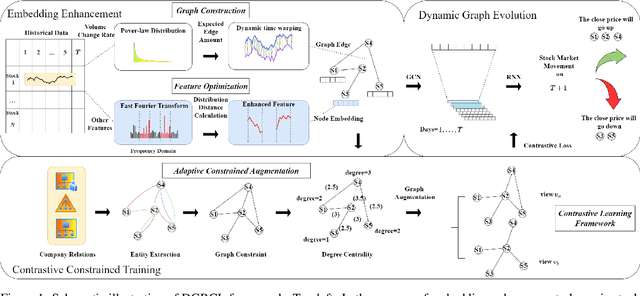


Temporal Graph Learning (TGL) is crucial for capturing the evolving nature of stock markets. Traditional methods often ignore the interplay between dynamic temporal changes and static relational structures between stocks. To address this issue, we propose the Dynamic Graph Representation with Contrastive Learning (DGRCL) framework, which integrates dynamic and static graph relations to improve the accuracy of stock trend prediction. Our framework introduces two key components: the Embedding Enhancement (EE) module and the Contrastive Constrained Training (CCT) module. The EE module focuses on dynamically capturing the temporal evolution of stock data, while the CCT module enforces static constraints based on stock relations, refined within contrastive learning. This dual-relation approach allows for a more comprehensive understanding of stock market dynamics. Our experiments on two major U.S. stock market datasets, NASDAQ and NYSE, demonstrate that DGRCL significantly outperforms state-of-the-art TGL baselines. Ablation studies indicate the importance of both modules. Overall, DGRCL not only enhances prediction ability but also provides a robust framework for integrating temporal and relational data in dynamic graphs. Code and data are available for public access.