 Add to Chrome
 Add to Firefox
 Add to Edge
MDQEC-QAS: Meta-Decoding for Quantum Error Correction with Hardware-Aware VQC Search and Confidence-Gated Recovery
Jul 12, 2026
We propose a unified meta-decoding framework for quantum error correction that learns syndrome-to-recovery mappings across multiple stabilizer codes and noise settings, without requiring separate decoders for each configuration. The benchmark includes FiveQubit, Steane, Planar3x3, and Planar5x5 codes, four noise families, and five evaluation regimes: interpolation, unseen-p transfer, unseen-noise transfer, few-shot unseen-code adaptation, and few-shot held-out-size adaptation. We compare a classical Meta-MLP teacher-trained baseline with variational quantum circuit (VQC) meta-decoders selected through hardware-aware quantum architecture search over qubit count, circuit depth, and entangling topology. The Meta-MLP achieves teacher-label accuracies of 0.9993, 0.9118, 0.9342, 0.6304, and 0.7548 across the five regimes, while the hardware-aware VQC achieves 0.9400, 0.8495, 0.8415, 0.5678, and 0.7143. However, logical-level evaluation shows that high teacher-label accuracy alone is insufficient in the most challenging Planar5x5 setting. During interpolation, the raw logical-failure ratios relative to the teacher are 12.08 and 25.91 for the Meta-MLP and VQC, respectively, whereas confidence-gated fallback reduces them to 1.71 and 1.11. These results support confidence-aware selective recovery rather than unconditional teacher replacement.

Graph-Based Bayesian Optimization for Quantum Circuit Architecture Search with Uncertainty Calibrated Surrogates
Dec 10, 2025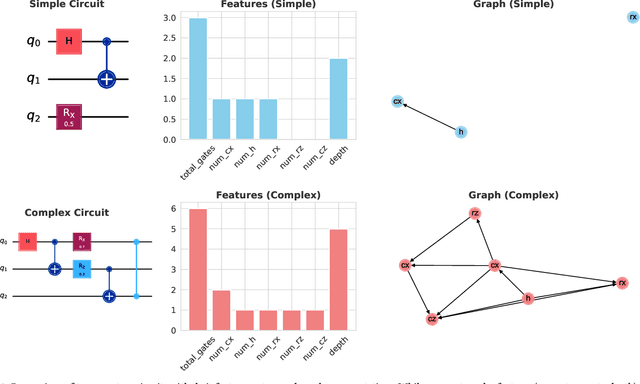
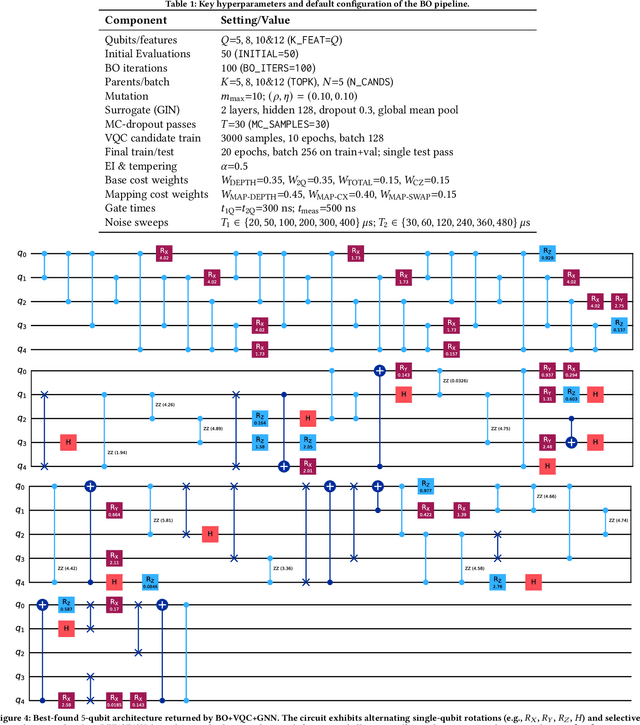
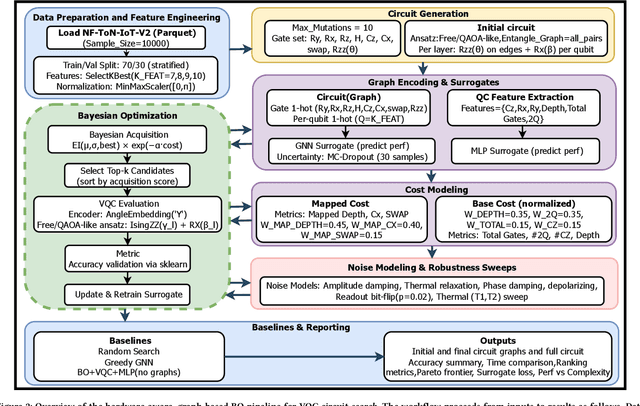
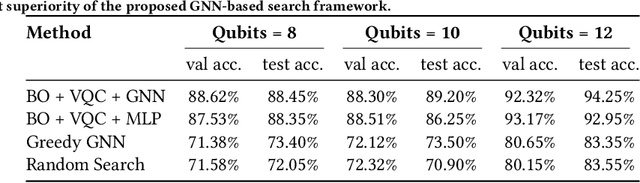
Quantum circuit design is a key bottleneck for practical quantum machine learning on complex, real-world data. We present an automated framework that discovers and refines variational quantum circuits (VQCs) using graph-based Bayesian optimization with a graph neural network (GNN) surrogate. Circuits are represented as graphs and mutated and selected via an expected improvement acquisition function informed by surrogate uncertainty with Monte Carlo dropout. Candidate circuits are evaluated with a hybrid quantum-classical variational classifier on the next generation firewall telemetry and network internet of things (NF-ToN-IoT-V2) cybersecurity dataset, after feature selection and scaling for quantum embedding. We benchmark our pipeline against an MLP-based surrogate, random search, and greedy GNN selection. The GNN-guided optimizer consistently finds circuits with lower complexity and competitive or superior classification accuracy compared to all baselines. Robustness is assessed via a noise study across standard quantum noise channels, including amplitude damping, phase damping, thermal relaxation, depolarizing, and readout bit flip noise. The implementation is fully reproducible, with time benchmarking and export of best found circuits, providing a scalable and interpretable route to automated quantum circuit discovery.
HQNN-FSP: A Hybrid Classical-Quantum Neural Network for Regression-Based Financial Stock Market Prediction
Mar 19, 2025Financial time-series forecasting remains a challenging task due to complex temporal dependencies and market fluctuations. This study explores the potential of hybrid quantum-classical approaches to assist in financial trend prediction by leveraging quantum resources for improved feature representation and learning. A custom Quantum Neural Network (QNN) regressor is introduced, designed with a novel ansatz tailored for financial applications. Two hybrid optimization strategies are proposed: (1) a sequential approach where classical recurrent models (RNN/LSTM) extract temporal dependencies before quantum processing, and (2) a joint learning framework that optimizes classical and quantum parameters simultaneously. Systematic evaluation using TimeSeriesSplit, k-fold cross-validation, and predictive error analysis highlights the ability of these hybrid models to integrate quantum computing into financial forecasting workflows. The findings demonstrate how quantum-assisted learning can contribute to financial modeling, offering insights into the practical role of quantum resources in time-series analysis.