 Add to Chrome
 Add to Firefox
 Add to Edge
Openpose
Papers and Code
Rethink Sparse Signals for Pose-guided Text-to-image Generation
Jun 26, 2025
Recent works favored dense signals (e.g., depth, DensePose), as an alternative to sparse signals (e.g., OpenPose), to provide detailed spatial guidance for pose-guided text-to-image generation. However, dense representations raised new challenges, including editing difficulties and potential inconsistencies with textual prompts. This fact motivates us to revisit sparse signals for pose guidance, owing to their simplicity and shape-agnostic nature, which remains underexplored. This paper proposes a novel Spatial-Pose ControlNet(SP-Ctrl), equipping sparse signals with robust controllability for pose-guided image generation. Specifically, we extend OpenPose to a learnable spatial representation, making keypoint embeddings discriminative and expressive. Additionally, we introduce keypoint concept learning, which encourages keypoint tokens to attend to the spatial positions of each keypoint, thus improving pose alignment. Experiments on animal- and human-centric image generation tasks demonstrate that our method outperforms recent spatially controllable T2I generation approaches under sparse-pose guidance and even matches the performance of dense signal-based methods. Moreover, SP-Ctrl shows promising capabilities in diverse and cross-species generation through sparse signals. Codes will be available at https://github.com/DREAMXFAR/SP-Ctrl.

Automated ARAT Scoring Using Multimodal Video Analysis, Multi-View Fusion, and Hierarchical Bayesian Models: A Clinician Study
May 03, 2025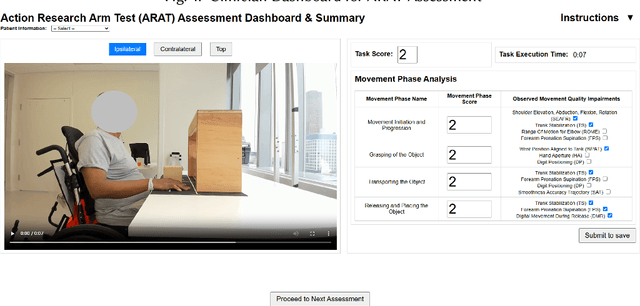
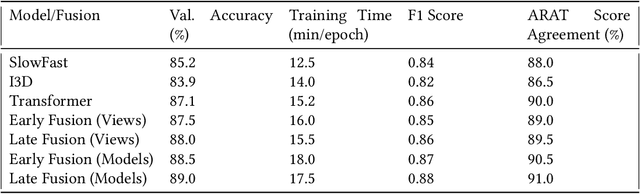
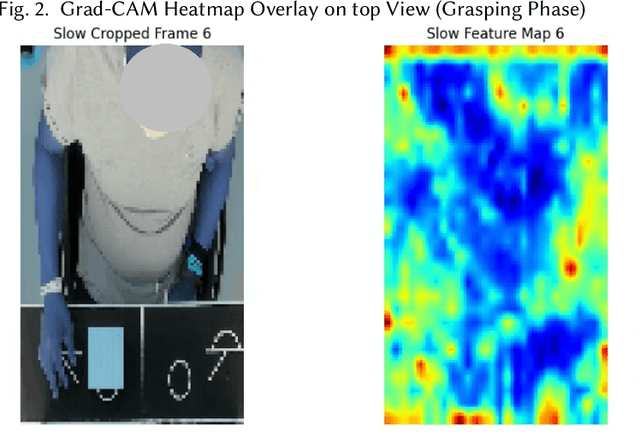
Manual scoring of the Action Research Arm Test (ARAT) for upper extremity assessment in stroke rehabilitation is time-intensive and variable. We propose an automated ARAT scoring system integrating multimodal video analysis with SlowFast, I3D, and Transformer-based models using OpenPose keypoints and object locations. Our approach employs multi-view data (ipsilateral, contralateral, and top perspectives), applying early and late fusion to combine features across views and models. Hierarchical Bayesian Models (HBMs) infer movement quality components, enhancing interpretability. A clinician dashboard displays task scores, execution times, and quality assessments. We conducted a study with five clinicians who reviewed 500 video ratings generated by our system, providing feedback on its accuracy and usability. Evaluated on a stroke rehabilitation dataset, our framework achieves 89.0% validation accuracy with late fusion, with HBMs aligning closely with manual assessments. This work advances automated rehabilitation by offering a scalable, interpretable solution with clinical validation.
Multi-modal Transfer Learning for Dynamic Facial Emotion Recognition in the Wild
Apr 30, 2025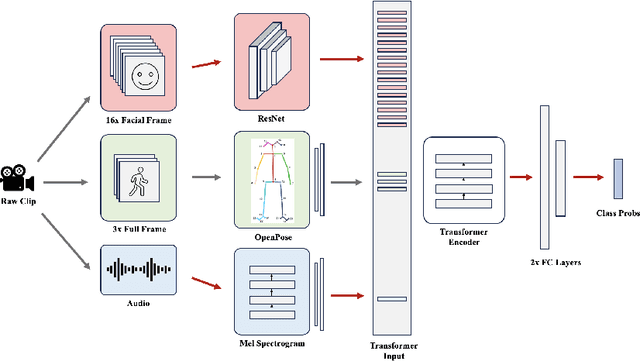
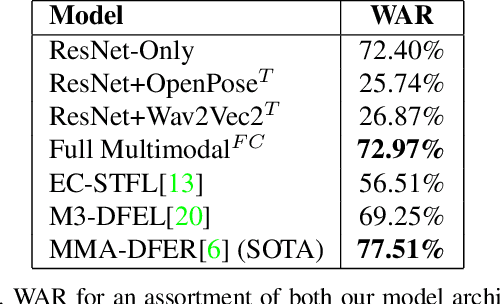
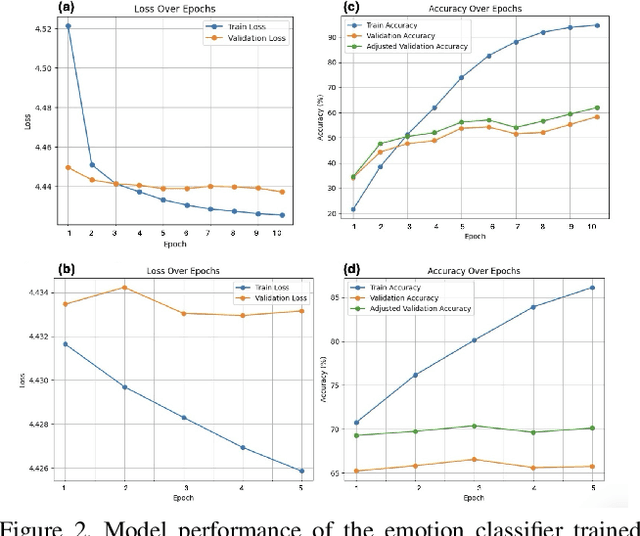
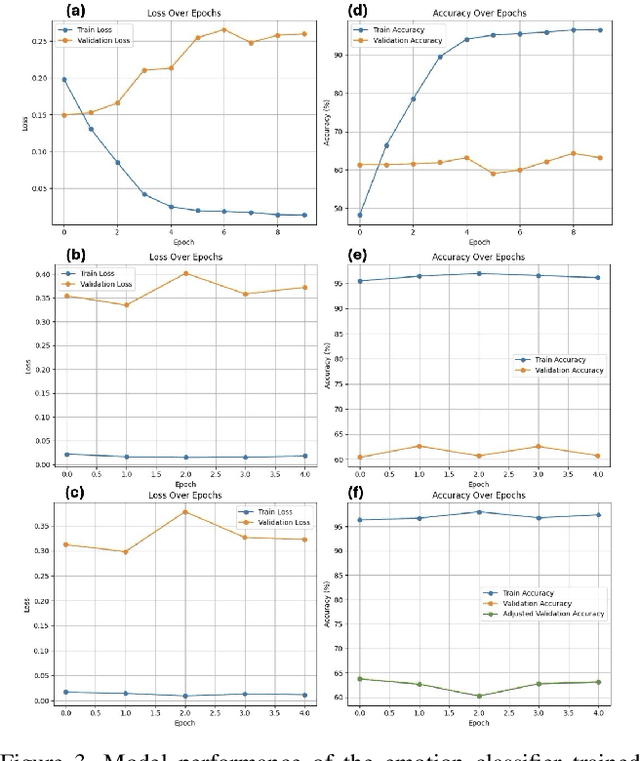
Facial expression recognition (FER) is a subset of computer vision with important applications for human-computer-interaction, healthcare, and customer service. FER represents a challenging problem-space because accurate classification requires a model to differentiate between subtle changes in facial features. In this paper, we examine the use of multi-modal transfer learning to improve performance on a challenging video-based FER dataset, Dynamic Facial Expression in-the-Wild (DFEW). Using a combination of pretrained ResNets, OpenPose, and OmniVec networks, we explore the impact of cross-temporal, multi-modal features on classification accuracy. Ultimately, we find that these finely-tuned multi-modal feature generators modestly improve accuracy of our transformer-based classification model.
ISLR101: an Iranian Word-Level Sign Language Recognition Dataset
Mar 16, 2025
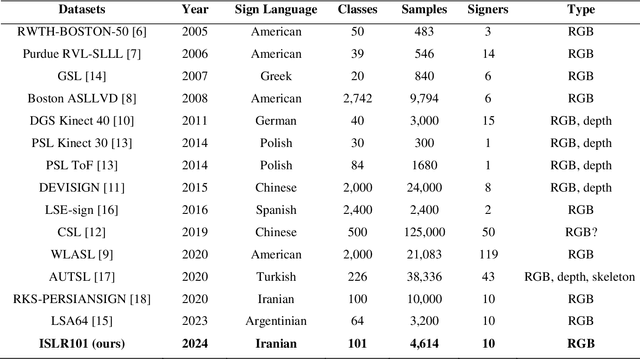
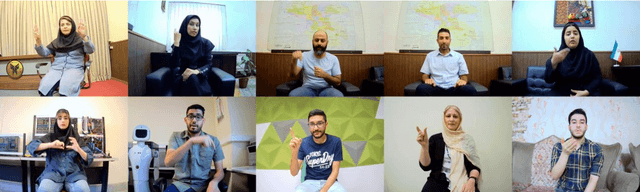
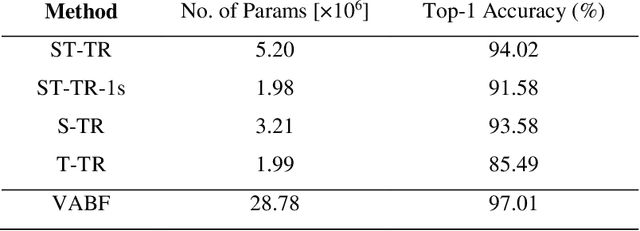
Sign language recognition involves modeling complex multichannel information, such as hand shapes and movements while relying on sufficient sign language-specific data. However, sign languages are often under-resourced, posing a significant challenge for research and development in this field. To address this gap, we introduce ISLR101, the first publicly available Iranian Sign Language dataset for isolated sign language recognition. This comprehensive dataset includes 4,614 videos covering 101 distinct signs, recorded by 10 different signers (3 deaf individuals, 2 sign language interpreters, and 5 L2 learners) against varied backgrounds, with a resolution of 800x600 pixels and a frame rate of 25 frames per second. It also includes skeleton pose information extracted using OpenPose. We establish both a visual appearance-based and a skeleton-based framework as baseline models, thoroughly training and evaluating them on ISLR101. These models achieve 97.01% and 94.02% accuracy on the test set, respectively. Additionally, we publish the train, validation, and test splits to facilitate fair comparisons.
IoT-Based 3D Pose Estimation and Motion Optimization for Athletes: Application of C3D and OpenPose
Nov 19, 2024This study proposes the IoT-Enhanced Pose Optimization Network (IE-PONet) for high-precision 3D pose estimation and motion optimization of track and field athletes. IE-PONet integrates C3D for spatiotemporal feature extraction, OpenPose for real-time keypoint detection, and Bayesian optimization for hyperparameter tuning. Experimental results on NTURGB+D and FineGYM datasets demonstrate superior performance, with AP\(^p50\) scores of 90.5 and 91.0, and mAP scores of 74.3 and 74.0, respectively. Ablation studies confirm the essential roles of each module in enhancing model accuracy. IE-PONet provides a robust tool for athletic performance analysis and optimization, offering precise technical insights for training and injury prevention. Future work will focus on further model optimization, multimodal data integration, and developing real-time feedback mechanisms to enhance practical applications.
Analyzing Data Efficiency and Performance of Machine Learning Algorithms for Assessing Low Back Pain Physical Rehabilitation Exercises
Aug 05, 2024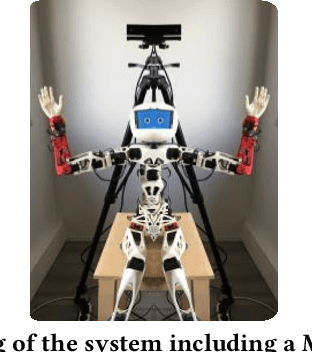
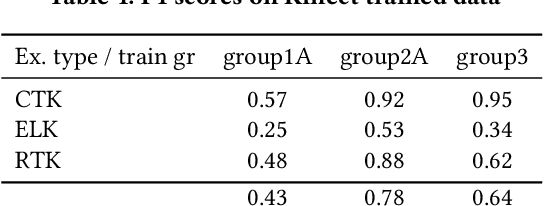

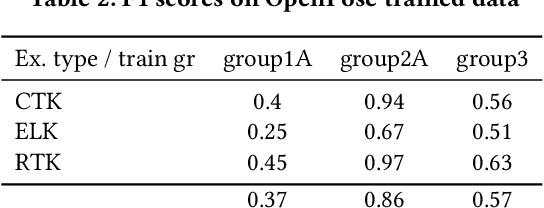
Analyzing human motion is an active research area, with various applications. In this work, we focus on human motion analysis in the context of physical rehabilitation using a robot coach system. Computer-aided assessment of physical rehabilitation entails evaluation of patient performance in completing prescribed rehabilitation exercises, based on processing movement data captured with a sensory system, such as RGB and RGB-D cameras. As 2D and 3D human pose estimation from RGB images had made impressive improvements, we aim to compare the assessment of physical rehabilitation exercises using movement data obtained from both RGB-D camera (Microsoft Kinect) and estimation from RGB videos (OpenPose and BlazePose algorithms). A Gaussian Mixture Model (GMM) is employed from position (and orientation) features, with performance metrics defined based on the log-likelihood values from GMM. The evaluation is performed on a medical database of clinical patients carrying out low back-pain rehabilitation exercises, previously coached by robot Poppy.
Deep-Learning-Based Markerless Pose Estimation Systems in Gait Analysis: DeepLabCut Custom Training and the Refinement Function
Jul 15, 2024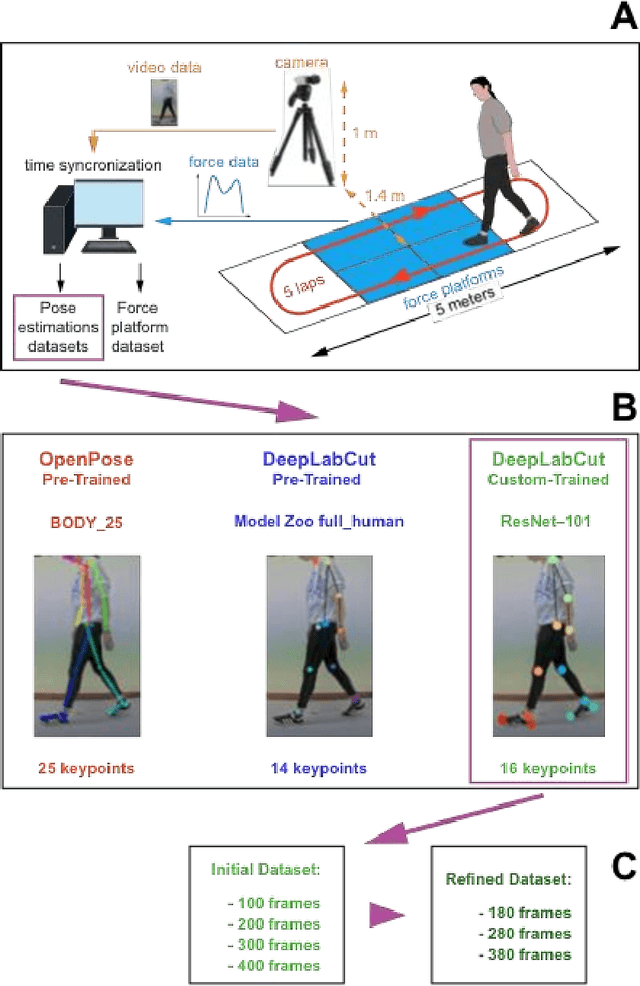
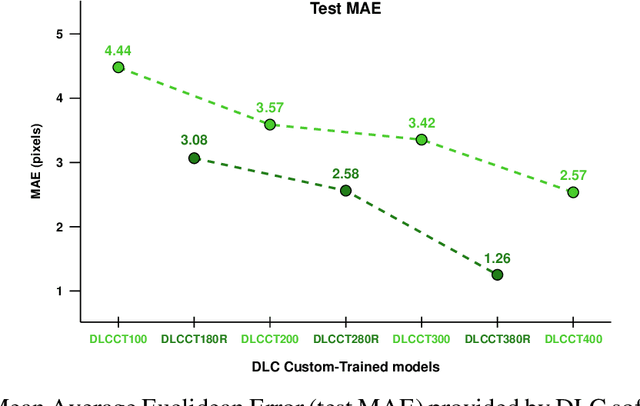
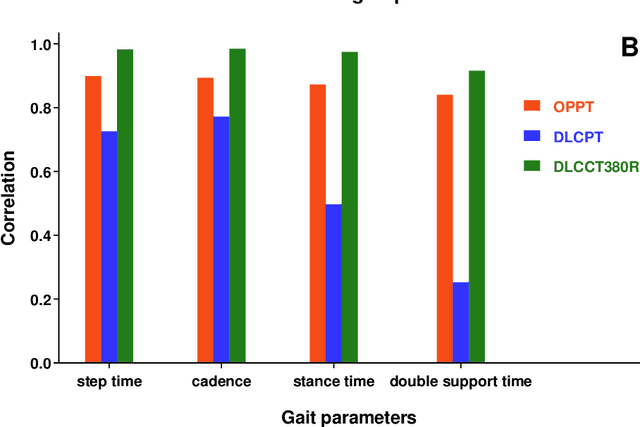
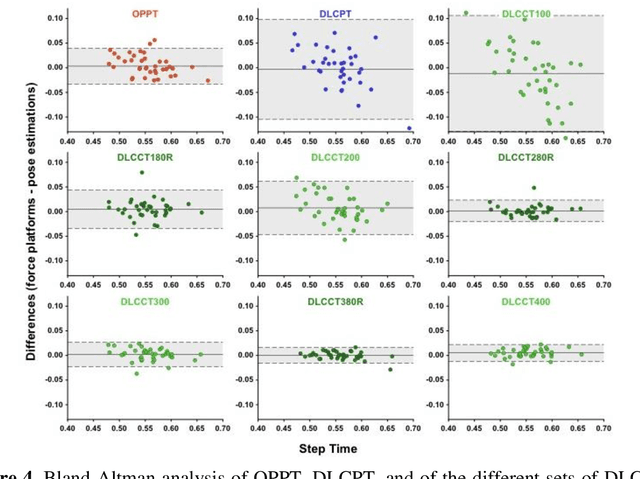
The current gold standard for the study of human movement is the marker-based motion capture system that offers high precision but constrained by costs and controlled environments. Markerless pose estimation systems emerge as ecological alternatives, allowing unobtrusive data acquisition in natural settings. This study compares the performance of two popular markerless systems, OpenPose (OP) and DeepLabCut (DLC), in assessing locomotion. Forty healthy subjects walked along a 5 meters walkway equipped with four force platforms and a camera. Gait parameters were obtained using OP BODY 25 Pre-Trained model (OPPT), DLC Model Zoo full human Pre-Trained model (DLCPT) and DLC Custom-Trained model (DLCCT), then compared with those acquired from the force platforms as reference system. Our results demonstrated that DLCCT outperformed DLCPT and OPPT, highlighting the importance of leveraging DeepLabCut transfer learning to enhance the pose estimation performance with a custom-trained neural networks. Moreover, DLCCT, with the implementation of the DLC refinement function, offers the most promising markerless pose estimation solution for evaluating locomotion. Therefore, our data provide insights into the DLC training and refinement processes required to achieve optimal performance. This study offers perspectives for clinicians and practitioners seeking accurate low-cost methods for movement assessment beyond laboratory settings.
Emotion Detection through Body Gesture and Face
Jul 13, 2024The project leverages advanced machine and deep learning techniques to address the challenge of emotion recognition by focusing on non-facial cues, specifically hands, body gestures, and gestures. Traditional emotion recognition systems mainly rely on facial expression analysis and often ignore the rich emotional information conveyed through body language. To bridge this gap, this method leverages the Aff-Wild2 and DFEW databases to train and evaluate a model capable of recognizing seven basic emotions (angry, disgust, fear, happiness, sadness, surprise, and neutral) and estimating valence and continuous scales wakeup descriptor. Leverage OpenPose for pose estimation to extract detailed body posture and posture features from images and videos. These features serve as input to state-of-the-art neural network architectures, including ResNet, and ANN for emotion classification, and fully connected layers for valence arousal regression analysis. This bifurcation strategy can solve classification and regression problems in the field of emotion recognition. The project aims to contribute to the field of affective computing by enhancing the ability of machines to interpret and respond to human emotions in a more comprehensive and nuanced way. By integrating multimodal data and cutting-edge computational models, I aspire to develop a system that not only enriches human-computer interaction but also has potential applications in areas as diverse as mental health support, educational technology, and autonomous vehicle systems.
Automatic infant 2D pose estimation from videos: comparing seven deep neural network methods
Jun 25, 2024Automatic markerless estimation of infant posture and motion from ordinary videos carries great potential for movement studies "in the wild", facilitating understanding of motor development and massively increasing the chances of early diagnosis of disorders. There is rapid development of human pose estimation methods in computer vision thanks to advances in deep learning and machine learning. However, these methods are trained on datasets featuring adults in different contexts. This work tests and compares seven popular methods (AlphaPose, DeepLabCut/DeeperCut, Detectron2, HRNet, MediaPipe/BlazePose, OpenPose, and ViTPose) on videos of infants in supine position. Surprisingly, all methods except DeepLabCut and MediaPipe have competitive performance without additional finetuning, with ViTPose performing best. Next to standard performance metrics (object keypoint similarity, average precision and recall), we introduce errors expressed in the neck-mid-hip ratio and additionally study missed and redundant detections and the reliability of the internal confidence ratings of the different methods, which are relevant for downstream tasks. Among the networks with competitive performance, only AlphaPose could run close to real time (27 fps) on our machine. We provide documented Docker containers or instructions for all the methods we used, our analysis scripts, and processed data at https://hub.docker.com/u/humanoidsctu and https://osf.io/x465b/.
SecurePose: Automated Face Blurring and Human Movement Kinematics Extraction from Videos Recorded in Clinical Settings
Feb 21, 2024Movement disorders are typically diagnosed by consensus-based expert evaluation of clinically acquired patient videos. However, such broad sharing of patient videos poses risks to patient privacy. Face blurring can be used to de-identify videos, but this process is often manual and time-consuming. Available automated face blurring techniques are subject to either excessive, inconsistent, or insufficient facial blurring - all of which can be disastrous for video assessment and patient privacy. Furthermore, assessing movement disorders in these videos is often subjective. The extraction of quantifiable kinematic features can help inform movement disorder assessment in these videos, but existing methods to do this are prone to errors if using pre-blurred videos. We have developed an open-source software called SecurePose that can both achieve reliable face blurring and automated kinematic extraction in patient videos recorded in a clinic setting using an iPad. SecurePose, extracts kinematics using a pose estimation method (OpenPose), tracks and uniquely identifies all individuals in the video, identifies the patient, and performs face blurring. The software was validated on gait videos recorded in outpatient clinic visits of 116 children with cerebral palsy. The validation involved assessing intermediate steps of kinematics extraction and face blurring with manual blurring (ground truth). Moreover, when SecurePose was compared with six selected existing methods, it outperformed other methods in automated face detection and achieved ceiling accuracy in 91.08% less time than a robust manual face blurring method. Furthermore, ten experienced researchers found SecurePose easy to learn and use, as evidenced by the System Usability Scale. The results of this work validated the performance and usability of SecurePose on clinically recorded gait videos for face blurring and kinematics extraction.