 Add to Chrome
 Add to Firefox
 Add to Edge
Enhancing Clinician Decision-Making via Uncertainty-Aware Multi-Expert Fusion for Stroke Rehabilitation
Jun 23, 2026
Tailoring stroke rehabilitation requires assessing how movements are organized, not merely if they succeed. Currently, this assessment is a rate-limiting bottleneck. Instruments like the Action Research Arm Test (ARAT) compress rich behavioral observations into single ordinal endpoints, discarding the movement-quality details that distinguish recovery from compensation. Automated alternatives typically chase accuracy on noisy, single-observer labels to output opaque scores - a technology-centric approach that rarely reaches clinical practice. To address this, we present xAARA: an engine designed to augment rather than replace clinical judgment. From multi-view video, xAARA returns ARAT assessments with calibrated uncertainty and explanations across task, movement-phase, and movement-quality levels. Treating clinical scoring as an ill-posed inference problem, xAARA composes 692 calibrated multimodal models via a Dynamic Bayesian Network with entropy-based gating. It qualifies results against clinical validity rules and defers low-confidence cases. In 105 stroke survivors (788 exercises), xAARA achieved 94.2% task accuracy (Cohen's kappa=0.934) and 81.3% movement-phase accuracy (kappa=0.727), reducing predictive uncertainty by 96.1% compared to single-clinician scoring. For subjective cases, it matched at least one rater 100% of the time and never returned out-of-range scores. Four independent clinicians validated the assessments and indicated willingness to adopt the system. We argue that principled uncertainty quantification and clinician-aligned explainability are the critical bridges moving automated assessment from technical demonstration to a deployable clinical tool.

MixSarc: A Bangla-English Code-Mixed Corpus for Implicit Meaning Identification
Feb 25, 2026Bangla-English code-mixing is widespread across South Asian social media, yet resources for implicit meaning identification in this setting remain scarce. Existing sentiment and sarcasm models largely focus on monolingual English or high-resource languages and struggle with transliteration variation, cultural references, and intra-sentential language switching. To address this gap, we introduce MixSarc, the first publicly available Bangla-English code-mixed corpus for implicit meaning identification. The dataset contains 9,087 manually annotated sentences labeled for humor, sarcasm, offensiveness, and vulgarity. We construct the corpus through targeted social media collection, systematic filtering, and multi-annotator validation. We benchmark transformer-based models and evaluate zero-shot large language models under structured prompting. Results show strong performance on humor detection but substantial degradation on sarcasm, offense, and vulgarity due to class imbalance and pragmatic complexity. Zero-shot models achieve competitive micro-F1 scores but low exact match accuracy. Further analysis reveals that over 42\% of negative sentiment instances in an external dataset exhibit sarcastic characteristics. MixSarc provides a foundational resource for culturally aware NLP and supports more reliable multi-label modeling in code-mixed environments.
Weather-Driven Agricultural Decision-Making Using Digital Twins Under Imperfect Conditions
Aug 10, 2025By offering a dynamic, real-time virtual representation of physical systems, digital twin technology can enhance data-driven decision-making in digital agriculture. Our research shows how digital twins are useful for detecting inconsistencies in agricultural weather data measurements, which are key attributes for various agricultural decision-making and automation tasks. We develop a modular framework named Cerealia that allows end-users to check for data inconsistencies when perfect weather feeds are unavailable. Cerealia uses neural network models to check anomalies and aids end-users in informed decision-making. We develop a prototype of Cerealia using the NVIDIA Jetson Orin platform and test it with an operational weather network established in a commercial orchard as well as publicly available weather datasets.
Automated ARAT Scoring Using Multimodal Video Analysis, Multi-View Fusion, and Hierarchical Bayesian Models: A Clinician Study
May 03, 2025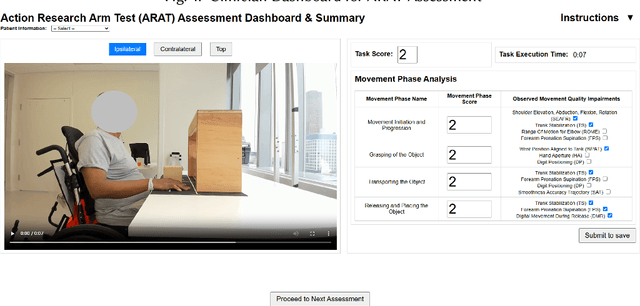
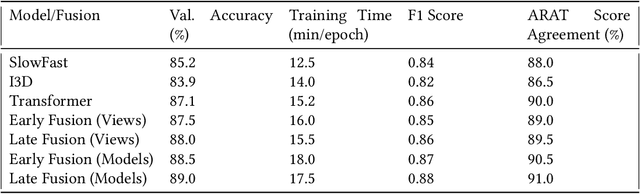
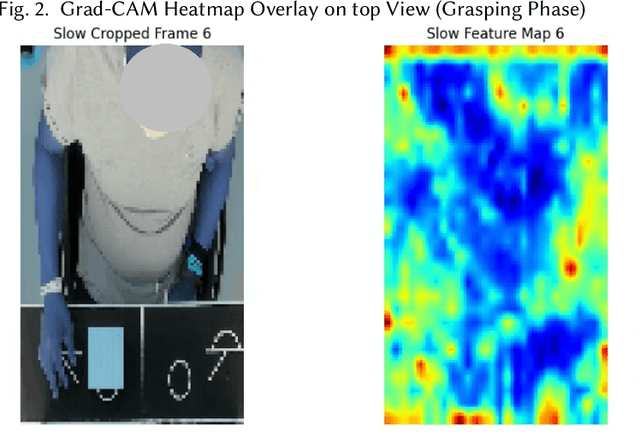
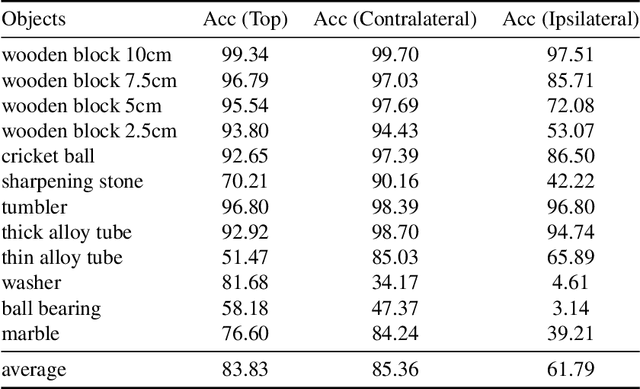
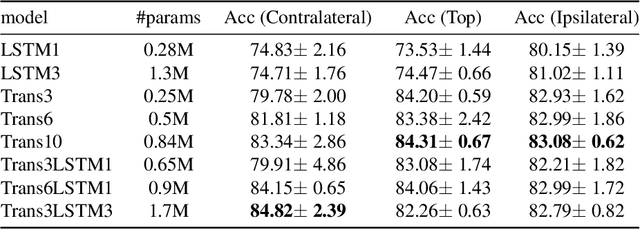
Manual scoring of the Action Research Arm Test (ARAT) for upper extremity assessment in stroke rehabilitation is time-intensive and variable. We propose an automated ARAT scoring system integrating multimodal video analysis with SlowFast, I3D, and Transformer-based models using OpenPose keypoints and object locations. Our approach employs multi-view data (ipsilateral, contralateral, and top perspectives), applying early and late fusion to combine features across views and models. Hierarchical Bayesian Models (HBMs) infer movement quality components, enhancing interpretability. A clinician dashboard displays task scores, execution times, and quality assessments. We conducted a study with five clinicians who reviewed 500 video ratings generated by our system, providing feedback on its accuracy and usability. Evaluated on a stroke rehabilitation dataset, our framework achieves 89.0% validation accuracy with late fusion, with HBMs aligning closely with manual assessments. This work advances automated rehabilitation by offering a scalable, interpretable solution with clinical validation.
Automatic Temporal Segmentation for Post-Stroke Rehabilitation: A Keypoint Detection and Temporal Segmentation Approach for Small Datasets
Feb 27, 2025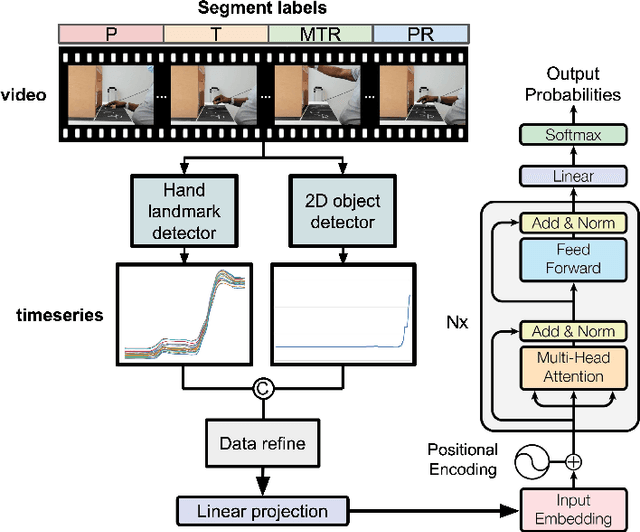
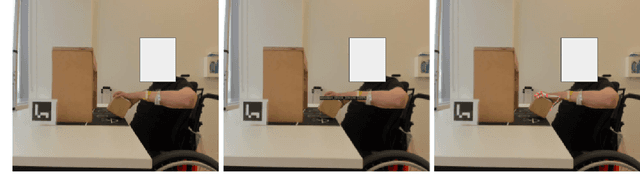
Rehabilitation is essential and critical for post-stroke patients, addressing both physical and cognitive aspects. Stroke predominantly affects older adults, with 75% of cases occurring in individuals aged 65 and older, underscoring the urgent need for tailored rehabilitation strategies in aging populations. Despite the critical role therapists play in evaluating rehabilitation progress and ensuring the effectiveness of treatment, current assessment methods can often be subjective, inconsistent, and time-consuming, leading to delays in adjusting therapy protocols. This study aims to address these challenges by providing a solution for consistent and timely analysis. Specifically, we perform temporal segmentation of video recordings to capture detailed activities during stroke patients' rehabilitation. The main application scenario motivating this study is the clinical assessment of daily tabletop object interactions, which are crucial for post-stroke physical rehabilitation. To achieve this, we present a framework that leverages the biomechanics of movement during therapy sessions. Our solution divides the process into two main tasks: 2D keypoint detection to track patients' physical movements, and 1D time-series temporal segmentation to analyze these movements over time. This dual approach enables automated labeling with only a limited set of real-world data, addressing the challenges of variability in patient movements and limited dataset availability. By tackling these issues, our method shows strong potential for practical deployment in physical therapy settings, enhancing the speed and accuracy of rehabilitation assessments.