 Add to Chrome
 Add to Firefox
 Add to Edge
Design and Evaluation of a Touchscreen-Based Teleoperation Interface for Robotic Manipulators
Aug 06, 2026
Intuitive teleoperation interfaces are crucial for the safe and effective operation of robotic manipulators in challenging environments. In the nuclear industry, surface contact tasks such as swab sampling require precise path and force tracking, obstacle avoidance, and sustained operator attention, which conventional joystick interfaces struggle to support effectively. This study designs and evaluates a novel touchscreen teleoperation interface that maps continuous finger movements directly to robotic manipulator motions, provides finer velocity control, and integrates control with visualization, enabling more natural, precise, and intuitive surface interaction than conventional controllers. A comparative user study with 20 participants evaluated task performance and workload using the proposed touchscreen, a conventional joystick, and a single-click autonomous mode. Tasks simulated realistic surface manipulation using a Franka Emika Panda arm, remotely controlled from another country. Kinematic, physiological, and behavioral data were recorded to comprehensively assess task performance, cognitive load, and operator trust across each control condition. Participants completed teleoperation tasks more efficiently and accurately with the touchscreen interface, achieving a 53.5% reduction in completion time (median: 2.50 vs. 5.38 min), higher in-area coverage on the sinusoidal path (90.7% vs. 84.1%), and lower overshoot on both path geometries compared with the joystick. Cognitive load, quantified via NASA-TLX (0-100), decreased from joystick to touchscreen (mean TLX 52 to 43; -9 points, -17.3%) and was lowest under the autonomous one-click mode (31; -21 points vs. joystick, -40.4%; -12 vs. touchscreen, -27.9%). This research presents an easy-to-implement touchscreen interface that improves performance in teleoperated surface tasks while reducing cognitive load.

AgiPIX: Bridging Simulation and Reality in Indoor Aerial Inspection
Apr 09, 2026Autonomous indoor flight for critical asset inspection presents fundamental challenges in perception, planning, control, and learning. Despite rapid progress, there is still a lack of a compact, active-sensing, open-source platform that is reproducible across simulation and real-world operation. To address this gap, we present Agipix, a co-designed open hardware and software platform for indoor aerial autonomy and critical asset inspection. Agipix features a compact, hardware-synchronized active-sensing platform with onboard GPU-accelerated compute that is capable of agile flight; a containerized ROS~2-based modular autonomy stack; and a photorealistic digital twin of the hardware platform together with a reliable UI. These elements enable rapid iteration via zero-shot transfer of containerized autonomy components between simulation and real flights. We demonstrate trajectory tracking and exploration performance using onboard sensing in industrial indoor environments. All hardware designs, simulation assets, and containerized software are released openly together with documentation.
Analyzing Data Efficiency and Performance of Machine Learning Algorithms for Assessing Low Back Pain Physical Rehabilitation Exercises
Aug 05, 2024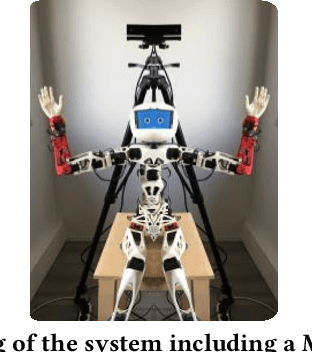
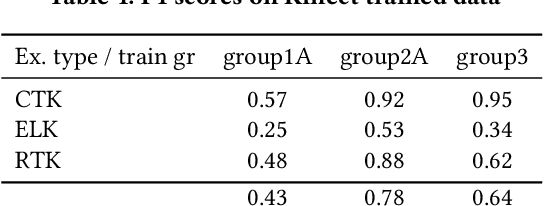

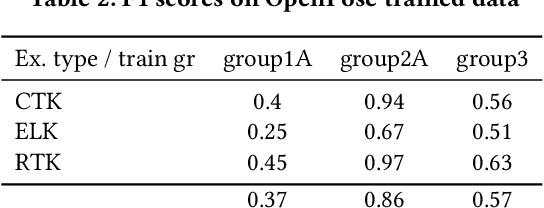
Analyzing human motion is an active research area, with various applications. In this work, we focus on human motion analysis in the context of physical rehabilitation using a robot coach system. Computer-aided assessment of physical rehabilitation entails evaluation of patient performance in completing prescribed rehabilitation exercises, based on processing movement data captured with a sensory system, such as RGB and RGB-D cameras. As 2D and 3D human pose estimation from RGB images had made impressive improvements, we aim to compare the assessment of physical rehabilitation exercises using movement data obtained from both RGB-D camera (Microsoft Kinect) and estimation from RGB videos (OpenPose and BlazePose algorithms). A Gaussian Mixture Model (GMM) is employed from position (and orientation) features, with performance metrics defined based on the log-likelihood values from GMM. The evaluation is performed on a medical database of clinical patients carrying out low back-pain rehabilitation exercises, previously coached by robot Poppy.
Exploratory Study: Children's with Autism Awareness of being Imitated by Nao Robot
Mar 07, 2020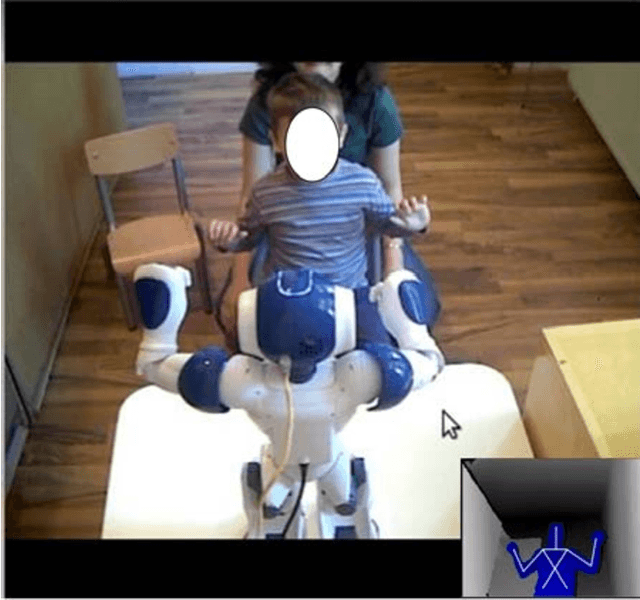
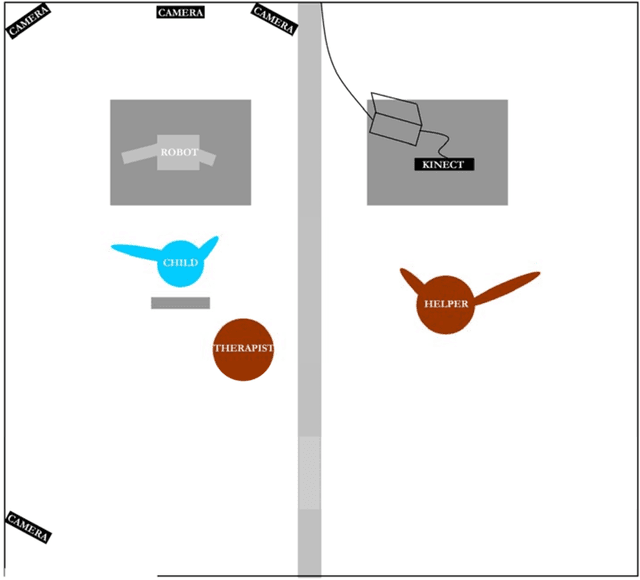
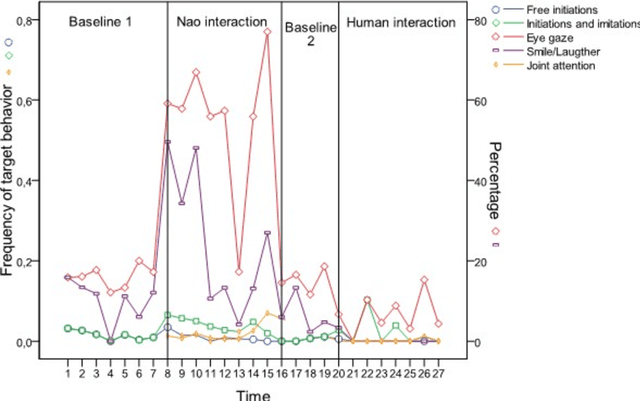
This paper presents an exploratory study designed for children with Autism Spectrum Disorders (ASD) that investigates children's awareness of being imitated by a robot in a play/game scenario. The Nao robot imitates all the arm movement behaviors of the child in real-time in dyadic and triadic interactions. Different behavioral criteria (i.e., eye gaze, gaze shifting, initiation and imitation of arm movements, smile/laughter) were analyzed based on the video data of the interaction. The results confirm only parts of the research hypothesis. However, these results are promising for the future directions of this work.
Social Engagement of Children with Autism during Interaction with a Robot
Feb 27, 2020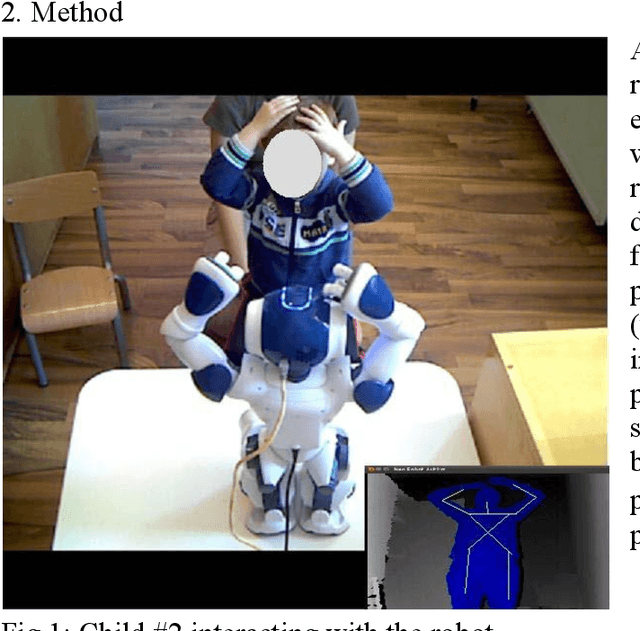
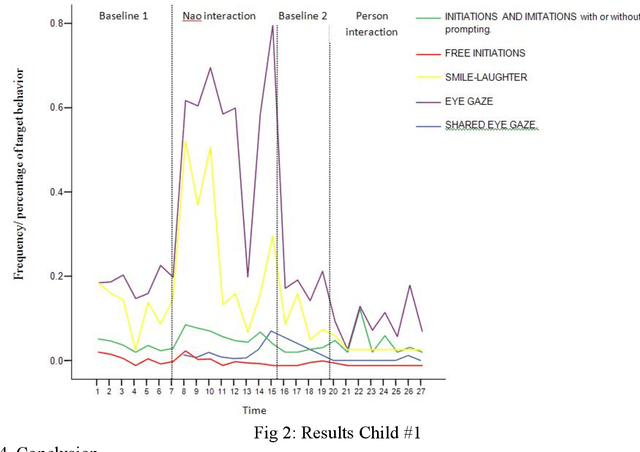
Imitation plays an important role in development, being one of the precursors of social cognition. Even though some children with autism imitate spontaneously and other children with autism can learn to imitate, the dynamics of imitation is affected in the large majority of cases. Existing studies from the literature suggest that robots can be used to teach children with autism basic interaction skills like imitation. Based on these findings, in this study, we investigate if children with autism show more social engagement when interacting with an imitative robot (Fig 1) compared to a human partner in a motor imitation task.