 Add to Chrome
 Add to Firefox
 Add to Edge
RoboSolver: A Multi-Agent Large Language Model Framework for Solving Robotic Arm Problems
Feb 16, 2026
This study proposes an intelligent multi-agent framework built on LLMs and VLMs and specifically tailored to robotics. The goal is to integrate the strengths of LLMs and VLMs with computational tools to automatically analyze and solve problems related to robotic manipulators. Our developed framework accepts both textual and visual inputs and can automatically perform forward and inverse kinematics, compute velocities and accelerations of key points, generate 3D simulations of the robot, and ultimately execute motion control within the simulated environment, all according to the user's query. To evaluate the framework, three benchmark tests were designed, each consisting of ten questions. In the first benchmark test, the framework was evaluated while connected to GPT-4o, DeepSeek-V3.2, and Claude-Sonnet-4.5, as well as their corresponding raw models. The objective was to extract the forward kinematics of robots directly from textual descriptions. The results showed that the framework integrated with GPT-4o achieved the highest accuracy, reaching 0.97 in computing the final solution, whereas the raw model alone attained an accuracy of only 0.30 for the same task. Similarly, for the other two models, the framework consistently outperformed the corresponding raw models in terms of accuracy. The second benchmark test was identical to the first, except that the input was provided in visual form. In this test, the GPT-4o LLM was used alongside the Gemini 2.5 Pro VLM. The results showed that the framework achieved an accuracy of 0.93 in obtaining the final answer, which is approximately 20% higher than that of the corresponding raw model. The third benchmark test encompassed a range of robotic tasks, including simulation, control, velocity and acceleration computation, as well as inverse kinematics and Jacobian calculation, for which the framework achieved an accuracy of 0.97.

PISHYAR: A Socially Intelligent Smart Cane for Indoor Social Navigation and Multimodal Human-Robot Interaction for Visually Impaired People
Feb 13, 2026This paper presents PISHYAR, a socially intelligent smart cane designed by our group to combine socially aware navigation with multimodal human-AI interaction to support both physical mobility and interactive assistance. The system consists of two components: (1) a social navigation framework implemented on a Raspberry Pi 5 that integrates real-time RGB-D perception using an OAK-D Lite camera, YOLOv8-based object detection, COMPOSER-based collective activity recognition, D* Lite dynamic path planning, and haptic feedback via vibration motors for tasks such as locating a vacant seat; and (2) an agentic multimodal LLM-VLM interaction framework that integrates speech recognition, vision language models, large language models, and text-to-speech, with dynamic routing between voice-only and vision-only modes to enable natural voice-based communication, scene description, and object localization from visual input. The system is evaluated through a combination of simulation-based tests, real-world field experiments, and user-centered studies. Results from simulated and real indoor environments demonstrate reliable obstacle avoidance and socially compliant navigation, achieving an overall system accuracy of approximately 80% under different social conditions. Group activity recognition further shows robust performance across diverse crowd scenarios. In addition, a preliminary exploratory user study with eight visually impaired and low-vision participants evaluates the agentic interaction framework through structured tasks and a UTAUT-based questionnaire reveals high acceptance and positive perceptions of usability, trust, and perceived sociability during our experiments. The results highlight the potential of PISHYAR as a multimodal assistive mobility aid that extends beyond navigation to provide socially interactive support for such users.
Human-Like Gaze Behavior in Social Robots: A Deep Learning Approach Integrating Human and Non-Human Stimuli
Feb 12, 2026Nonverbal behaviors, particularly gaze direction, play a crucial role in enhancing effective communication in social interactions. As social robots increasingly participate in these interactions, they must adapt their gaze based on human activities and remain receptive to all cues, whether human-generated or not, to ensure seamless and effective communication. This study aims to increase the similarity between robot and human gaze behavior across various social situations, including both human and non-human stimuli (e.g., conversations, pointing, door openings, and object drops). A key innovation in this study, is the investigation of gaze responses to non-human stimuli, a critical yet underexplored area in prior research. These scenarios, were simulated in the Unity software as a 3D animation and a 360-degree real-world video. Data on gaze directions from 41 participants were collected via virtual reality (VR) glasses. Preprocessed data, trained two neural networks-LSTM and Transformer-to build predictive models based on individuals' gaze patterns. In the animated scenario, the LSTM and Transformer models achieved prediction accuracies of 67.6% and 70.4%, respectively; In the real-world scenario, the LSTM and Transformer models achieved accuracies of 72% and 71.6%, respectively. Despite the gaze pattern differences among individuals, our models outperform existing approaches in accuracy while uniquely considering non-human stimuli, offering a significant advantage over previous literature. Furthermore, deployed on the NAO robot, the system was evaluated by 275 participants via a comprehensive questionnaire, with results demonstrating high satisfaction during interactions. This work advances social robotics by enabling robots to dynamically mimic human gaze behavior in complex social contexts.
Design, Development, and Use of Maya Robot as an Assistant for the Therapy/Education of Children with Cancer: a Pilot Study
Feb 11, 2026This study centers around the design and implementation of the Maya Robot, a portable elephant-shaped social robot, intended to engage with children undergoing cancer treatment. Initial efforts were devoted to enhancing the robot's facial expression recognition accuracy, achieving a 98% accuracy through deep neural networks. Two subsequent preliminary exploratory experiments were designed to advance the study's objectives. The first experiment aimed to compare pain levels experienced by children during the injection process, with and without the presence of the Maya robot. Twenty-five children, aged 4 to 9, undergoing cancer treatment participated in this counterbalanced study. The paired T-test results revealed a significant reduction in perceived pain when the robot was actively present in the injection room. The second experiment sought to assess perspectives of hospitalized children and their mothers during engagement with Maya through a game. Forty participants, including 20 children aged 4 to 9 and their mothers, were involved. Post Human-Maya Interactions, UTAUT questionnaire results indicated that children experienced significantly less anxiety than their parents during the interaction and game play. Notably, children exhibited higher trust levels in both the robot and the games, presenting a statistically significant difference in trust levels compared to their parents (P-value < 0.05). This preliminary exploratory study highlights the positive impact of utilizing Maya as an assistant for therapy/education in a clinical setting, particularly benefiting children undergoing cancer treatment. The findings underscore the potential of social robots in pediatric healthcare contexts, emphasizing improved pain management and emotional well-being among young patients.
Developing Neural Network-Based Gaze Control Systems for Social Robots
Feb 11, 2026During multi-party interactions, gaze direction is a key indicator of interest and intent, making it essential for social robots to direct their attention appropriately. Understanding the social context is crucial for robots to engage effectively, predict human intentions, and navigate interactions smoothly. This study aims to develop an empirical motion-time pattern for human gaze behavior in various social situations (e.g., entering, leaving, waving, talking, and pointing) using deep neural networks based on participants' data. We created two video clips-one for a computer screen and another for a virtual reality headset-depicting different social scenarios. Data were collected from 30 participants: 15 using an eye-tracker and 15 using an Oculus Quest 1 headset. Deep learning models, specifically Long Short-Term Memory (LSTM) and Transformers, were used to analyze and predict gaze patterns. Our models achieved 60% accuracy in predicting gaze direction in a 2D animation and 65% accuracy in a 3D animation. Then, the best model was implemented onto the Nao robot; and 36 new participants evaluated its performance. The feedback indicated overall satisfaction, with those experienced in robotics rating the models more favorably.
LLM-Agent-Controller: A Universal Multi-Agent Large Language Model System as a Control Engineer
May 26, 2025This study presents the LLM-Agent-Controller, a multi-agent large language model (LLM) system developed to address a wide range of problems in control engineering (Control Theory). The system integrates a central controller agent with multiple specialized auxiliary agents, responsible for tasks such as controller design, model representation, control analysis, time-domain response, and simulation. A supervisor oversees high-level decision-making and workflow coordination, enhancing the system's reliability and efficiency. The LLM-Agent-Controller incorporates advanced capabilities, including Retrieval-Augmented Generation (RAG), Chain-of-Thought reasoning, self-criticism and correction, efficient memory handling, and user-friendly natural language communication. It is designed to function without requiring users to have prior knowledge of Control Theory, enabling them to input problems in plain language and receive complete, real-time solutions. To evaluate the system, we propose new performance metrics assessing both individual agents and the system as a whole. We test five categories of Control Theory problems and benchmark performance across three advanced LLMs. Additionally, we conduct a comprehensive qualitative conversational analysis covering all key services. Results show that the LLM-Agent-Controller successfully solved 83% of general tasks, with individual agents achieving an average success rate of 87%. Performance improved with more advanced LLMs. This research demonstrates the potential of multi-agent LLM architectures to solve complex, domain-specific problems. By integrating specialized agents, supervisory control, and advanced reasoning, the LLM-Agent-Controller offers a scalable, robust, and accessible solution framework that can be extended to various technical domains.
ISLR101: an Iranian Word-Level Sign Language Recognition Dataset
Mar 16, 2025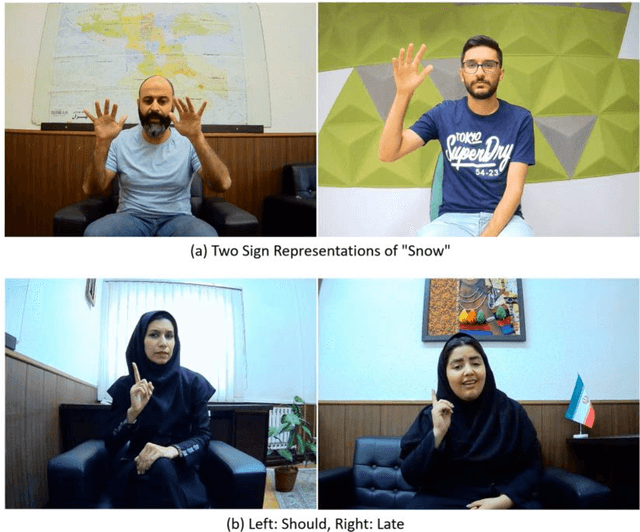
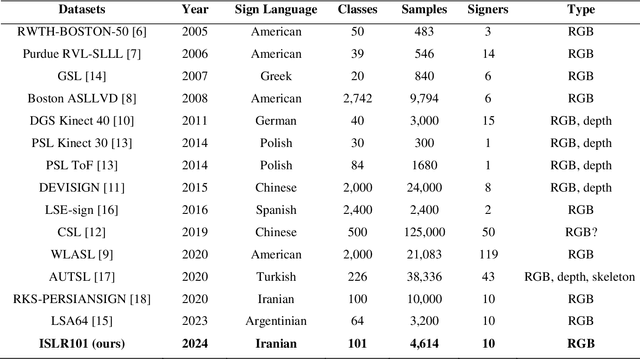
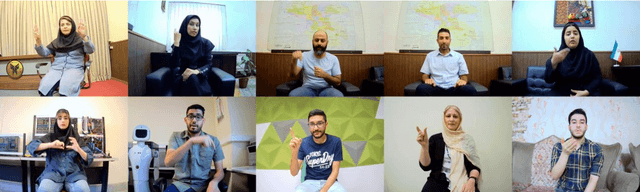
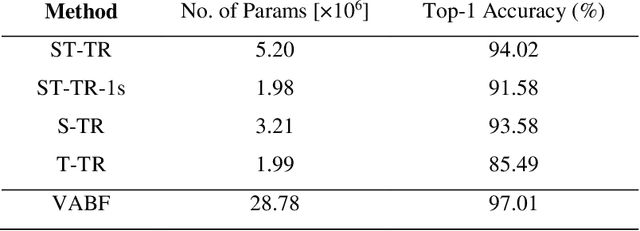
Sign language recognition involves modeling complex multichannel information, such as hand shapes and movements while relying on sufficient sign language-specific data. However, sign languages are often under-resourced, posing a significant challenge for research and development in this field. To address this gap, we introduce ISLR101, the first publicly available Iranian Sign Language dataset for isolated sign language recognition. This comprehensive dataset includes 4,614 videos covering 101 distinct signs, recorded by 10 different signers (3 deaf individuals, 2 sign language interpreters, and 5 L2 learners) against varied backgrounds, with a resolution of 800x600 pixels and a frame rate of 25 frames per second. It also includes skeleton pose information extracted using OpenPose. We establish both a visual appearance-based and a skeleton-based framework as baseline models, thoroughly training and evaluating them on ISLR101. These models achieve 97.01% and 94.02% accuracy on the test set, respectively. Additionally, we publish the train, validation, and test splits to facilitate fair comparisons.
Continuous Sign Language Recognition Using Intra-inter Gloss Attention
Jun 26, 2024Many continuous sign language recognition (CSLR) studies adopt transformer-based architectures for sequence modeling due to their powerful capacity for capturing global contexts. Nevertheless, vanilla self-attention, which serves as the core module of the transformer, calculates a weighted average over all time steps; therefore, the local temporal semantics of sign videos may not be fully exploited. In this study, we introduce a novel module in sign language recognition studies, called intra-inter gloss attention module, to leverage the relationships among frames within glosses and the semantic and grammatical dependencies between glosses in the video. In the intra-gloss attention module, the video is divided into equally sized chunks and a self-attention mechanism is applied within each chunk. This localized self-attention significantly reduces complexity and eliminates noise introduced by considering non-relative frames. In the inter-gloss attention module, we first aggregate the chunk-level features within each gloss chunk by average pooling along the temporal dimension. Subsequently, multi-head self-attention is applied to all chunk-level features. Given the non-significance of the signer-environment interaction, we utilize segmentation to remove the background of the videos. This enables the proposed model to direct its focus toward the signer. Experimental results on the PHOENIX-2014 benchmark dataset demonstrate that our method can effectively extract sign language features in an end-to-end manner without any prior knowledge, improve the accuracy of CSLR, and achieve the word error rate (WER) of 20.4 on the test set which is a competitive result compare to the state-of-the-art which uses additional supervisions.
Reacting like Humans: Incorporating Intrinsic Human Behaviors into NAO through Sound-Based Reactions for Enhanced Sociability
Dec 12, 2023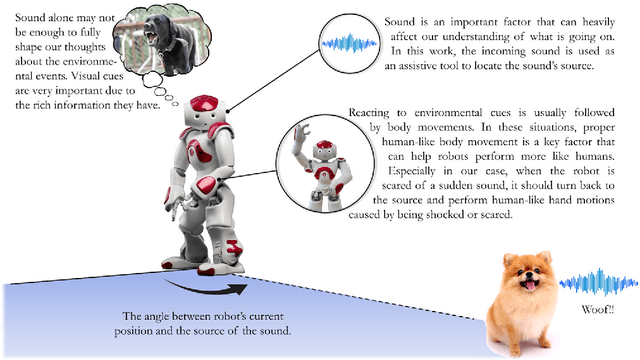

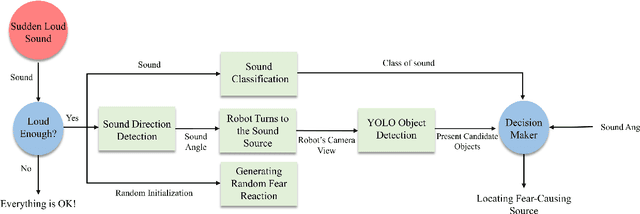

Robots' acceptability among humans and their sociability can be significantly enhanced by incorporating human-like reactions. Humans can react to environmental events very quickly and without thinking. An instance where humans display natural reactions is when they encounter a sudden and loud sound that startles or frightens them. During such moments, individuals may instinctively move their hands, turn toward the origin of the sound, and try to determine the event's cause. This inherent behavior motivated us to explore this less-studied part of social robotics. In this work, a multi-modal system composed of an action generator, sound classifier, and YOLO object detector was designed to sense the environment and, in the presence of sudden loud sounds, show natural human fear reactions, and finally, locate the fear-causing sound source in the environment. These unique and valid generated motions and inferences could imitate intrinsic human reactions and enhance the sociability of robots. For motion generation, a model based on LSTM and MDN networks was proposed to synthesize various motions. Also, in the case of sound detection, a transfer learning model was preferred that used the spectrogram of sound signals as its input. After developing individual models for sound detection, motion generation, and image recognition, they were integrated into a comprehensive fear module that was implemented on the NAO robot. Finally, the fear module was tested in practical application and two groups of experts and non-experts filled out a questionnaire to evaluate the performance of the robot. Given our promising results, this preliminary exploratory research provides a fresh perspective on social robotics and could be a starting point for modeling intrinsic human behaviors and emotions in robots.
cGAN-Based High Dimensional IMU Sensor Data Generation for Therapeutic Activities
Feb 16, 2023Human activity recognition is a core technology for applications such as rehabilitation, ambient health monitoring, and human-computer interactions. Wearable devices, particularly IMU sensors, can help us collect rich features of human movements that can be leveraged in activity recognition. Developing a robust classifier for activity recognition has always been of interest to researchers. One major problem is that there is usually a deficit of training data for some activities, making it difficult and sometimes impossible to develop a classifier. In this work, a novel GAN network called TheraGAN was developed to generate realistic IMU signals associated with a particular activity. The generated signal is of a 6-channel IMU. i.e., angular velocities and linear accelerations. Also, by introducing simple activities, which are meaningful subparts of a complex full-length activity, the generation process was facilitated for any activity with arbitrary length. To evaluate the generated signals, besides perceptual similarity metrics, they were applied along with real data to improve the accuracy of classifiers. The results show that the maximum increase in the f1-score belongs to the LSTM classifier by a 13.27% rise when generated data were added. This shows the validity of the generated data as well as TheraGAN as a tool to build more robust classifiers in case of imbalanced data problem.