 Add to Chrome
 Add to Firefox
 Add to Edge
Music Genre Classification
Papers and Code
Adopting State-of-the-Art Pretrained Audio Representations for Music Recommender Systems
Apr 25, 2026
Over the years, Music Information Retrieval (MIR) research community has released various models pretrained on large amounts of music data. Transfer learning showcases the proven effectiveness of pretrained backend models for a broad spectrum of downstream tasks, including auto-tagging and genre classification. However, MIR papers generally do not explore the efficiency of pretrained models for Music Recommender Systems (MRS). In addition, the Recommender Systems community tends to favour traditional end-to-end neural network training. Our research addresses this gap and evaluates the performance of nine pretrained backend models (MusicFM, Music2Vec, MERT, EncodecMAE, Jukebox, MusiCNN, MULE, MuQ and MuQ-MuLan) in the context of MRS. We assess them using five recommendation approaches: K-Nearest Neighbours (KNN), Shallow Neural Network, Contrastive Multi-Modal projection, a Hybrid model, and BERT4Rec both for the hot and cold-start scenarios. Our findings suggest that pretrained audio representations exhibit significant performance disparity between traditional MIR tasks and both hot and cold music recommendations, indicating that valuable aspects of musical information captured by backend models may differ depending on the task. This study establishes a foundation for further exploration of pretrained audio representations to enhance music recommendation systems.

YMIR: A new Benchmark Dataset and Model for Arabic Yemeni Music Genre Classification Using Convolutional Neural Networks
Apr 06, 2026Automatic music genre classification is a major task in music information retrieval; however, most current benchmarks and models have been developed primarily for Western music, leaving culturally specific traditions underrepresented. In this paper, we introduce the Yemeni Music Information Retrieval (YMIR) dataset, which contains 1,475 carefully selected audio clips covering five traditional Yemeni genres: Sanaani, Hadhrami, Lahji, Tihami, and Adeni. The dataset was labeled by five Yemeni music experts following a clear and structured protocol, resulting in strong inter-annotator agreement (Fleiss kappa = 0.85). We also propose the Yemeni Music Classification Model (YMCM), a convolutional neural network (CNN)-based system designed to classify music genres from time-frequency features. Using a consistent preprocessing pipeline, we perform a systematic comparison across six experimental groups and five different architectures, resulting in a total of 30 experiments. Specifically, we evaluate several feature representations, including Mel-spectrograms, Chroma, FilterBank, and MFCCs with 13, 20, and 40 coefficients, and benchmark YMCM against standard models (AlexNet, VGG16, MobileNet, and a baseline CNN) under the same experimental conditions. The experimental findings reveal that YMCM is the most effective, achieving the highest accuracy of 98.8% with Mel-spectrogram features. The results also provide practical insights into the relationship between feature representation and model capacity. The findings establish YMIR as a useful benchmark and YMCM as a strong baseline for classifying Yemeni music genres.
Evaluating Pretrained General-Purpose Audio Representations for Music Genre Classification
Mar 14, 2026This study investigates the use of self-supervised learning embeddings, particularly BYOL-A, in conjunction with a deep neural network classifier for Music Genre Classification. Our experiments demonstrate that BYOL-A embeddings outperform other pre-trained models, such as PANNs and VGGish, achieving an accuracy of 81.5% on the GTZAN dataset and 64.3% on FMA-Small. The proposed DNN classifier improved performance by 10-16% over linear classifiers. We explore the effects of contrastive and triplet loss and multitask training with optimized loss weights, achieving the highest accuracy. To address cross dataset challenges, we combined GTZAN and FMA-Small into a unified 18-class label space for joint training, resulting in slight performance drops on GTZAN but comparable results on FMA-Small. The scripts developed in this work are publicly available.
Enhancing Music Recommendation with User Mood Input
Mar 12, 2026Recommendation systems have become essential in modern music streaming platforms, due to the vast amount of content available. A common approach in recommendation systems is collaborative filtering, which suggests content to users based on the preferences of others with similar patterns. However, this method performs poorly in domains where interactions are sparse, such as music. Content-based filtering is an alternative approach that examines the qualities of the items themselves. Prior work has explored a range of content-filtering techniques for music, including genre classification, instrument detection, and lyrics analysis. In the literature review component of this work, we examine these methods in detail. Music emotion recognition is a type of content-based filtering that is less explored but has significant potential. Since a user's emotional state influences their musical choices, incorporating user mood into recommendation systems is an alternative way to personalize the listening experience. In this study, we explore a mood-assisted recommendation system that suggests songs based on the desired mood using the energy-valence spectrum. Single-blind experiments are conducted, in which participants are presented with two recommendations (one generated from a mood-assisted recommendation system and one from a baseline system) and are asked to rate them. Results show that integrating user mood leads to a statistically significant improvement in recommendation quality, highlighting the potential of such approaches.
Bangla Music Genre Classification Using Bidirectional LSTMS
Jan 21, 2026Bangla music is enrich in its own music cultures. Now a days music genre classification is very significant because of the exponential increase in available music, both in digital and physical formats. It is necessary to index them accordingly to facilitate improved retrieval. Automatically classifying Bangla music by genre is essential for efficiently locating specific pieces within a vast and diverse music library. Prevailing methods for genre classification predominantly employ conventional machine learning or deep learning approaches. This work introduces a novel music dataset comprising ten distinct genres of Bangla music. For the task of audio classification, we utilize a recurrent neural network (RNN) architecture. Specifically, a Long Short-Term Memory (LSTM) network is implemented to train the model and perform the classification. Feature extraction represents a foundational stage in audio data processing. This study utilizes Mel-Frequency Cepstral Coefficients (MFCCs) to transform raw audio waveforms into a compact and representative set of features. The proposed framework facilitates music genre classification by leveraging these extracted features. Experimental results demonstrate a classification accuracy of 78%, indicating the system's strong potential to enhance and streamline the organization of Bangla music genres.
Beyond Mapping : Domain-Invariant Representations via Spectral Embedding of Optimal Transport Plans
Jan 19, 2026Distributional shifts between training and inference time data remain a central challenge in machine learning, often leading to poor performance. It motivated the study of principled approaches for domain alignment, such as optimal transport based unsupervised domain adaptation, that relies on approximating Monge map using transport plans, which is sensitive to the transport problem regularization strategy and hyperparameters, and might yield biased domains alignment. In this work, we propose to interpret smoothed transport plans as adjacency matrices of bipartite graphs connecting source to target domain and derive domain-invariant samples' representations through spectral embedding. We evaluate our approach on acoustic adaptation benchmarks for music genre recognition, music-speech discrimination, as well as electrical cable defect detection and classification tasks using time domain reflection in different diagnosis settings, achieving overall strong performances.
Parallel Algorithms for Combined Regularized Support Vector Machines: Application in Music Genre Classification
Dec 08, 2025In the era of rapid development of artificial intelligence, its applications span across diverse fields, relying heavily on effective data processing and model optimization. Combined Regularized Support Vector Machines (CR-SVMs) can effectively handle the structural information among data features, but there is a lack of efficient algorithms in distributed-stored big data. To address this issue, we propose a unified optimization framework based on consensus structure. This framework is not only applicable to various loss functions and combined regularization terms but can also be effectively extended to non-convex regularization terms, showing strong scalability. Based on this framework, we develop a distributed parallel alternating direction method of multipliers (ADMM) algorithm to efficiently compute CR-SVMs when data is stored in a distributed manner. To ensure the convergence of the algorithm, we also introduce the Gaussian back-substitution method. Meanwhile, for the integrity of the paper, we introduce a new model, the sparse group lasso support vector machine (SGL-SVM), and apply it to music information retrieval. Theoretical analysis confirms that the computational complexity of the proposed algorithm is not affected by different regularization terms and loss functions, highlighting the universality of the parallel algorithm. Experiments on synthetic and free music archiv datasets demonstrate the reliability, stability, and efficiency of the algorithm.
Training a Perceptual Model for Evaluating Auditory Similarity in Music Adversarial Attack
Sep 05, 2025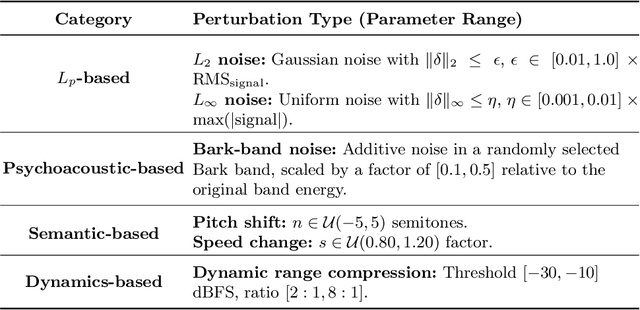
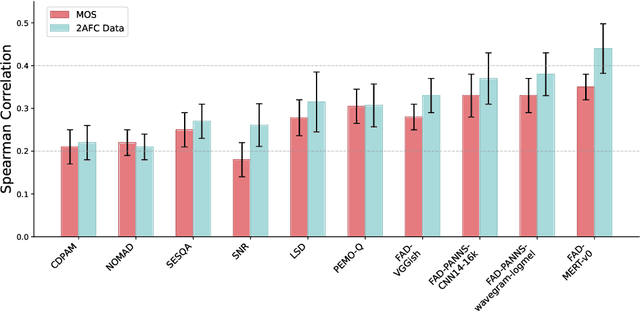
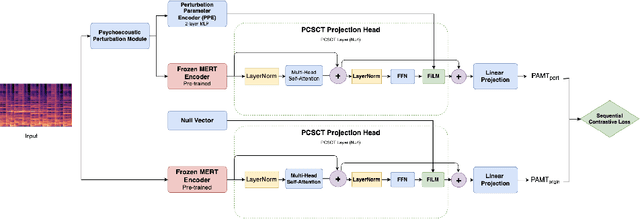
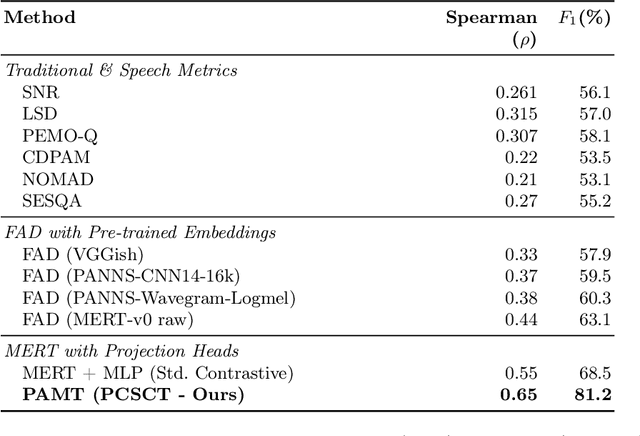
Music Information Retrieval (MIR) systems are highly vulnerable to adversarial attacks that are often imperceptible to humans, primarily due to a misalignment between model feature spaces and human auditory perception. Existing defenses and perceptual metrics frequently fail to adequately capture these auditory nuances, a limitation supported by our initial listening tests showing low correlation between common metrics and human judgments. To bridge this gap, we introduce Perceptually-Aligned MERT Transformer (PAMT), a novel framework for learning robust, perceptually-aligned music representations. Our core innovation lies in the psychoacoustically-conditioned sequential contrastive transformer, a lightweight projection head built atop a frozen MERT encoder. PAMT achieves a Spearman correlation coefficient of 0.65 with subjective scores, outperforming existing perceptual metrics. Our approach also achieves an average of 9.15\% improvement in robust accuracy on challenging MIR tasks, including Cover Song Identification and Music Genre Classification, under diverse perceptual adversarial attacks. This work pioneers architecturally-integrated psychoacoustic conditioning, yielding representations significantly more aligned with human perception and robust against music adversarial attacks.
Music4All A+A: A Multimodal Dataset for Music Information Retrieval Tasks
Sep 18, 2025Music is characterized by aspects related to different modalities, such as the audio signal, the lyrics, or the music video clips. This has motivated the development of multimodal datasets and methods for Music Information Retrieval (MIR) tasks such as genre classification or autotagging. Music can be described at different levels of granularity, for instance defining genres at the level of artists or music albums. However, most datasets for multimodal MIR neglect this aspect and provide data at the level of individual music tracks. We aim to fill this gap by providing Music4All Artist and Album (Music4All A+A), a dataset for multimodal MIR tasks based on music artists and albums. Music4All A+A is built on top of the Music4All-Onion dataset, an existing track-level dataset for MIR tasks. Music4All A+A provides metadata, genre labels, image representations, and textual descriptors for 6,741 artists and 19,511 albums. Furthermore, since Music4All A+A is built on top of Music4All-Onion, it allows access to other multimodal data at the track level, including user--item interaction data. This renders Music4All A+A suitable for a broad range of MIR tasks, including multimodal music recommendation, at several levels of granularity. To showcase the use of Music4All A+A, we carry out experiments on multimodal genre classification of artists and albums, including an analysis in missing-modality scenarios, and a quantitative comparison with genre classification in the movie domain. Our experiments show that images are more informative for classifying the genres of artists and albums, and that several multimodal models for genre classification struggle in generalizing across domains. We provide the code to reproduce our experiments at https://github.com/hcai-mms/Music4All-A-A, the dataset is linked in the repository and provided open-source under a CC BY-NC-SA 4.0 license.
X-ARES: A Comprehensive Framework for Assessing Audio Encoder Performance
May 22, 2025We introduces X-ARES (eXtensive Audio Representation and Evaluation Suite), a novel open-source benchmark designed to systematically assess audio encoder performance across diverse domains. By encompassing tasks spanning speech, environmental sounds, and music, X-ARES provides two evaluation approaches for evaluating audio representations: linear fine-tuning and unparameterized evaluation. The framework includes 22 distinct tasks that cover essential aspects of audio processing, from speech recognition and emotion detection to sound event classification and music genre identification. Our extensive evaluation of state-of-the-art audio encoders reveals significant performance variations across different tasks and domains, highlighting the complexity of general audio representation learning.