 Add to Chrome
 Add to Firefox
 Add to Edge
Lexical Simplification
Papers and Code
Right at My Level: A Unified Multilingual Framework for Proficiency-Aware Text Simplification
Apr 07, 2026
Text simplification supports second language (L2) learning by providing comprehensible input, consistent with the Input Hypothesis. However, constructing personalized parallel corpora is costly, while existing large language model (LLM)-based readability control methods rely on pre-labeled sentence corpora and primarily target English. We propose Re-RIGHT, a unified reinforcement learning framework for adaptive multilingual text simplification without parallel corpus supervision. We first show that prompting-based lexical simplification at target proficiency levels (CEFR, JLPT, TOPIK, and HSK) performs poorly at easier levels and for non-English languages, even with state-of-the-art LLMs such as GPT-5.2 and Gemini 2.5. To address this, we collect 43K vocabulary-level data across four languages (English, Japanese, Korean, and Chinese) and train a compact 4B policy model using Re-RIGHT, which integrates three reward modules: vocabulary coverage, semantic preservation, and coherence. Compared to the stronger LLM baselines, Re-RIGHT achieves higher lexical coverage at target proficiency levels while maintaining original meaning and fluency.

Controlling Reading Ease with Gaze-Guided Text Generation
Jan 25, 2026The way our eyes move while reading can tell us about the cognitive effort required to process the text. In the present study, we use this fact to generate texts with controllable reading ease. Our method employs a model that predicts human gaze patterns to steer language model outputs towards eliciting certain reading behaviors. We evaluate the approach in an eye-tracking experiment with native and non-native speakers of English. The results demonstrate that the method is effective at making the generated texts easier or harder to read, measured both in terms of reading times and perceived difficulty of the texts. A statistical analysis reveals that the changes in reading behavior are mostly due to features that affect lexical processing. Possible applications of our approach include text simplification for information accessibility and generation of personalized educational material for language learning.
Hallucination or Creativity: How to Evaluate AI-Generated Scientific Stories?
Feb 02, 2026Generative AI can turn scientific articles into narratives for diverse audiences, but evaluating these stories remains challenging. Storytelling demands abstraction, simplification, and pedagogical creativity-qualities that are not often well-captured by standard summarization metrics. Meanwhile, factual hallucinations are critical in scientific contexts, yet, detectors often misclassify legitimate narrative reformulations or prove unstable when creativity is involved. In this work, we propose StoryScore, a composite metric for evaluating AI-generated scientific stories. StoryScore integrates semantic alignment, lexical grounding, narrative control, structural fidelity, redundancy avoidance, and entity-level hallucination detection into a unified framework. Our analysis also reveals why many hallucination detection methods fail to distinguish pedagogical creativity from factual errors, highlighting a key limitation: while automatic metrics can effectively assess semantic similarity with original content, they struggle to evaluate how it is narrated and controlled.
Towards Automated Lexicography: Generating and Evaluating Definitions for Learner's Dictionaries
Jan 05, 2026We study dictionary definition generation (DDG), i.e., the generation of non-contextualized definitions for given headwords. Dictionary definitions are an essential resource for learning word senses, but manually creating them is costly, which motivates us to automate the process. Specifically, we address learner's dictionary definition generation (LDDG), where definitions should consist of simple words. First, we introduce a reliable evaluation approach for DDG, based on our new evaluation criteria and powered by an LLM-as-a-judge. To provide reference definitions for the evaluation, we also construct a Japanese dataset in collaboration with a professional lexicographer. Validation results demonstrate that our evaluation approach agrees reasonably well with human annotators. Second, we propose an LDDG approach via iterative simplification with an LLM. Experimental results indicate that definitions generated by our approach achieve high scores on our criteria while maintaining lexical simplicity.
On Text Simplification Metrics and General-Purpose LLMs for Accessible Health Information, and A Potential Architectural Advantage of The Instruction-Tuned LLM class
Nov 07, 2025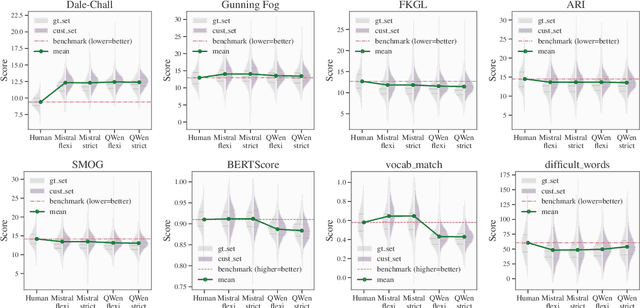
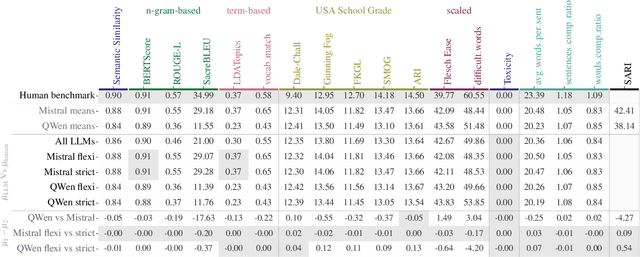
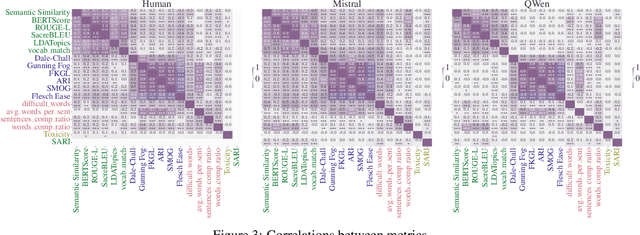
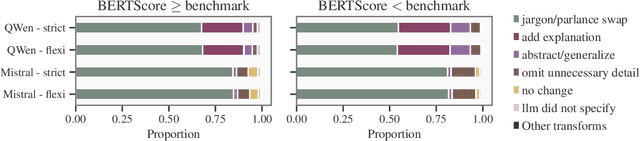
The increasing health-seeking behavior and digital consumption of biomedical information by the general public necessitate scalable solutions for automatically adapting complex scientific and technical documents into plain language. Automatic text simplification solutions, including advanced large language models, however, continue to face challenges in reliably arbitrating the tension between optimizing readability performance and ensuring preservation of discourse fidelity. This report empirically assesses the performance of two major classes of general-purpose LLMs, demonstrating their linguistic capabilities and foundational readiness for the task compared to a human benchmark. Using a comparative analysis of the instruction-tuned Mistral 24B and the reasoning-augmented QWen2.5 32B, we identify a potential architectural advantage in the instruction-tuned LLM. Mistral exhibits a tempered lexical simplification strategy that enhances readability across a suite of metrics and the simplification-specific formula SARI (mean 42.46), while preserving human-level discourse with a BERTScore of 0.91. QWen also attains enhanced readability performance, but its operational strategy shows a disconnect in balancing between readability and accuracy, reaching a statistically significantly lower BERTScore of 0.89. Additionally, a comprehensive correlation analysis of 21 metrics spanning readability, discourse fidelity, content safety, and underlying distributional measures for mechanistic insights, confirms strong functional redundancies among five readability indices. This empirical evidence tracks baseline performance of the evolving LLMs for the task of text simplification, identifies the instruction-tuned Mistral 24B for simplification, provides necessary heuristics for metric selection, and points to lexical support as a primary domain-adaptation issue for simplification.
JEBS: A Fine-grained Biomedical Lexical Simplification Task
Jun 15, 2025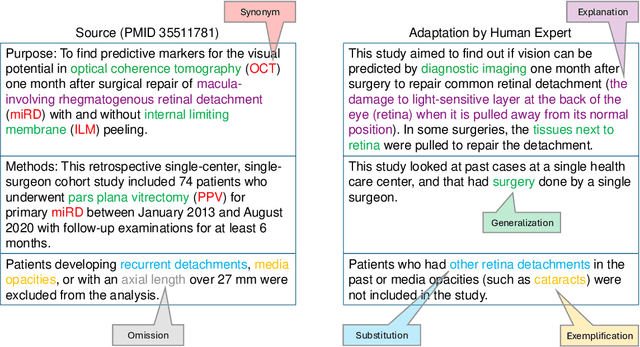
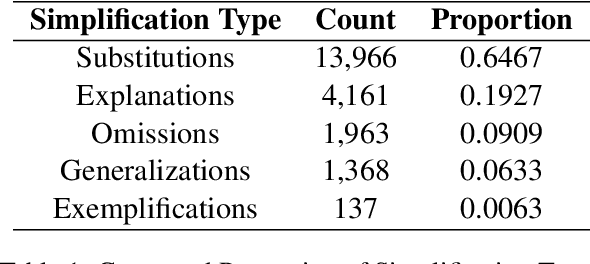
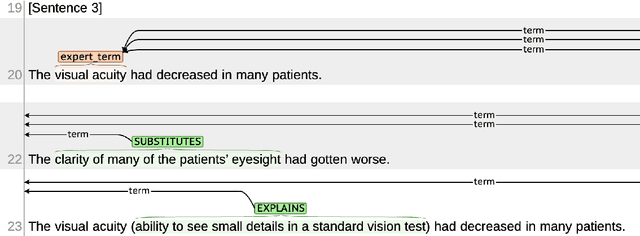
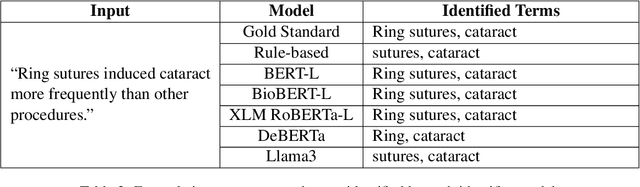
Online medical literature has made health information more available than ever, however, the barrier of complex medical jargon prevents the general public from understanding it. Though parallel and comparable corpora for Biomedical Text Simplification have been introduced, these conflate the many syntactic and lexical operations involved in simplification. To enable more targeted development and evaluation, we present a fine-grained lexical simplification task and dataset, Jargon Explanations for Biomedical Simplification (JEBS, https://github.com/bill-from-ri/JEBS-data ). The JEBS task involves identifying complex terms, classifying how to replace them, and generating replacement text. The JEBS dataset contains 21,595 replacements for 10,314 terms across 400 biomedical abstracts and their manually simplified versions. Additionally, we provide baseline results for a variety of rule-based and transformer-based systems for the three sub-tasks. The JEBS task, data, and baseline results pave the way for development and rigorous evaluation of systems for replacing or explaining complex biomedical terms.
New Evaluation Paradigm for Lexical Simplification
Jan 25, 2025Lexical Simplification (LS) methods use a three-step pipeline: complex word identification, substitute generation, and substitute ranking, each with separate evaluation datasets. We found large language models (LLMs) can simplify sentences directly with a single prompt, bypassing the traditional pipeline. However, existing LS datasets are not suitable for evaluating these LLM-generated simplified sentences, as they focus on providing substitutes for single complex words without identifying all complex words in a sentence. To address this gap, we propose a new annotation method for constructing an all-in-one LS dataset through human-machine collaboration. Automated methods generate a pool of potential substitutes, which human annotators then assess, suggesting additional alternatives as needed. Additionally, we explore LLM-based methods with single prompts, in-context learning, and chain-of-thought techniques. We introduce a multi-LLMs collaboration approach to simulate each step of the LS task. Experimental results demonstrate that LS based on multi-LLMs approaches significantly outperforms existing baselines.
Redefining Simplicity: Benchmarking Large Language Models from Lexical to Document Simplification
Feb 12, 2025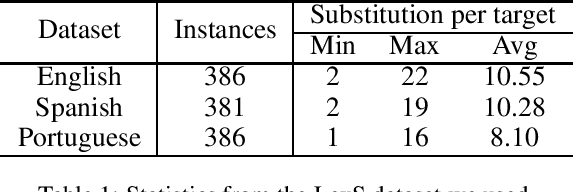
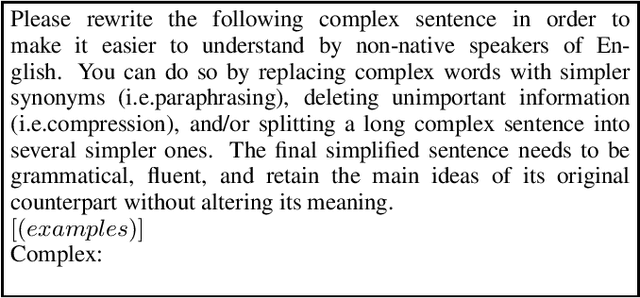
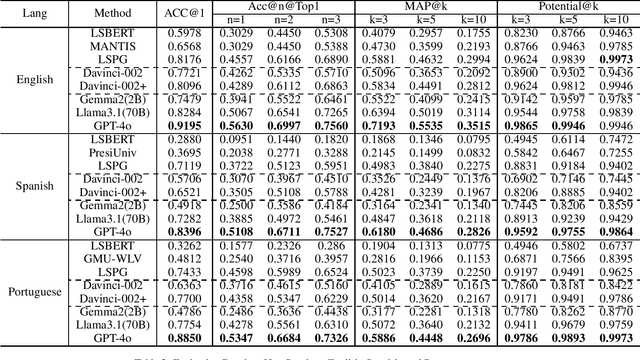
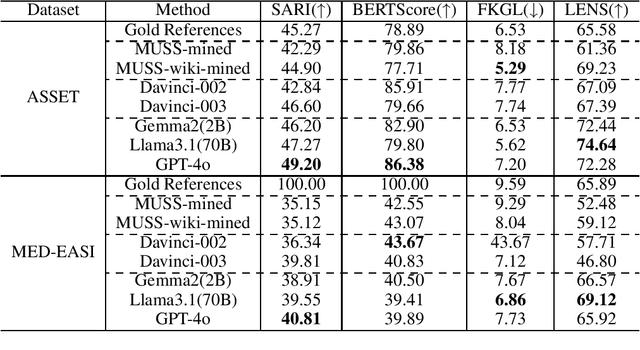
Text simplification (TS) refers to the process of reducing the complexity of a text while retaining its original meaning and key information. Existing work only shows that large language models (LLMs) have outperformed supervised non-LLM-based methods on sentence simplification. This study offers the first comprehensive analysis of LLM performance across four TS tasks: lexical, syntactic, sentence, and document simplification. We compare lightweight, closed-source and open-source LLMs against traditional non-LLM methods using automatic metrics and human evaluations. Our experiments reveal that LLMs not only outperform non-LLM approaches in all four tasks but also often generate outputs that exceed the quality of existing human-annotated references. Finally, we present some future directions of TS in the era of LLMs.
Progressive Document-level Text Simplification via Large Language Models
Jan 07, 2025


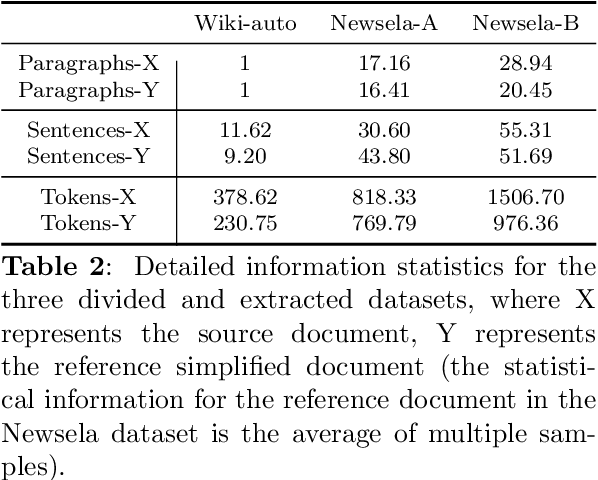
Research on text simplification has primarily focused on lexical and sentence-level changes. Long document-level simplification (DS) is still relatively unexplored. Large Language Models (LLMs), like ChatGPT, have excelled in many natural language processing tasks. However, their performance on DS tasks is unsatisfactory, as they often treat DS as merely document summarization. For the DS task, the generated long sequences not only must maintain consistency with the original document throughout, but complete moderate simplification operations encompassing discourses, sentences, and word-level simplifications. Human editors employ a hierarchical complexity simplification strategy to simplify documents. This study delves into simulating this strategy through the utilization of a multi-stage collaboration using LLMs. We propose a progressive simplification method (ProgDS) by hierarchically decomposing the task, including the discourse-level, topic-level, and lexical-level simplification. Experimental results demonstrate that ProgDS significantly outperforms existing smaller models or direct prompting with LLMs, advancing the state-of-the-art in the document simplification task.
Investigating Large Language Models for Complex Word Identification in Multilingual and Multidomain Setups
Nov 03, 2024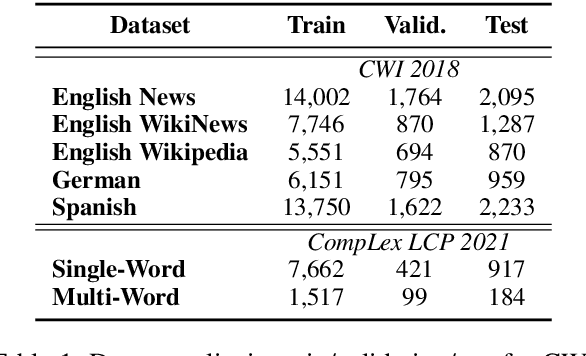
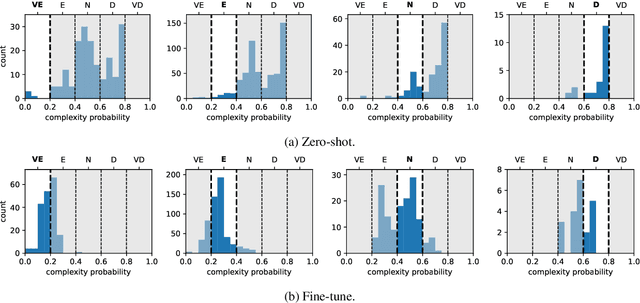
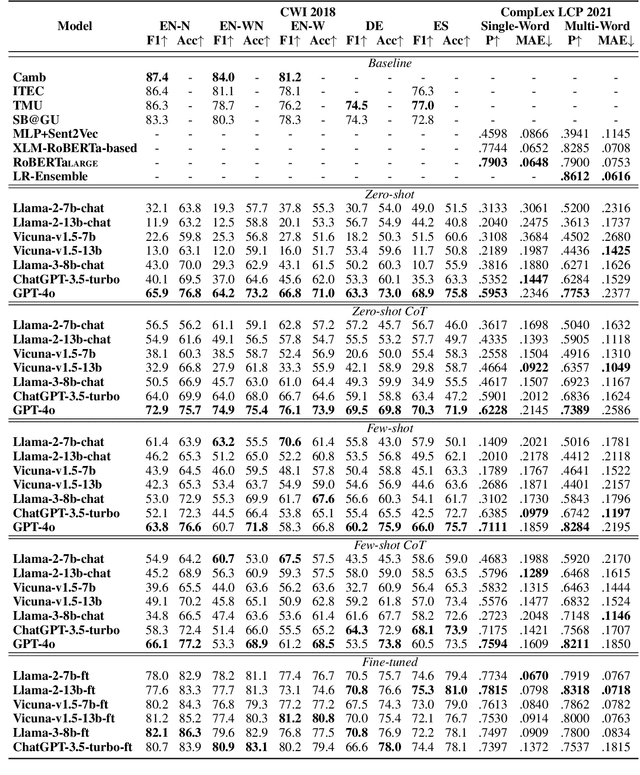
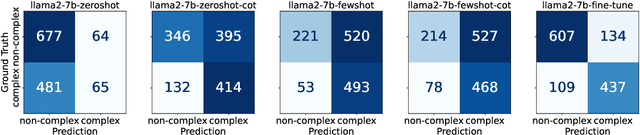
Complex Word Identification (CWI) is an essential step in the lexical simplification task and has recently become a task on its own. Some variations of this binary classification task have emerged, such as lexical complexity prediction (LCP) and complexity evaluation of multi-word expressions (MWE). Large language models (LLMs) recently became popular in the Natural Language Processing community because of their versatility and capability to solve unseen tasks in zero/few-shot settings. Our work investigates LLM usage, specifically open-source models such as Llama 2, Llama 3, and Vicuna v1.5, and closed-source, such as ChatGPT-3.5-turbo and GPT-4o, in the CWI, LCP, and MWE settings. We evaluate zero-shot, few-shot, and fine-tuning settings and show that LLMs struggle in certain conditions or achieve comparable results against existing methods. In addition, we provide some views on meta-learning combined with prompt learning. In the end, we conclude that the current state of LLMs cannot or barely outperform existing methods, which are usually much smaller.