 Add to Chrome
 Add to Firefox
 Add to Edge
Handwritten Ocr
Papers and Code
Evaluating OCR Performance for Assistive Technology: Effects of Walking Speed, Camera Placement, and Camera Type
Feb 02, 2026
Optical character recognition (OCR), which converts printed or handwritten text into machine-readable form, is widely used in assistive technology for people with blindness and low vision. Yet, most evaluations rely on static datasets that do not reflect the challenges of mobile use. In this study, we systematically evaluated OCR performance under both static and dynamic conditions. Static tests measured detection range across distances of 1-7 meters and viewing angles of 0-75 degrees horizontally. Dynamic tests examined the impact of motion by varying walking speed from slow (0.8 m/s) to very fast (1.8 m/s) and comparing three camera mounting positions: head-mounted, shoulder-mounted, and hand-held. We evaluated both a smartphone and smart glasses, using the phone's main and ultra-wide cameras. Four OCR engines were benchmarked to assess accuracy at different distances and viewing angles: Google Vision, PaddleOCR 3.0, EasyOCR, and Tesseract. PaddleOCR 3.0 was then used to evaluate accuracy at different walking speeds. Accuracy was computed at the character level using the Levenshtein ratio against manually defined ground truth. Results showed that recognition accuracy declined with increased walking speed and wider viewing angles. Google Vision achieved the highest overall accuracy, with PaddleOCR close behind as the strongest open-source alternative. Across devices, the phone's main camera achieved the highest accuracy, and a shoulder-mounted placement yielded the highest average among body positions; however, differences among shoulder, head, and hand were not statistically significant.

Typhoon OCR: Open Vision-Language Model For Thai Document Extraction
Jan 21, 2026Document extraction is a core component of digital workflows, yet existing vision-language models (VLMs) predominantly favor high-resource languages. Thai presents additional challenges due to script complexity from non-latin letters, the absence of explicit word boundaries, and the prevalence of highly unstructured real-world documents, limiting the effectiveness of current open-source models. This paper presents Typhoon OCR, an open VLM for document extraction tailored for Thai and English. The model is fine-tuned from vision-language backbones using a Thai-focused training dataset. The dataset is developed using a multi-stage data construction pipeline that combines traditional OCR, VLM-based restructuring, and curated synthetic data. Typhoon OCR is a unified framework capable of text transcription, layout reconstruction, and document-level structural consistency. The latest iteration of our model, Typhoon OCR V1.5, is a compact and inference-efficient model designed to reduce reliance on metadata and simplify deployment. Comprehensive evaluations across diverse Thai document categories, including financial reports, government forms, books, infographics, and handwritten documents, show that Typhoon OCR achieves performance comparable to or exceeding larger frontier proprietary models, despite substantially lower computational cost. The results demonstrate that open vision-language OCR models can achieve accurate text extraction and layout reconstruction for Thai documents, reaching performance comparable to proprietary systems while remaining lightweight and deployable.
synthocr-gen: A synthetic ocr dataset generator for low-resource languages- breaking the data barrier
Jan 22, 2026Optical Character Recognition (OCR) for low-resource languages remains a significant challenge due to the scarcity of large-scale annotated training datasets. Languages such as Kashmiri, with approximately 7 million speakers and a complex Perso-Arabic script featuring unique diacritical marks, currently lack support in major OCR systems including Tesseract, TrOCR, and PaddleOCR. Manual dataset creation for such languages is prohibitively expensive, time-consuming, and error-prone, often requiring word by word transcription of printed or handwritten text. We present SynthOCR-Gen, an open-source synthetic OCR dataset generator specifically designed for low-resource languages. Our tool addresses the fundamental bottleneck in OCR development by transforming digital Unicode text corpora into ready-to-use training datasets. The system implements a comprehensive pipeline encompassing text segmentation (character, word, n-gram, sentence, and line levels), Unicode normalization with script purity enforcement, multi-font rendering with configurable distribution, and 25+ data augmentation techniques simulating real-world document degradations including rotation, blur, noise, and scanner artifacts. We demonstrate the efficacy of our approach by generating a 600,000-sample word-segmented Kashmiri OCR dataset, which we release publicly on HuggingFace. This work provides a practical pathway for bringing low-resource languages into the era of vision-language AI models, and the tool is openly available for researchers and practitioners working with underserved writing systems worldwide.
FP-THD: Full page transcription of historical documents
Jan 20, 2026The transcription of historical documents written in Latin in XV and XVI centuries has special challenges as it must maintain the characters and special symbols that have distinct meanings to ensure that historical texts retain their original style and significance. This work proposes a pipeline for the transcription of historical documents preserving these special features. We propose to extend an existing text line recognition method with a layout analysis model. We analyze historical text images using a layout analysis model to extract text lines, which are then processed by an OCR model to generate a fully digitized page. We showed that our pipeline facilitates the processing of the page and produces an efficient result. We evaluated our approach on multiple datasets and demonstrate that the masked autoencoder effectively processes different types of text, including handwritten, printed and multi-language.
A Hybrid Architecture for Multi-Stage Claim Document Understanding: Combining Vision-Language Models and Machine Learning for Real-Time Processing
Jan 05, 2026Claims documents are fundamental to healthcare and insurance operations, serving as the basis for reimbursement, auditing, and compliance. However, these documents are typically not born digital; they often exist as scanned PDFs or photographs captured under uncontrolled conditions. Consequently, they exhibit significant content heterogeneity, ranging from typed invoices to handwritten medical reports, as well as linguistic diversity. This challenge is exemplified by operations at Fullerton Health, which handles tens of millions of claims annually across nine markets, including Singapore, the Philippines, Indonesia, Malaysia, Mainland China, Hong Kong, Vietnam, Papua New Guinea, and Cambodia. Such variability, coupled with inconsistent image quality and diverse layouts, poses a significant obstacle to automated parsing and structured information extraction. This paper presents a robust multi-stage pipeline that integrates the multilingual optical character recognition (OCR) engine PaddleOCR, a traditional Logistic Regression classifier, and a compact Vision-Language Model (VLM), Qwen 2.5-VL-7B, to achieve efficient and accurate field extraction from large-scale claims data. The proposed system achieves a document-type classification accuracy of over 95 percent and a field-level extraction accuracy of approximately 87 percent, while maintaining an average processing latency of under 2 seconds per document. Compared to manual processing, which typically requires around 10 minutes per claim, our system delivers a 300x improvement in efficiency. These results demonstrate that combining traditional machine learning models with modern VLMs enables production-grade accuracy and speed for real-world automation. The solution has been successfully deployed in our mobile application and is currently processing tens of thousands of claims weekly from Vietnam and Singapore.
Seeing Justice Clearly: Handwritten Legal Document Translation with OCR and Vision-Language Models
Dec 19, 2025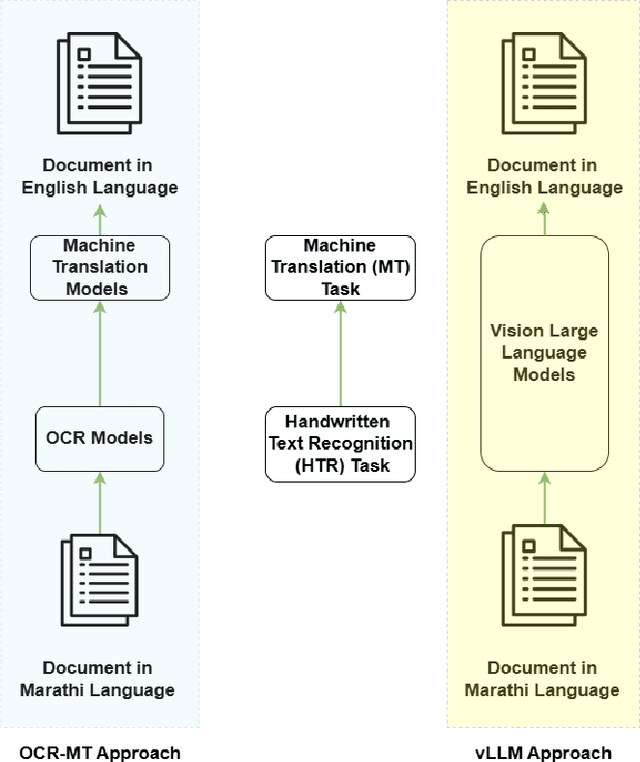
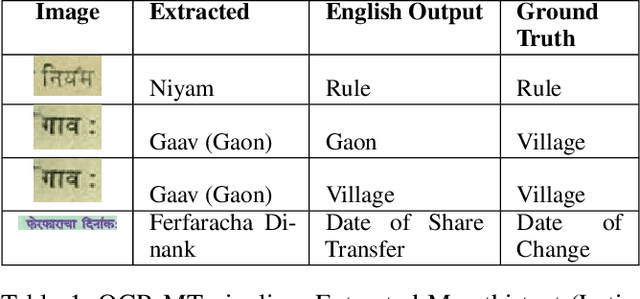
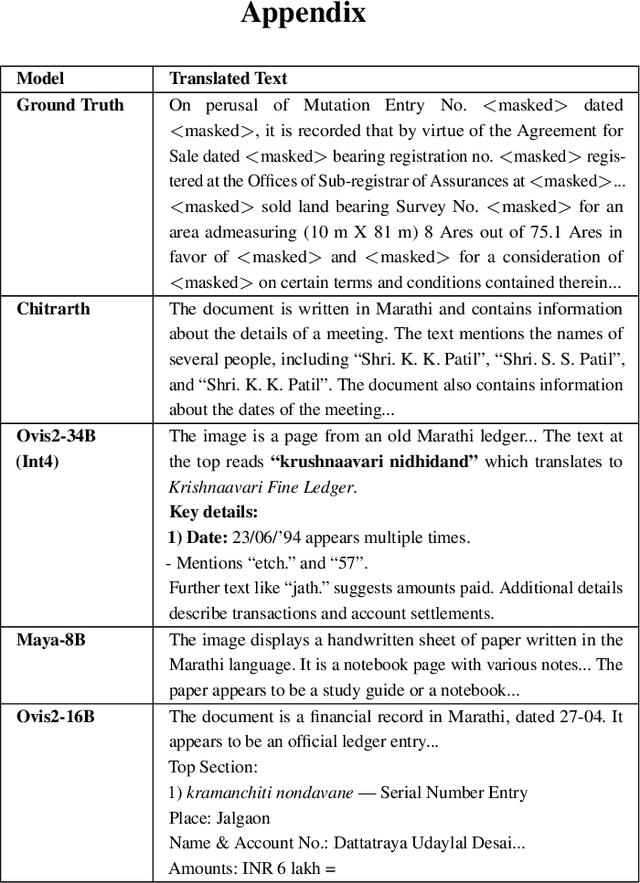
Handwritten text recognition (HTR) and machine translation continue to pose significant challenges, particularly for low-resource languages like Marathi, which lack large digitized corpora and exhibit high variability in handwriting styles. The conventional approach to address this involves a two-stage pipeline: an OCR system extracts text from handwritten images, which is then translated into the target language using a machine translation model. In this work, we explore and compare the performance of traditional OCR-MT pipelines with Vision Large Language Models that aim to unify these stages and directly translate handwritten text images in a single, end-to-end step. Our motivation is grounded in the urgent need for scalable, accurate translation systems to digitize legal records such as FIRs, charge sheets, and witness statements in India's district and high courts. We evaluate both approaches on a curated dataset of handwritten Marathi legal documents, with the goal of enabling efficient legal document processing, even in low-resource environments. Our findings offer actionable insights toward building robust, edge-deployable solutions that enhance access to legal information for non-native speakers and legal professionals alike.
Finetuning Vision-Language Models as OCR Systems for Low-Resource Languages: A Case Study of Manchu
Jul 09, 2025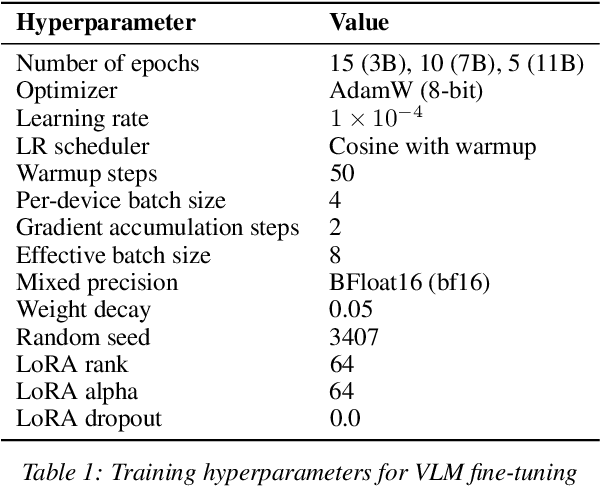
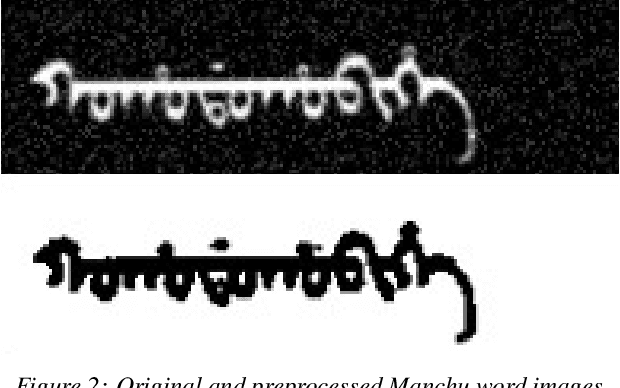

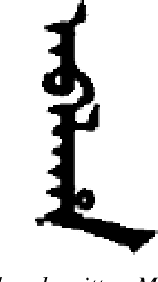
Manchu, a critically endangered language essential for understanding early modern Eastern Eurasian history, lacks effective OCR systems that can handle real-world historical documents. This study develops high-performing OCR systems by fine-tuning three open-source vision-language models (LLaMA-3.2-11B, Qwen2.5-VL-7B, Qwen2.5-VL-3B) on 60,000 synthetic Manchu word images using parameter-efficient training. LLaMA-3.2-11B achieved exceptional performance with 98.3\% word accuracy and 0.0024 character error rate on synthetic data, while crucially maintaining 93.1\% accuracy on real-world handwritten documents. Comparative evaluation reveals substantial advantages over traditional approaches: while a CRNN baseline achieved 99.8\% synthetic accuracy, it suffered severe degradation to 72.5\% on real documents. Our approach demonstrates effective synthetic-to-real domain transfer, providing a cost-effective solution deployable on accessible infrastructure. This work establishes a transferable framework for endangered language OCR that removes technical and financial barriers in digital humanities, enabling historians and linguists to process historical archives without specialized computing resources. Code and model weights are available at https://github.com/mic7ch1/ManchuAI-OCR.
Uni-MuMER: Unified Multi-Task Fine-Tuning of Vision-Language Model for Handwritten Mathematical Expression Recognition
May 29, 2025Handwritten Mathematical Expression Recognition (HMER) remains a persistent challenge in Optical Character Recognition (OCR) due to the inherent freedom of symbol layout and variability in handwriting styles. Prior methods have faced performance bottlenecks, proposing isolated architectural modifications that are difficult to integrate coherently into a unified framework. Meanwhile, recent advances in pretrained vision-language models (VLMs) have demonstrated strong cross-task generalization, offering a promising foundation for developing unified solutions. In this paper, we introduce Uni-MuMER, which fully fine-tunes a VLM for the HMER task without modifying its architecture, effectively injecting domain-specific knowledge into a generalist framework. Our method integrates three data-driven tasks: Tree-Aware Chain-of-Thought (Tree-CoT) for structured spatial reasoning, Error-Driven Learning (EDL) for reducing confusion among visually similar characters, and Symbol Counting (SC) for improving recognition consistency in long expressions. Experiments on the CROHME and HME100K datasets show that Uni-MuMER achieves new state-of-the-art performance, surpassing the best lightweight specialized model SSAN by 16.31% and the top-performing VLM Gemini2.5-flash by 24.42% in the zero-shot setting. Our datasets, models, and code are open-sourced at: https://github.com/BFlameSwift/Uni-MuMER
MegaHan97K: A Large-Scale Dataset for Mega-Category Chinese Character Recognition with over 97K Categories
Jun 05, 2025Foundational to the Chinese language and culture, Chinese characters encompass extraordinarily extensive and ever-expanding categories, with the latest Chinese GB18030-2022 standard containing 87,887 categories. The accurate recognition of this vast number of characters, termed mega-category recognition, presents a formidable yet crucial challenge for cultural heritage preservation and digital applications. Despite significant advances in Optical Character Recognition (OCR), mega-category recognition remains unexplored due to the absence of comprehensive datasets, with the largest existing dataset containing merely 16,151 categories. To bridge this critical gap, we introduce MegaHan97K, a mega-category, large-scale dataset covering an unprecedented 97,455 categories of Chinese characters. Our work offers three major contributions: (1) MegaHan97K is the first dataset to fully support the latest GB18030-2022 standard, providing at least six times more categories than existing datasets; (2) It effectively addresses the long-tail distribution problem by providing balanced samples across all categories through its three distinct subsets: handwritten, historical and synthetic subsets; (3) Comprehensive benchmarking experiments reveal new challenges in mega-category scenarios, including increased storage demands, morphologically similar character recognition, and zero-shot learning difficulties, while also unlocking substantial opportunities for future research. To the best of our knowledge, the MetaHan97K is likely the dataset with the largest classes not only in the field of OCR but may also in the broader domain of pattern recognition. The dataset is available at https://github.com/SCUT-DLVCLab/MegaHan97K.
Use of Metric Learning for the Recognition of Handwritten Digits, and its Application to Increase the Outreach of Voice-based Communication Platforms
Apr 26, 2025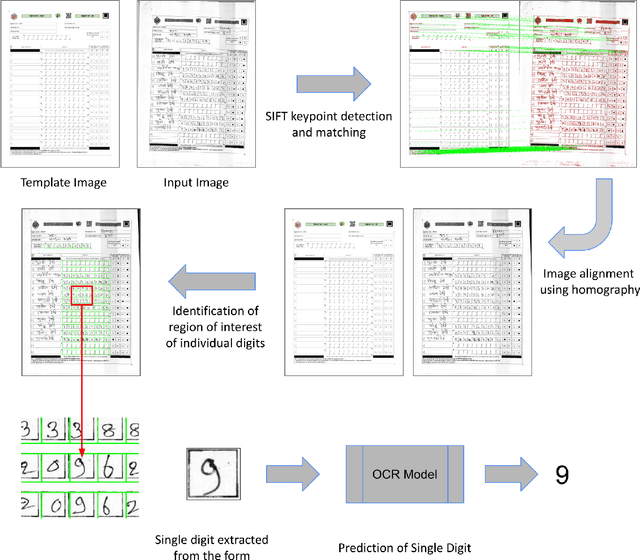
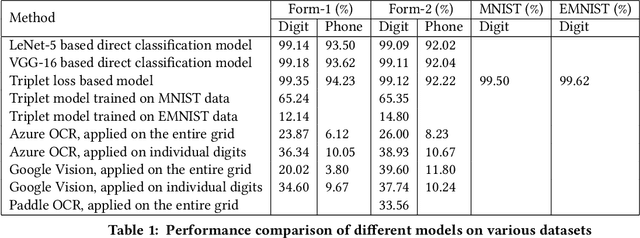
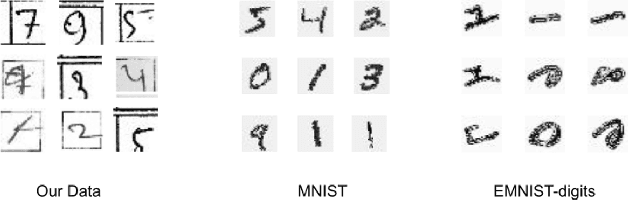
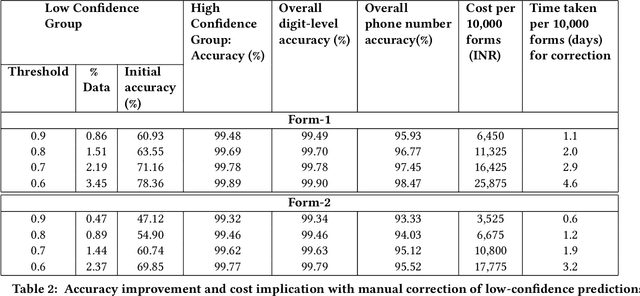
Initiation, monitoring, and evaluation of development programmes can involve field-based data collection about project activities. This data collection through digital devices may not always be feasible though, for reasons such as unaffordability of smartphones and tablets by field-based cadre, or shortfalls in their training and capacity building. Paper-based data collection has been argued to be more appropriate in several contexts, with automated digitization of the paper forms through OCR (Optical Character Recognition) and OMR (Optical Mark Recognition) techniques. We contribute with providing a large dataset of handwritten digits, and deep learning based models and methods built using this data, that are effective in real-world environments. We demonstrate the deployment of these tools in the context of a maternal and child health and nutrition awareness project, which uses IVR (Interactive Voice Response) systems to provide awareness information to rural women SHG (Self Help Group) members in north India. Paper forms were used to collect phone numbers of the SHG members at scale, which were digitized using the OCR tools developed by us, and used to push almost 4 million phone calls. The data, model, and code have been released in the open-source domain.
* 10 Pages, 7 Figures, ACM COMPASS 2022