 Add to Chrome
 Add to Firefox
 Add to Edge
Few-shot Text Classification
Papers and Code
Revisiting Prompt Sensitivity in Large Language Models for Text Classification: The Role of Prompt Underspecification
Feb 04, 2026
Large language models (LLMs) are widely used as zero-shot and few-shot classifiers, where task behaviour is largely controlled through prompting. A growing number of works have observed that LLMs are sensitive to prompt variations, with small changes leading to large changes in performance. However, in many cases, the investigation of sensitivity is performed using underspecified prompts that provide minimal task instructions and weakly constrain the model's output space. In this work, we argue that a significant portion of the observed prompt sensitivity can be attributed to prompt underspecification. We systematically study and compare the sensitivity of underspecified prompts and prompts that provide specific instructions. Utilising performance analysis, logit analysis, and linear probing, we find that underspecified prompts exhibit higher performance variance and lower logit values for relevant tokens, while instruction-prompts suffer less from such problems. However, linear probing analysis suggests that the effects of prompt underspecification have only a marginal impact on the internal LLM representations, instead emerging in the final layers. Overall, our findings highlight the need for more rigour when investigating and mitigating prompt sensitivity.

GFlowPO: Generative Flow Network as a Language Model Prompt Optimizer
Feb 03, 2026Finding effective prompts for language models (LMs) is critical yet notoriously difficult: the prompt space is combinatorially large, rewards are sparse due to expensive target-LM evaluation. Yet, existing RL-based prompt optimizers often rely on on-policy updates and a meta-prompt sampled from a fixed distribution, leading to poor sample efficiency. We propose GFlowPO, a probabilistic prompt optimization framework that casts prompt search as a posterior inference problem over latent prompts regularized by a meta-prompted reference-LM prior. In the first step, we fine-tune a lightweight prompt-LM with an off-policy Generative Flow Network (GFlowNet) objective, using a replay-based training policy that reuses past prompt evaluations to enable sample-efficient exploration. In the second step, we introduce Dynamic Memory Update (DMU), a training-free mechanism that updates the meta-prompt by injecting both (i) diverse prompts from a replay buffer and (ii) top-performing prompts from a small priority queue, thereby progressively concentrating the search process on high-reward regions. Across few-shot text classification, instruction induction benchmarks, and question answering tasks, GFlowPO consistently outperforms recent discrete prompt optimization baselines.
MultiModal Fine-tuning with Synthetic Captions
Jan 29, 2026In this paper, we address a fundamental gap between pre-training and fine-tuning of deep neural networks: while pre-training has shifted from unimodal to multimodal learning with enhanced visual understanding, fine-tuning predominantly remains unimodal, limiting the benefits of rich pre-trained representations. To bridge this gap, we propose a novel approach that transforms unimodal datasets into multimodal ones using Multimodal Large Language Models (MLLMs) to generate synthetic image captions for fine-tuning models with a multimodal objective. Our method employs carefully designed prompts incorporating class labels and domain context to produce high-quality captions tailored for classification tasks. Furthermore, we introduce a supervised contrastive loss function that explicitly encourages clustering of same-class representations during fine-tuning, along with a new inference technique that leverages class-averaged text embeddings from multiple synthetic captions per image. Extensive experiments across 13 image classification benchmarks demonstrate that our approach outperforms baseline methods, with particularly significant improvements in few-shot learning scenarios. Our work establishes a new paradigm for dataset enhancement that effectively bridges the gap between multimodal pre-training and fine-tuning. Our code is available at https://github.com/s-enmt/MMFT.
Curate-Train-Refine: A Closed-Loop Agentic Framework for Zero Shot Classification
Jan 23, 2026Large language models (LLMs) and high-capacity encoders have advanced zero and few-shot classification, but their inference cost and latency limit practical deployment. We propose training lightweight text classifiers using dynamically generated supervision from an LLM. Our method employs an iterative, agentic loop in which the LLM curates training data, analyzes model successes and failures, and synthesizes targeted examples to address observed errors. This closed-loop generation and evaluation process progressively improves data quality and adapts it to the downstream classifier and task. Across four widely used benchmarks, our approach consistently outperforms standard zero and few-shot baselines. These results indicate that LLMs can serve effectively as data curators, enabling accurate and efficient classification without the operational cost of large-model deployment.
Analyzing VLM-Based Approaches for Anomaly Classification and Segmentation
Jan 19, 2026Vision-Language Models (VLMs), particularly CLIP, have revolutionized anomaly detection by enabling zero-shot and few-shot defect identification without extensive labeled datasets. By learning aligned representations of images and text, VLMs facilitate anomaly classification and segmentation through natural language descriptions of normal and abnormal states, eliminating traditional requirements for task-specific training or defect examples. This project presents a comprehensive analysis of VLM-based approaches for anomaly classification (AC) and anomaly segmentation (AS). We systematically investigate key architectural paradigms including sliding window-based dense feature extraction (WinCLIP), multi-stage feature alignment with learnable projections (AprilLab framework), and compositional prompt ensemble strategies. Our analysis evaluates these methods across critical dimensions: feature extraction mechanisms, text-visual alignment strategies, prompt engineering techniques, zero-shot versus few-shot trade-offs, computational efficiency, and cross-domain generalization. Through rigorous experimentation on benchmarks such as MVTec AD and VisA, we compare classification accuracy, segmentation precision, and inference efficiency. The primary contribution is a foundational understanding of how and why VLMs succeed in anomaly detection, synthesizing practical insights for method selection and identifying current limitations. This work aims to facilitate informed adoption of VLM-based methods in industrial quality control and guide future research directions.
Profiling German Text Simplification with Interpretable Model-Fingerprints
Jan 19, 2026While Large Language Models (LLMs) produce highly nuanced text simplifications, developers currently lack tools for a holistic, efficient, and reproducible diagnosis of their behavior. This paper introduces the Simplification Profiler, a diagnostic toolkit that generates a multidimensional, interpretable fingerprint of simplified texts. Multiple aggregated simplifications of a model result in a model's fingerprint. This novel evaluation paradigm is particularly vital for languages, where the data scarcity problem is magnified when creating flexible models for diverse target groups rather than a single, fixed simplification style. We propose that measuring a model's unique behavioral signature is more relevant in this context as an alternative to correlating metrics with human preferences. We operationalize this with a practical meta-evaluation of our fingerprints' descriptive power, which bypasses the need for large, human-rated datasets. This test measures if a simple linear classifier can reliably identify various model configurations by their created simplifications, confirming that our metrics are sensitive to a model's specific characteristics. The Profiler can distinguish high-level behavioral variations between prompting strategies and fine-grained changes from prompt engineering, including few-shot examples. Our complete feature set achieves classification F1-scores up to 71.9 %, improving upon simple baselines by over 48 percentage points. The Simplification Profiler thus offers developers a granular, actionable analysis to build more effective and truly adaptive text simplification systems.
LiteEmbed: Adapting CLIP to Rare Classes
Jan 14, 2026Large-scale vision-language models such as CLIP achieve strong zero-shot recognition but struggle with classes that are rarely seen during pretraining, including newly emerging entities and culturally specific categories. We introduce LiteEmbed, a lightweight framework for few-shot personalization of CLIP that enables new classes to be added without retraining its encoders. LiteEmbed performs subspace-guided optimization of text embeddings within CLIP's vocabulary, leveraging a PCA-based decomposition that disentangles coarse semantic directions from fine-grained variations. Two complementary objectives, coarse alignment and fine separation, jointly preserve global semantic consistency while enhancing discriminability among visually similar classes. Once optimized, the embeddings are plug-and-play, seamlessly substituting CLIP's original text features across classification, retrieval, segmentation, and detection tasks. Extensive experiments demonstrate substantial gains over prior methods, establishing LiteEmbed as an effective approach for adapting CLIP to underrepresented, rare, or unseen classes.
Left, Right, or Center? Evaluating LLM Framing in News Classification and Generation
Jan 09, 2026Large Language Model (LLM) based summarization and text generation are increasingly used for producing and rewriting text, raising concerns about political framing in journalism where subtle wording choices can shape interpretation. Across nine state-of-the-art LLMs, we study political framing by testing whether LLMs' classification-based bias signals align with framing behavior in their generated summaries. We first compare few-shot ideology predictions against LEFT/CENTER/RIGHT labels. We then generate "steered" summaries under FAITHFUL, CENTRIST, LEFT, and RIGHT prompts, and score all outputs using a single fixed ideology evaluator. We find pervasive ideological center-collapse in both article-level ratings and generated text, indicating a systematic tendency toward centrist framing. Among evaluated models, Grok 4 is by far the most ideologically expressive generator, while Claude Sonnet 4.5 and Llama 3.1 achieve the strongest bias-rating performance among commercial and open-weight models, respectively.
Why Text Prevails: Vision May Undermine Multimodal Medical Decision Making
Dec 15, 2025With the rapid progress of large language models (LLMs), advanced multimodal large language models (MLLMs) have demonstrated impressive zero-shot capabilities on vision-language tasks. In the biomedical domain, however, even state-of-the-art MLLMs struggle with basic Medical Decision Making (MDM) tasks. We investigate this limitation using two challenging datasets: (1) three-stage Alzheimer's disease (AD) classification (normal, mild cognitive impairment, dementia), where category differences are visually subtle, and (2) MIMIC-CXR chest radiograph classification with 14 non-mutually exclusive conditions. Our empirical study shows that text-only reasoning consistently outperforms vision-only or vision-text settings, with multimodal inputs often performing worse than text alone. To mitigate this, we explore three strategies: (1) in-context learning with reason-annotated exemplars, (2) vision captioning followed by text-only inference, and (3) few-shot fine-tuning of the vision tower with classification supervision. These findings reveal that current MLLMs lack grounded visual understanding and point to promising directions for improving multimodal decision making in healthcare.
Evaluating LLMs for Zeolite Synthesis Event Extraction (ZSEE): A Systematic Analysis of Prompting Strategies
Dec 17, 2025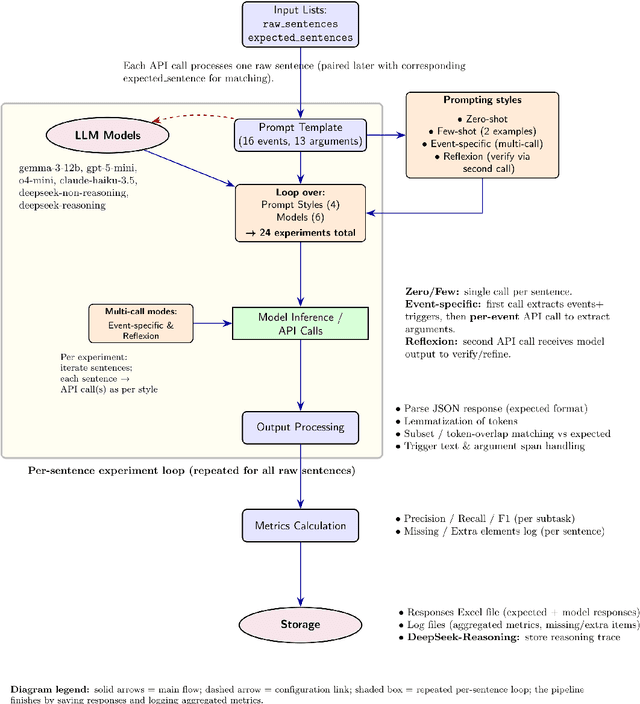
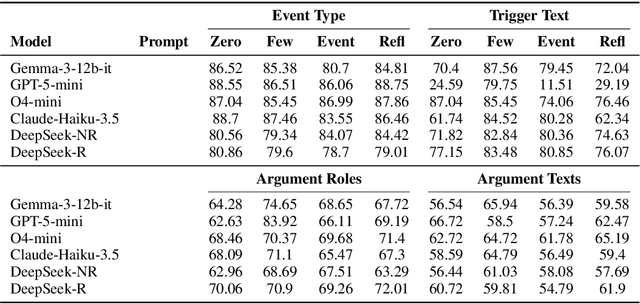
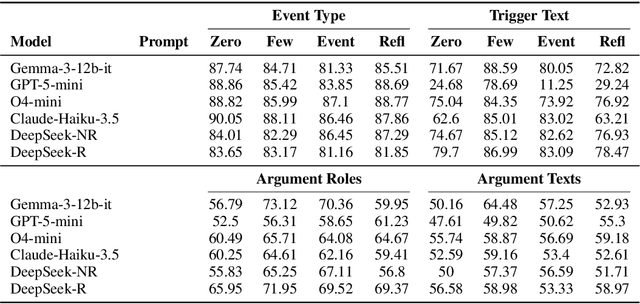
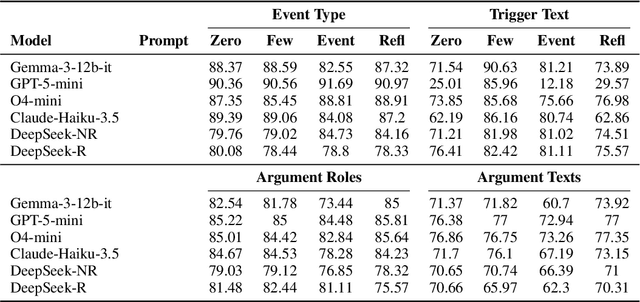
Extracting structured information from zeolite synthesis experimental procedures is critical for materials discovery, yet existing methods have not systematically evaluated Large Language Models (LLMs) for this domain-specific task. This work addresses a fundamental question: what is the efficacy of different prompting strategies when applying LLMs to scientific information extraction? We focus on four key subtasks: event type classification (identifying synthesis steps), trigger text identification (locating event mentions), argument role extraction (recognizing parameter types), and argument text extraction (extracting parameter values). We evaluate four prompting strategies - zero-shot, few-shot, event-specific, and reflection-based - across six state-of-the-art LLMs (Gemma-3-12b-it, GPT-5-mini, O4-mini, Claude-Haiku-3.5, DeepSeek reasoning and non-reasoning) using the ZSEE dataset of 1,530 annotated sentences. Results demonstrate strong performance on event type classification (80-90\% F1) but modest performance on fine-grained extraction tasks, particularly argument role and argument text extraction (50-65\% F1). GPT-5-mini exhibits extreme prompt sensitivity with 11-79\% F1 variation. Notably, advanced prompting strategies provide minimal improvements over zero-shot approaches, revealing fundamental architectural limitations. Error analysis identifies systematic hallucination, over-generalization, and inability to capture synthesis-specific nuances. Our findings demonstrate that while LLMs achieve high-level understanding, precise extraction of experimental parameters requires domain-adapted models, providing quantitative benchmarks for scientific information extraction.