 Add to Chrome
 Add to Firefox
 Add to Edge
Classification Of Variable Stars
Papers and Code
OmniSpectra: A Unified Foundation Model for Native Resolution Astronomical Spectra
Jan 21, 2026
We present OmniSpectra, the first native-resolution foundation model for astronomy spectra. Unlike traditional models, which are limited to fixed-length input sizes or configurations, OmniSpectra handles spectra of any length at their original size, without resampling or interpolation. Despite the large-scale spectroscopic data from diverse surveys fueling the rapid growth of astronomy, existing foundation models are limited to a fixed wavelength range and specific instruments. OmniSpectra is the first foundation model to learn simultaneously from multiple real-world spectra surveys with different configurations at a large scale. We achieve this by designing a novel architecture with adaptive patching across variable lengths, sinusoidal global wavelength encoding, local positional embeddings through depthwise convolution, and validity-aware self-attention masks. Allowing us to learn multi-scale spatial patterns while skipping attention for invalid patches. Even with a limited training example, OmniSpectra demonstrates excellent zero-shot generalization compared to methods tailored for specific tasks. This transfer learning capability makes this model the state-of-the-art across various astronomy tasks, including source classification, redshift estimation, and properties prediction for stars and galaxies. OmniSpectra reduces the need for training individual models for different tasks from scratch, establishing itself as the next-generation astronomy foundation model.

Exploring Spatial-Temporal Representation via Star Graph for mmWave Radar-based Human Activity Recognition
Dec 12, 2025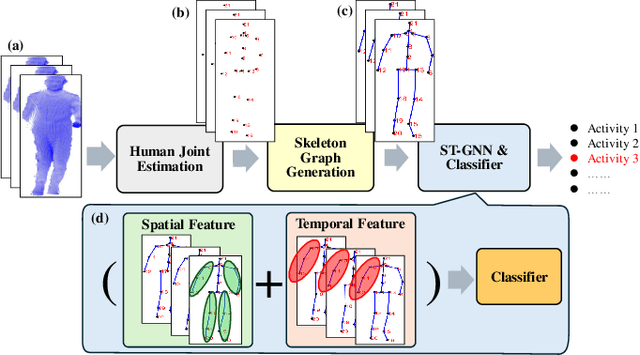
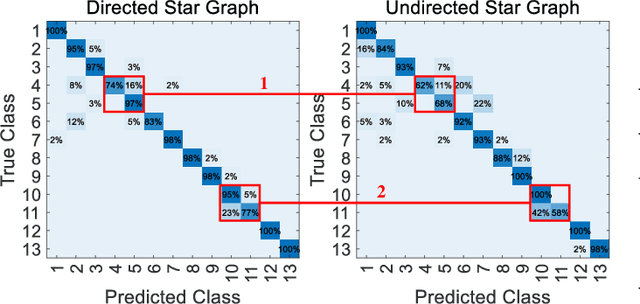
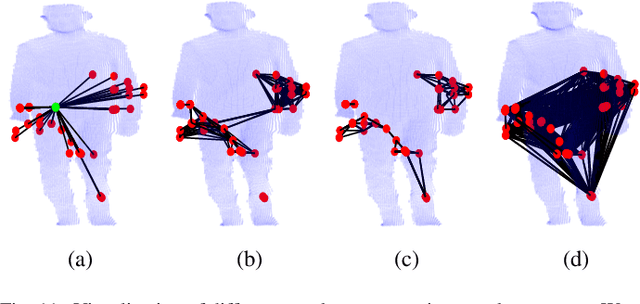
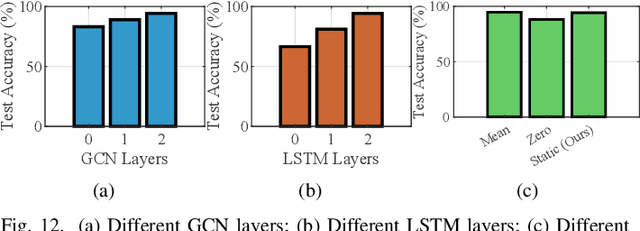
Human activity recognition (HAR) requires extracting accurate spatial-temporal features with human movements. A mmWave radar point cloud-based HAR system suffers from sparsity and variable-size problems due to the physical features of the mmWave signal. Existing works usually borrow the preprocessing algorithms for the vision-based systems with dense point clouds, which may not be optimal for mmWave radar systems. In this work, we proposed a graph representation with a discrete dynamic graph neural network (DDGNN) to explore the spatial-temporal representation of human movement-related features. Specifically, we designed a star graph to describe the high-dimensional relative relationship between a manually added static center point and the dynamic mmWave radar points in the same and consecutive frames. We then adopted DDGNN to learn the features residing in the star graph with variable sizes. Experimental results demonstrated that our approach outperformed other baseline methods using real-world HAR datasets. Our system achieved an overall classification accuracy of 94.27\%, which gets the near-optimal performance with a vision-based skeleton data accuracy of 97.25\%. We also conducted an inference test on Raspberry Pi~4 to demonstrate its effectiveness on resource-constraint platforms. \sh{ We provided a comprehensive ablation study for variable DDGNN structures to validate our model design. Our system also outperformed three recent radar-specific methods without requiring resampling or frame aggregators.
What ZTF Saw Where Rubin Looked: Anomaly Hunting in DR23
Jul 08, 2025We present results from the SNAD VIII Workshop, during which we conducted the first systematic anomaly search in the ZTF fields also observed by LSSTComCam during Rubin Scientific Pipeline commissioning. Using the PineForest active anomaly detection algorithm, we analysed four selected fields (two galactic and two extragalactic) and visually inspected 400 candidates. As a result, we discovered six previously uncatalogued variable stars, including RS~CVn, BY Draconis, ellipsoidal, and solar-type variables, and refined classifications and periods for six known objects. These results demonstrate the effectiveness of the SNAD anomaly detection pipeline and provide a preview of the discovery potential in the upcoming LSST data.
A self-regulated convolutional neural network for classifying variable stars
May 20, 2025Over the last two decades, machine learning models have been widely applied and have proven effective in classifying variable stars, particularly with the adoption of deep learning architectures such as convolutional neural networks, recurrent neural networks, and transformer models. While these models have achieved high accuracy, they require high-quality, representative data and a large number of labelled samples for each star type to generalise well, which can be challenging in time-domain surveys. This challenge often leads to models learning and reinforcing biases inherent in the training data, an issue that is not easily detectable when validation is performed on subsamples from the same catalogue. The problem of biases in variable star data has been largely overlooked, and a definitive solution has yet to be established. In this paper, we propose a new approach to improve the reliability of classifiers in variable star classification by introducing a self-regulated training process. This process utilises synthetic samples generated by a physics-enhanced latent space variational autoencoder, incorporating six physical parameters from Gaia Data Release 3. Our method features a dynamic interaction between a classifier and a generative model, where the generative model produces ad-hoc synthetic light curves to reduce confusion during classifier training and populate underrepresented regions in the physical parameter space. Experiments conducted under various scenarios demonstrate that our self-regulated training approach outperforms traditional training methods for classifying variable stars on biased datasets, showing statistically significant improvements.
Using machine learning method for variable star classification using the TESS Sectors 1-57 data
Apr 01, 2025The Transiting Exoplanet Survey Satellite (TESS) is a wide-field all-sky survey mission designed to detect Earth-sized exoplanets. After over four years photometric surveys, data from sectors 1-57, including approximately 1,050,000 light curves with a 2-minute cadence, were collected. By cross-matching the data with Gaia's variable star catalogue, we obtained labeled datasets for further analysis. Using a random forest classifier, we performed classification of variable stars and designed distinct classification processes for each subclass, 6770 EA, 2971 EW, 980 CEP, 8347 DSCT, 457 RRab, 404 RRc and 12348 ROT were identified. Each variable star was visually inspected to ensure the reliability and accuracy of the compiled catalog. Subsequently, we ultimately obtained 6046 EA, 3859 EW, 2058 CEP, 8434 DSCT, 482 RRab, 416 RRc, and 9694 ROT, and a total of 14092 new variable stars were discovered.
ORACLE: A Real-Time, Hierarchical, Deep-Learning Photometric Classifier for the LSST
Jan 02, 2025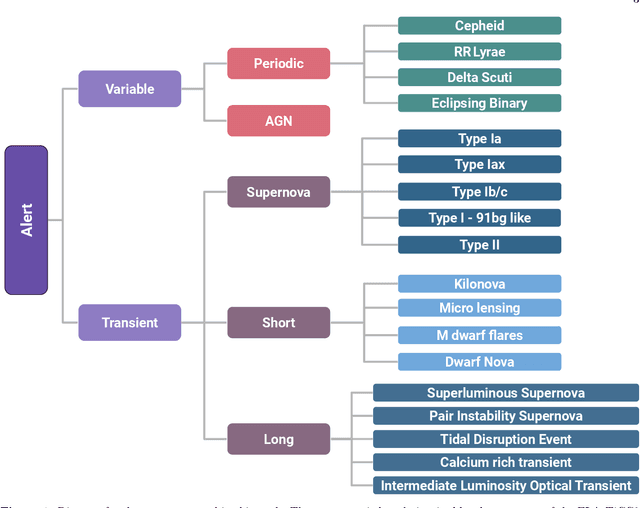
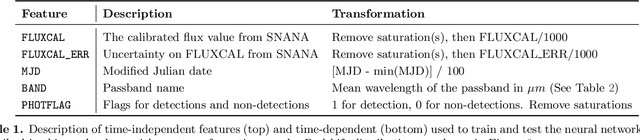
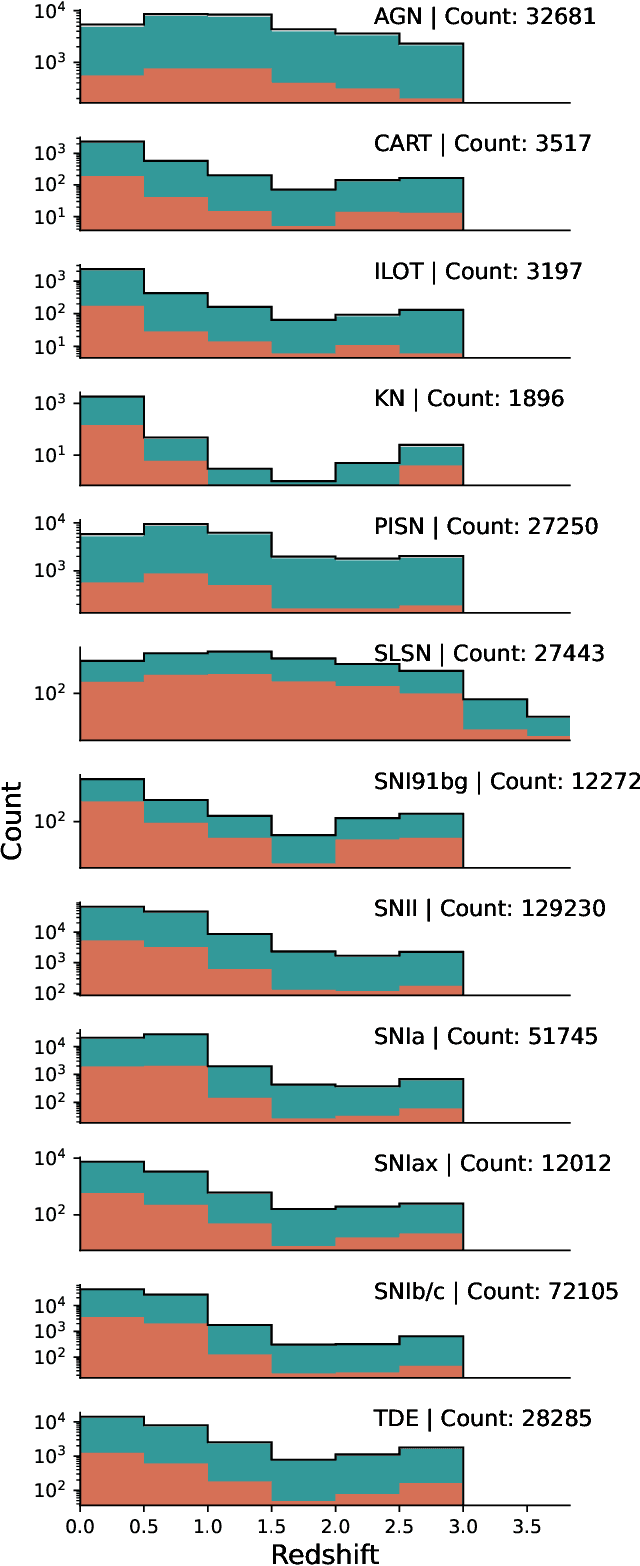
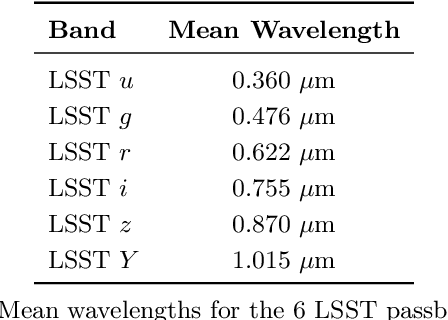
We present ORACLE, the first hierarchical deep-learning model for real-time, context-aware classification of transient and variable astrophysical phenomena. ORACLE is a recurrent neural network with Gated Recurrent Units (GRUs), and has been trained using a custom hierarchical cross-entropy loss function to provide high-confidence classifications along an observationally-driven taxonomy with as little as a single photometric observation. Contextual information for each object, including host galaxy photometric redshift, offset, ellipticity and brightness, is concatenated to the light curve embedding and used to make a final prediction. Training on $\sim$0.5M events from the Extended LSST Astronomical Time-Series Classification Challenge, we achieve a top-level (Transient vs Variable) macro-averaged precision of 0.96 using only 1 day of photometric observations after the first detection in addition to contextual information, for each event; this increases to $>$0.99 once 64 days of the light curve has been obtained, and 0.83 at 1024 days after first detection for 19-way classification (including supernova sub-types, active galactic nuclei, variable stars, microlensing events, and kilonovae). We also compare ORACLE with other state-of-the-art classifiers and report comparable performance for the 19-way classification task, in addition to delivering accurate top-level classifications much earlier. The code and model weights used in this work are publicly available at our associated GitHub repository (https://github.com/uiucsn/ELAsTiCC-Classification).
Representation Learning for Time-Domain High-Energy Astrophysics: Discovery of Extragalactic Fast X-ray Transient XRT 200515
Dec 02, 2024


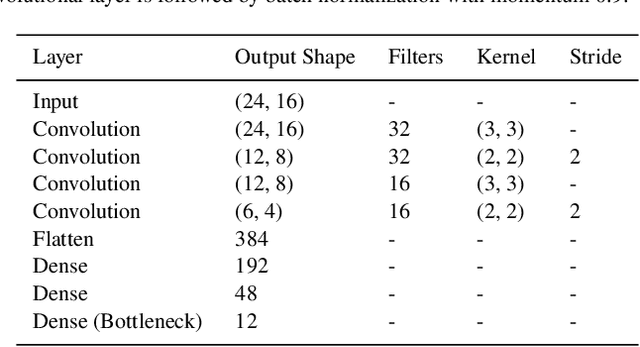
We present a novel representation learning method for downstream tasks such as anomaly detection and unsupervised transient classification in high-energy datasets. This approach enabled the discovery of a new fast X-ray transient (FXT) in the Chandra archive, XRT 200515, a needle-in-the-haystack event and the first Chandra FXT of its kind. Recent serendipitous breakthroughs in X-ray astronomy, including FXTs from binary neutron star mergers and an extragalactic planetary transit candidate, highlight the need for systematic transient searches in X-ray archives. We introduce new event file representations, E-t Maps and E-t-dt Cubes, designed to capture both temporal and spectral information, effectively addressing the challenges posed by variable-length event file time series in machine learning applications. Our pipeline extracts low-dimensional, informative features from these representations using principal component analysis or sparse autoencoders, followed by clustering in the embedding space with DBSCAN. New transients are identified within transient-dominant clusters or through nearest-neighbor searches around known transients, producing a catalog of 3,539 candidates (3,427 flares and 112 dips). XRT 200515 exhibits unique temporal and spectral variability, including an intense, hard <10 s initial burst followed by spectral softening in an ~800 s oscillating tail. We interpret XRT 200515 as either the first giant magnetar flare observed at low X-ray energies or the first extragalactic Type I X-ray burst from a faint LMXB in the LMC. Our method extends to datasets from other observatories such as XMM-Newton, Swift-XRT, eROSITA, Einstein Probe, and upcoming missions like AXIS.
Autonomous Robotic System with Optical Coherence Tomography Guidance for Vascular Anastomosis
Oct 10, 2024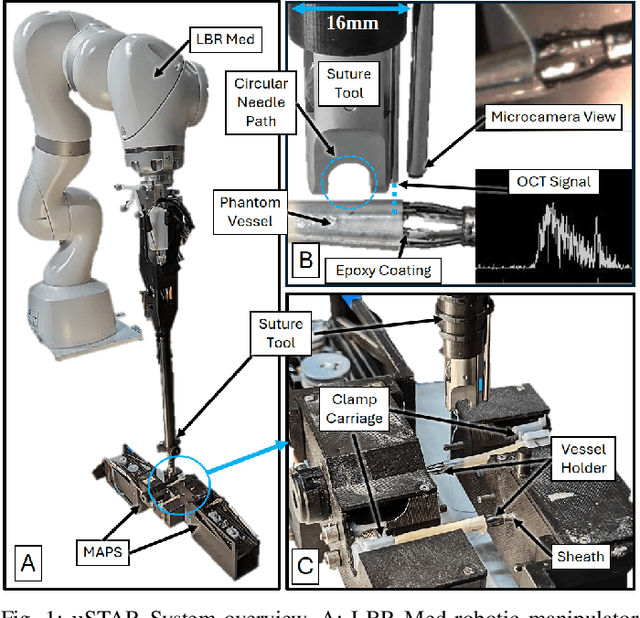
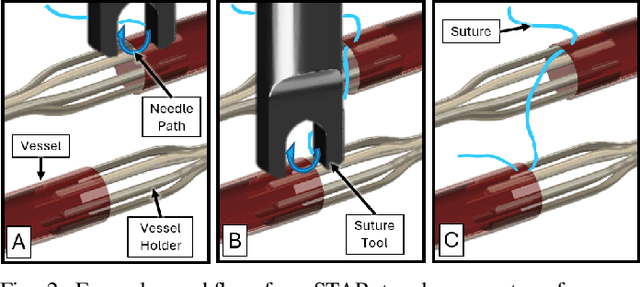
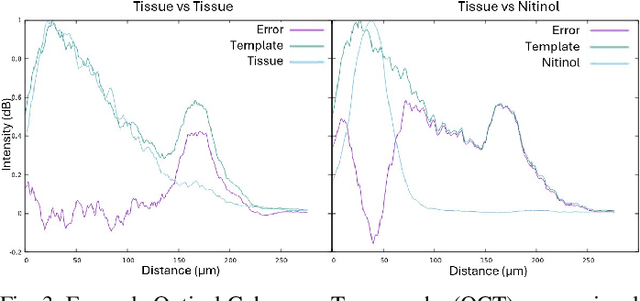
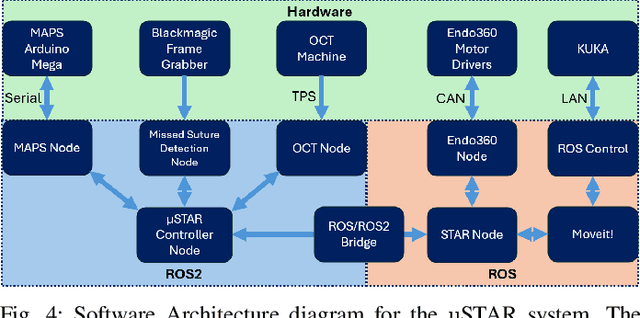
Vascular anastomosis, the surgical connection of blood vessels, is essential in procedures such as organ transplants and reconstructive surgeries. The precision required limits accessibility due to the extensive training needed, with manual suturing leading to variable outcomes and revision rates up to 7.9%. Existing robotic systems, while promising, are either fully teleoperated or lack the capabilities necessary for autonomous vascular anastomosis. We present the Micro Smart Tissue Autonomous Robot (micro-STAR), an autonomous robotic system designed to perform vascular anastomosis on small-diameter vessels. The micro-STAR system integrates a novel suturing tool equipped with Optical Coherence Tomography (OCT) fiber-optic sensor and a microcamera, enabling real-time tissue detection and classification. Our system autonomously places sutures and manipulates tissue with minimal human intervention. In an ex vivo study, micro-STAR achieved outcomes competitive with experienced surgeons in terms of leak pressure, lumen reduction, and suture placement variation, completing 90% of sutures without human intervention. This represents the first instance of a robotic system autonomously performing vascular anastomosis on real tissue, offering significant potential for improving surgical precision and expanding access to high-quality care.
Deep Learning and LLM-based Methods Applied to Stellar Lightcurve Classification
Apr 16, 2024Light curves serve as a valuable source of information on stellar formation and evolution. With the rapid advancement of machine learning techniques, it can be effectively processed to extract astronomical patterns and information. In this study, we present a comprehensive evaluation of deep-learning and large language model (LLM) based models for the automatic classification of variable star light curves, based on large datasets from the Kepler and K2 missions. Special emphasis is placed on Cepheids, RR Lyrae, and eclipsing binaries, examining the influence of observational cadence and phase distribution on classification precision. Employing AutoDL optimization, we achieve striking performance with the 1D-Convolution+BiLSTM architecture and the Swin Transformer, hitting accuracies of 94\% and 99\% correspondingly, with the latter demonstrating a notable 83\% accuracy in discerning the elusive Type II Cepheids-comprising merely 0.02\% of the total dataset.We unveil StarWhisper LightCurve (LC), an innovative Series comprising three LLM-based models: LLM, multimodal large language model (MLLM), and Large Audio Language Model (LALM). Each model is fine-tuned with strategic prompt engineering and customized training methods to explore the emergent abilities of these models for astronomical data. Remarkably, StarWhisper LC Series exhibit high accuracies around 90\%, significantly reducing the need for explicit feature engineering, thereby paving the way for streamlined parallel data processing and the progression of multifaceted multimodal models in astronomical applications. The study furnishes two detailed catalogs illustrating the impacts of phase and sampling intervals on deep learning classification accuracy, showing that a substantial decrease of up to 14\% in observation duration and 21\% in sampling points can be realized without compromising accuracy by more than 10\%.
Light Curve Classification with DistClassiPy: a new distance-based classifier
Mar 18, 2024The rise of synoptic sky surveys has ushered in an era of big data in time-domain astronomy, making data science and machine learning essential tools for studying celestial objects. Tree-based (e.g. Random Forests) and deep learning models represent the current standard in the field. We explore the use of different distance metrics to aid in the classification of objects. For this, we developed a new distance metric based classifier called DistClassiPy. The direct use of distance metrics is an approach that has not been explored in time-domain astronomy, but distance-based methods can aid in increasing the interpretability of the classification result and decrease the computational costs. In particular, we classify light curves of variable stars by comparing the distances between objects of different classes. Using 18 distance metrics applied to a catalog of 6,000 variable stars in 10 classes, we demonstrate classification and dimensionality reduction. We show that this classifier meets state-of-the-art performance but has lower computational requirements and improved interpretability. We have made DistClassiPy open-source and accessible at https://pypi.org/project/distclassipy/ with the goal of broadening its applications to other classification scenarios within and beyond astronomy.