 Add to Chrome
 Add to Firefox
 Add to Edge
Class Incremental Object Detection
Papers and Code
Few-Shot Incremental 3D Object Detection in Dynamic Indoor Environments
Apr 09, 2026
Incremental 3D object perception is a critical step toward embodied intelligence in dynamic indoor environments. However, existing incremental 3D detection methods rely on extensive annotations of novel classes for satisfactory performance. To address this limitation, we propose FI3Det, a Few-shot Incremental 3D Detection framework that enables efficient 3D perception with only a few novel samples by leveraging vision-language models (VLMs) to learn knowledge of unseen categories. FI3Det introduces a VLM-guided unknown object learning module in the base stage to enhance perception of unseen categories. Specifically, it employs VLMs to mine unknown objects and extract comprehensive representations, including 2D semantic features and class-agnostic 3D bounding boxes. To mitigate noise in these representations, a weighting mechanism is further designed to re-weight the contributions of point- and box-level features based on their spatial locations and feature consistency within each box. Moreover, FI3Det proposes a gated multimodal prototype imprinting module, where category prototypes are constructed from aligned 2D semantic and 3D geometric features to compute classification scores, which are then fused via a multimodal gating mechanism for novel object detection. As the first framework for few-shot incremental 3D object detection, we establish both batch and sequential evaluation settings on two datasets, ScanNet V2 and SUN RGB-D, where FI3Det achieves strong and consistent improvements over baseline methods. Code is available at https://github.com/zyrant/FI3Det.
* Accepted by CVPR 2026

Detecting Unknown Objects via Energy-based Separation for Open World Object Detection
Mar 31, 2026In this work, we tackle the problem of Open World Object Detection (OWOD). This challenging scenario requires the detector to incrementally learn to classify known objects without forgetting while identifying unknown objects without supervision. Previous OWOD methods have enhanced the unknown discovery process and employed memory replay to mitigate catastrophic forgetting. However, since existing methods heavily rely on the detector's known class predictions for detecting unknown objects, they struggle to effectively learn and recognize unknown object representations. Moreover, while memory replay mitigates forgetting of old classes, it often sacrifices the knowledge of newly learned classes. To resolve these limitations, we propose DEUS (Detecting Unknowns via energy-based Separation), a novel framework that addresses the challenges of Open World Object Detection. DEUS consists of Equiangular Tight Frame (ETF)-Subspace Unknown Separation (EUS) and an Energy-based Known Distinction (EKD) loss. EUS leverages ETF-based geometric properties to create orthogonal subspaces, enabling cleaner separation between known and unknown object representations. Unlike prior energy-based approaches that consider only the known space, EUS utilizes energies from both spaces to better capture distinct patterns of unknown objects. Furthermore, EKD loss enforces the separation between previous and current classifiers, thus minimizing knowledge interference between previous and newly learned classes during memory replay. We thoroughly validate DEUS on OWOD benchmarks, demonstrating outstanding performance improvements in unknown detection while maintaining competitive known class performance.
Better Matching, Less Forgetting: A Quality-Guided Matcher for Transformer-based Incremental Object Detection
Mar 02, 2026Incremental Object Detection (IOD) aims to continuously learn new object classes without forgetting previously learned ones. A persistent challenge is catastrophic forgetting, primarily attributed to background shift in conventional detectors. While pseudo-labeling mitigates this in dense detectors, we identify a novel, distinct source of forgetting specific to DETR-like architectures: background foregrounding. This arises from the exhaustiveness constraint of the Hungarian matcher, which forcibly assigns every ground truth target to one prediction, even when predictions primarily cover background regions (i.e., low IoU). This erroneous supervision compels the model to misclassify background features as specific foreground classes, disrupting learned representations and accelerating forgetting. To address this, we propose a Quality-guided Min-Cost Max-Flow (Q-MCMF) matcher. To avoid forced assignments, Q-MCMF builds a flow graph and prunes implausible matches based on geometric quality. It then optimizes for the final matching that minimizes cost and maximizes valid assignments. This strategy eliminates harmful supervision from background foregrounding while maximizing foreground learning signals. Extensive experiments on the COCO dataset under various incremental settings demonstrate that our method consistently outperforms existing state-of-the-art approaches.
EW-DETR: Evolving World Object Detection via Incremental Low-Rank DEtection TRansformer
Feb 24, 2026Real-world object detection must operate in evolving environments where new classes emerge, domains shift, and unseen objects must be identified as "unknown": all without accessing prior data. We introduce Evolving World Object Detection (EWOD), a paradigm coupling incremental learning, domain adaptation, and unknown detection under exemplar-free constraints. To tackle EWOD, we propose EW-DETR framework that augments DETR-based detectors with three synergistic modules: Incremental LoRA Adapters for exemplar-free incremental learning under evolving domains; a Query-Norm Objectness Adapter that decouples objectness-aware features from DETR decoder queries; and Entropy-Aware Unknown Mixing for calibrated unknown detection. This framework generalises across DETR-based detectors, enabling state-of-the-art RF-DETR to operate effectively in evolving-world settings. We also introduce FOGS (Forgetting, Openness, Generalisation Score) to holistically evaluate performance across these dimensions. Extensive experiments on Pascal Series and Diverse Weather benchmarks show EW-DETR outperforms other methods, improving FOGS by 57.24%.
Beyond Prompt Degradation: Prototype-guided Dual-pool Prompting for Incremental Object Detection
Mar 02, 2026Incremental Object Detection (IOD) aims to continuously learn new object categories without forgetting previously learned ones. Recently, prompt-based methods have gained popularity for their replay-free design and parameter efficiency. However, due to prompt coupling and prompt drift, these methods often suffer from prompt degradation during continual adaptation. To address these issues, we propose a novel prompt-decoupled framework called PDP. PDP innovatively designs a dual-pool prompt decoupling paradigm, which consists of a shared pool used to capture task-general knowledge for forward transfer, and a private pool used to learn task-specific discriminative features. This paradigm explicitly separates task-general and task-specific prompts, preventing interference between prompts and mitigating prompt coupling. In addition, to counteract prompt drift resulting from inconsistent supervision where old foreground objects are treated as background in subsequent tasks, PDP introduces a Prototypical Pseudo-Label Generation (PPG) module. PPG can dynamically update the class prototype space during training and use the class prototypes to further filter valuable pseudo-labels, maintaining supervisory signal consistency throughout the incremental process. PDP achieves state-of-the-art performance on MS-COCO (with a 9.2\% AP improvement) and PASCAL VOC (with a 3.3\% AP improvement) benchmarks, highlighting its potential in balancing stability and plasticity. The code and dataset are released at: https://github.com/zyt95579/PDP\_IOD/tree/main
Knowing the Unknown: Interpretable Open-World Object Detection via Concept Decomposition Model
Feb 24, 2026Open-world object detection (OWOD) requires incrementally detecting known categories while reliably identifying unknown objects. Existing methods primarily focus on improving unknown recall, yet overlook interpretability, often leading to known-unknown confusion and reduced prediction reliability. This paper aims to make the entire OWOD framework interpretable, enabling the detector to truly "knowing the unknown". To this end, we propose a concept-driven InterPretable OWOD framework(IPOW) by introducing a Concept Decomposition Model (CDM) for OWOD, which explicitly decomposes the coupled RoI features in Faster R-CNN into discriminative, shared, and background concepts. Discriminative concepts identify the most discriminative features to enlarge the distances between known categories, while shared and background concepts, due to their strong generalization ability, can be readily transferred to detect unknown categories. Leveraging the interpretable framework, we identify that known-unknown confusion arises when unknown objects fall into the discriminative space of known classes. To address this, we propose Concept-Guided Rectification (CGR) to further resolve such confusion. Extensive experiments show that IPOW significantly improves unknown recall while mitigating confusion, and provides concept-level interpretability for both known and unknown predictions.
MECAD: A multi-expert architecture for continual anomaly detection
Dec 17, 2025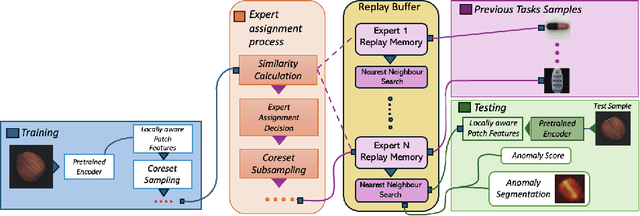
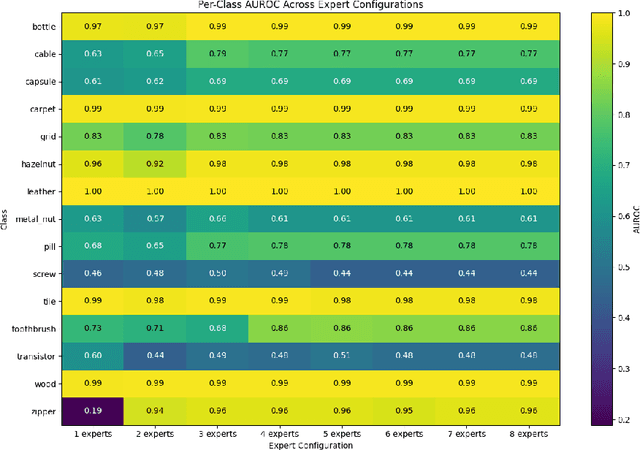
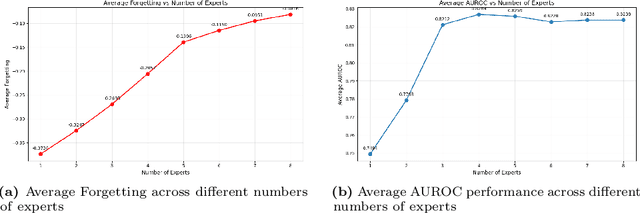
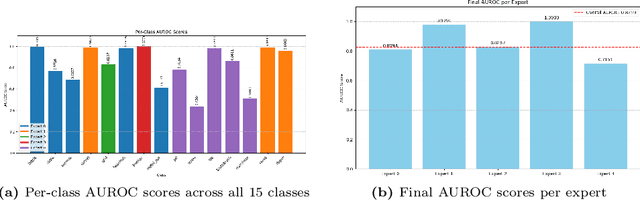
In this paper we propose MECAD, a novel approach for continual anomaly detection using a multi-expert architecture. Our system dynamically assigns experts to object classes based on feature similarity and employs efficient memory management to preserve the knowledge of previously seen classes. By leveraging an optimized coreset selection and a specialized replay buffer mechanism, we enable incremental learning without requiring full model retraining. Our experimental evaluation on the MVTec AD dataset demonstrates that the optimal 5-expert configuration achieves an average AUROC of 0.8259 across 15 diverse object categories while significantly reducing knowledge degradation compared to single-expert approaches. This framework balances computational efficiency, specialized knowledge retention, and adaptability, making it well-suited for industrial environments with evolving product types.
Overcoming Prompts Pool Confusion via Parameterized Prompt for Incremental Object Detection
Oct 31, 2025Recent studies have demonstrated that incorporating trainable prompts into pretrained models enables effective incremental learning. However, the application of prompts in incremental object detection (IOD) remains underexplored. Existing prompts pool based approaches assume disjoint class sets across incremental tasks, which are unsuitable for IOD as they overlook the inherent co-occurrence phenomenon in detection images. In co-occurring scenarios, unlabeled objects from previous tasks may appear in current task images, leading to confusion in prompts pool. In this paper, we hold that prompt structures should exhibit adaptive consolidation properties across tasks, with constrained updates to prevent catastrophic forgetting. Motivated by this, we introduce Parameterized Prompts for Incremental Object Detection (P$^2$IOD). Leveraging neural networks global evolution properties, P$^2$IOD employs networks as the parameterized prompts to adaptively consolidate knowledge across tasks. To constrain prompts structure updates, P$^2$IOD further engages a parameterized prompts fusion strategy. Extensive experiments on PASCAL VOC2007 and MS COCO datasets demonstrate that P$^2$IOD's effectiveness in IOD and achieves the state-of-the-art performance among existing baselines.
CADIC: Continual Anomaly Detection Based on Incremental Coreset
Nov 10, 2025The primary objective of Continual Anomaly Detection (CAD) is to learn the normal patterns of new tasks under dynamic data distribution assumptions while mitigating catastrophic forgetting. Existing embedding-based CAD approaches continuously update a memory bank with new embeddings to adapt to sequential tasks. However, these methods require constructing class-specific sub-memory banks for each task, which restricts their flexibility and scalability. To address this limitation, we propose a novel CAD framework where all tasks share a unified memory bank. During training, the method incrementally updates embeddings within a fixed-size coreset, enabling continuous knowledge acquisition from sequential tasks without task-specific memory fragmentation. In the inference phase, anomaly scores are computed via a nearest-neighbor matching mechanism, achieving state-of-the-art detection accuracy. We validate the method through comprehensive experiments on MVTec AD and Visa datasets. Results show that our approach outperforms existing baselines, achieving average image-level AUROC scores of 0.972 (MVTec AD) and 0.891 (Visa). Notably, on a real-world electronic paper dataset, it demonstrates 100% accuracy in anomaly sample detection, confirming its robustness in practical scenarios. The implementation will be open-sourced on GitHub.
Hierarchical Neural Collapse Detection Transformer for Class Incremental Object Detection
Jun 10, 2025Recently, object detection models have witnessed notable performance improvements, particularly with transformer-based models. However, new objects frequently appear in the real world, requiring detection models to continually learn without suffering from catastrophic forgetting. Although Incremental Object Detection (IOD) has emerged to address this challenge, these existing models are still not practical due to their limited performance and prolonged inference time. In this paper, we introduce a novel framework for IOD, called Hier-DETR: Hierarchical Neural Collapse Detection Transformer, ensuring both efficiency and competitive performance by leveraging Neural Collapse for imbalance dataset and Hierarchical relation of classes' labels.