 Add to Chrome
 Add to Firefox
 Add to Edge
Chinese Landscape Painting Generation
Papers and Code
A New Chinese Landscape Paintings Generation Model based on Stable Diffusion using DreamBooth
Aug 16, 2024
This study mainly introduces a method combining the Stable Diffusion Model (SDM) and Parameter-Efficient Fine-Tuning method for generating Chinese Landscape Paintings. This training process is accelerated by combining LoRA with pre-trained SDM and DreamBooth with pre-trained SDM, respectively. On the Chinese Landscape Paintings Internet dataset used in this paper, this study finds that SDM combined with DreamBooth exhibits superior performance, outperforming other models, including the generic pre-trained SDM and LoRA-based fine-tuning SDM. The SDM combined with DreamBooth achieves a FID of 12.75 on the dataset and outperforms all other models in terms of expert evaluation, highlighting the model's versatility in the field of Chinese Landscape Paintings given the unique identifier, high fidelity and high quality. This study illustrates the potential of specialised fine-tuning method to improve the performance of SDM on domain-specific tasks, particularly in the domain of Landscape Paintings.

DLP-GAN: learning to draw modern Chinese landscape photos with generative adversarial network
Mar 07, 2024Chinese landscape painting has a unique and artistic style, and its drawing technique is highly abstract in both the use of color and the realistic representation of objects. Previous methods focus on transferring from modern photos to ancient ink paintings. However, little attention has been paid to translating landscape paintings into modern photos. To solve such problems, in this paper, we (1) propose DLP-GAN (Draw Modern Chinese Landscape Photos with Generative Adversarial Network), an unsupervised cross-domain image translation framework with a novel asymmetric cycle mapping, and (2) introduce a generator based on a dense-fusion module to match different translation directions. Moreover, a dual-consistency loss is proposed to balance the realism and abstraction of model painting. In this way, our model can draw landscape photos and sketches in the modern sense. Finally, based on our collection of modern landscape and sketch datasets, we compare the images generated by our model with other benchmarks. Extensive experiments including user studies show that our model outperforms state-of-the-art methods.
* Corrected typos
CCLAP: Controllable Chinese Landscape Painting Generation via Latent Diffusion Model
Apr 22, 2023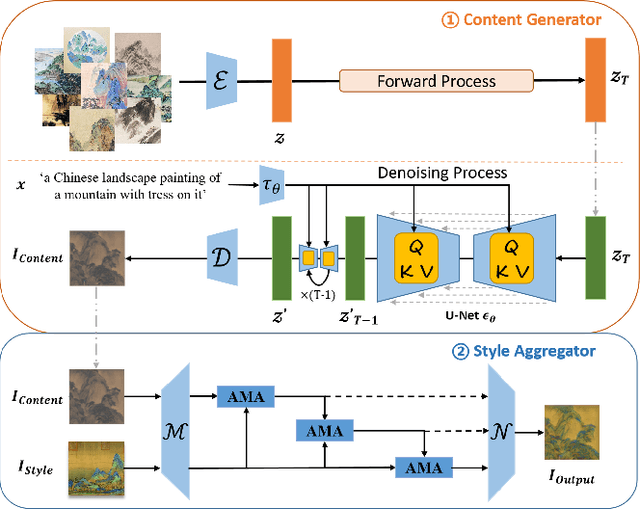
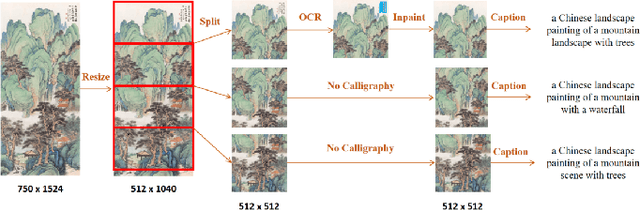
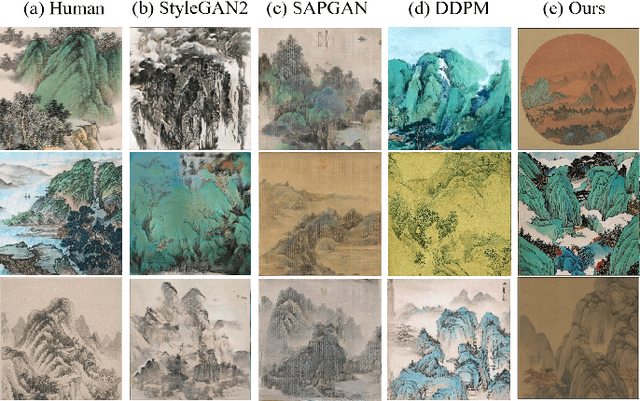
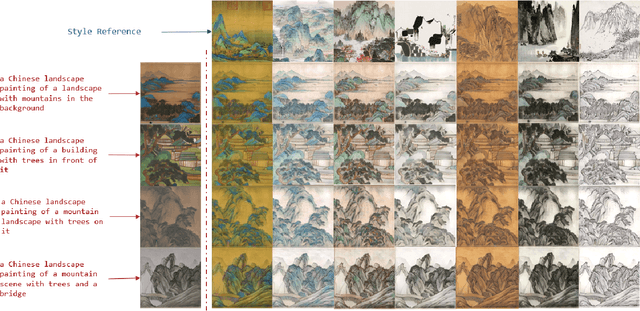
With the development of deep generative models, recent years have seen great success of Chinese landscape painting generation. However, few works focus on controllable Chinese landscape painting generation due to the lack of data and limited modeling capabilities. In this work, we propose a controllable Chinese landscape painting generation method named CCLAP, which can generate painting with specific content and style based on Latent Diffusion Model. Specifically, it consists of two cascaded modules, i.e., content generator and style aggregator. The content generator module guarantees the content of generated paintings specific to the input text. While the style aggregator module is to generate paintings of a style corresponding to a reference image. Moreover, a new dataset of Chinese landscape paintings named CLAP is collected for comprehensive evaluation. Both the qualitative and quantitative results demonstrate that our method achieves state-of-the-art performance, especially in artfully-composed and artistic conception. Codes are available at https://github.com/Robin-WZQ/CCLAP.
Learning to Generate Poetic Chinese Landscape Painting with Calligraphy
May 08, 2023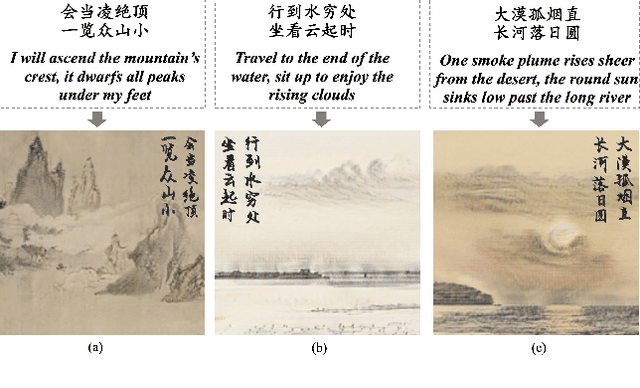

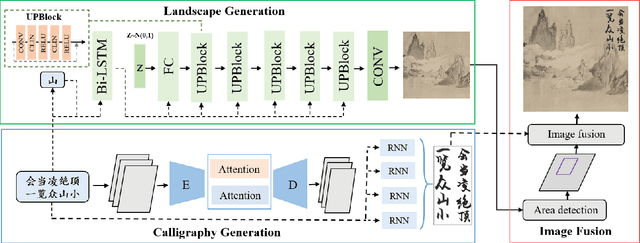

In this paper, we present a novel system (denoted as Polaca) to generate poetic Chinese landscape painting with calligraphy. Unlike previous single image-to-image painting generation, Polaca takes the classic poetry as input and outputs the artistic landscape painting image with the corresponding calligraphy. It is equipped with three different modules to complete the whole piece of landscape painting artwork: the first one is a text-to-image module to generate landscape painting image, the second one is an image-to-image module to generate stylistic calligraphy image, and the third one is an image fusion module to fuse the two images into a whole piece of aesthetic artwork.
Chinese Painting Style Transfer Using Deep Generative Models
Oct 17, 2023Artistic style transfer aims to modify the style of the image while preserving its content. Style transfer using deep learning models has been widely studied since 2015, and most of the applications are focused on specific artists like Van Gogh, Monet, Cezanne. There are few researches and applications on traditional Chinese painting style transfer. In this paper, we will study and leverage different state-of-the-art deep generative models for Chinese painting style transfer and evaluate the performance both qualitatively and quantitatively. In addition, we propose our own algorithm that combines several style transfer models for our task. Specifically, we will transfer two main types of traditional Chinese painting style, known as "Gong-bi" and "Shui-mo" (to modern images like nature objects, portraits and landscapes.
Space Narrative: Generating Images and 3D Scenes of Chinese Garden from Text using Deep Learning
Nov 01, 2023The consistent mapping from poems to paintings is essential for the research and restoration of traditional Chinese gardens. But the lack of firsthand ma-terial is a great challenge to the reconstruction work. In this paper, we pro-pose a method to generate garden paintings based on text descriptions using deep learning method. Our image-text pair dataset consists of more than one thousand Ming Dynasty Garden paintings and their inscriptions and post-scripts. A latent text-to-image diffusion model learns the mapping from de-scriptive texts to garden paintings of the Ming Dynasty, and then the text description of Jichang Garden guides the model to generate new garden paintings. The cosine similarity between the guide text and the generated image is the evaluation criterion for the generated images. Our dataset is used to fine-tune the pre-trained diffusion model using Low-Rank Adapta-tion of Large Language Models (LoRA). We also transformed the generated images into a panorama and created a free-roam scene in Unity 3D. Our post-trained model is capable of generating garden images in the style of Ming Dynasty landscape paintings based on textual descriptions. The gener-ated images are compatible with three-dimensional presentation in Unity 3D.
End-to-End Chinese Landscape Painting Creation Using Generative Adversarial Networks
Nov 11, 2020


Current GAN-based art generation methods produce unoriginal artwork due to their dependence on conditional input. Here, we propose Sketch-And-Paint GAN (SAPGAN), the first model which generates Chinese landscape paintings from end to end, without conditional input. SAPGAN is composed of two GANs: SketchGAN for generation of edge maps, and PaintGAN for subsequent edge-to-painting translation. Our model is trained on a new dataset of traditional Chinese landscape paintings never before used for generative research. A 242-person Visual Turing Test study reveals that SAPGAN paintings are mistaken as human artwork with 55% frequency, significantly outperforming paintings from baseline GANs. Our work lays a groundwork for truly machine-original art generation.
Ancient Painting to Natural Image: A New Solution for Painting Processing
Jan 02, 2019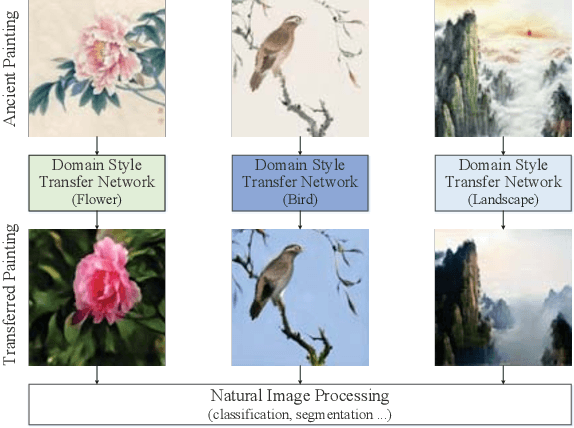
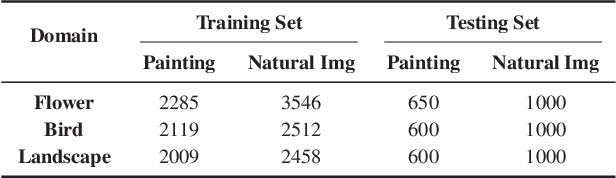
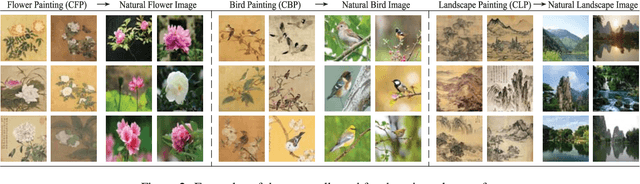
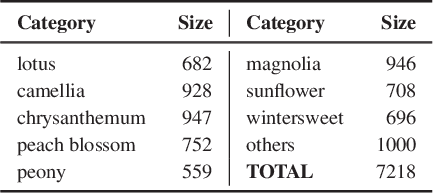
Collecting a large-scale and well-annotated dataset for image processing has become a common practice in computer vision. However, in the ancient painting area, this task is not practical as the number of paintings is limited and their style is greatly diverse. We, therefore, propose a novel solution for the problems that come with ancient painting processing. This is to use domain transfer to convert ancient paintings to photo-realistic natural images. By doing so, the ancient painting processing problems become natural image processing problems and models trained on natural images can be directly applied to the transferred paintings. Specifically, we focus on Chinese ancient flower, bird and landscape paintings in this work. A novel Domain Style Transfer Network (DSTN) is proposed to transfer ancient paintings to natural images which employ a compound loss to ensure that the transferred paintings still maintain the color composition and content of the input paintings. The experiment results show that the transferred paintings generated by the DSTN have a better performance in both the human perceptual test and other image processing tasks than other state-of-art methods, indicating the authenticity of the transferred paintings and the superiority of the proposed method.