 Add to Chrome
 Add to Firefox
 Add to Edge
Cantilever Beam
A cantilever beam is a beam that is supported at one end and free at the other end, allowing it to carry loads and resist bending.
Papers and Code
Distal-Stable Beam for Continuum Robots
Apr 01, 2026
Continuum robots are well suited for constrained environments but suffer from low distal stiffness, resulting in large posture errors under external loads. In this paper, we propose a novel structural primitive, the Distal-Stable Beam, which achieves a strong stiffness gradient through purely geometric design, maintaining compliance in the intermediate section while ensuring high distal rigidity. The structure consists of two parallel rods and one convergent rod constrained by guide disks, introducing geometric coupling that suppresses deformation modes and preserves distal posture. Experiments show that the distal stiffness is 12 times higher than at the center, corresponding to an approximately 100-fold improvement over a conventional cantilever beam. The proposed mechanism enables simultaneous compliance and distal stability without active stiffness modulation, providing a new design approach for continuum robots requiring both safety and precision.

Large Language Models as Optimization Controllers: Adaptive Continuation for SIMP Topology Optimization
Mar 26, 2026We present a framework in which a large language model (LLM) acts as an online adaptive controller for SIMP topology optimization, replacing conventional fixed-schedule continuation with real-time, state-conditioned parameter decisions. At every $k$-th iteration, the LLM receives a structured observation$-$current compliance, grayness index, stagnation counter, checkerboard measure, volume fraction, and budget consumption$-$and outputs numerical values for the penalization exponent $p$, projection sharpness $β$, filter radius $r_{\min}$, and move limit $δ$ via a Direct Numeric Control interface. A hard grayness gate prevents premature binarization, and a meta-optimization loop uses a second LLM pass to tune the agent's call frequency and gate threshold across runs. We benchmark the agent against four baselines$-$fixed (no-continuation), standard three-field continuation, an expert heuristic, and a schedule-only ablation$-$on three 2-D problems (cantilever, MBB beam, L-bracket) at $120\!\times\!60$ resolution and two 3-D problems (cantilever, MBB beam) at $40\!\times\!20\!\times\!10$ resolution, all run for 300 iterations. A standardized 40-iteration sharpening tail is applied from the best valid snapshot so that compliance differences reflect only the exploration phase. The LLM agent achieves the lowest final compliance on every benchmark: $-5.7\%$ to $-18.1\%$ relative to the fixed baseline, with all solutions fully binary. The schedule-only ablation underperforms the fixed baseline on two of three problems, confirming that the LLM's real-time intervention$-$not the schedule geometry$-$drives the gain. Code and reproduction scripts will be released upon publication.
Data-driven model order reduction for structures with piecewise linear nonlinearity using dynamic mode decomposition
Mar 18, 2026Piecewise-linear nonlinear systems appear in many engineering disciplines. Prediction of the dynamic behavior of such systems is of great importance from practical and theoretical viewpoint. In this paper, a data-driven model order reduction method for piecewise-linear systems is proposed, which is based on dynamic mode decomposition (DMD). The overview of the concept of DMD is provided, and its application to model order reduction for nonlinear systems based on Galerkin projection is explained. The proposed approach uses impulse responses of the system to obtain snapshots of the state variables. The snapshots are then used to extract the dynamic modes that are used to form the projection basis vectors. The dynamics described by the equations of motion of the original full-order system are then projected onto the subspace spanned by the basis vectors. This produces a system with much smaller number of degrees of freedom (DOFs). The proposed method is applied to two representative examples of piecewise linear systems: a cantilevered beam subjected to an elastic stop at its end, and a bonded plates assembly with partial debonding. The reduced order models (ROMs) of these systems are constructed by using the Galerkin projection of the equation of motion with DMD modes alone, or DMD modes with a set of classical constraint modes to be able to handle the contact nonlinearity efficiently. The obtained ROMs are used for the nonlinear forced response analysis of the systems under harmonic loading. It is shown that the ROMs constructed by the proposed method produce accurate forced response results.
Optimization is Not Enough: Why Problem Formulation Deserves Equal Attention
Feb 05, 2026Black-box optimization is increasingly used in engineering design problems where simulation-based evaluations are costly and gradients are unavailable. In this context, the optimization community has largely analyzed algorithm performance in context-free setups, while not enough attention has been devoted to how problem formulation and domain knowledge may affect the optimization outcomes. We address this gap through a case study in the topology optimization of laminated composite structures, formulated as a black-box optimization problem. Specifically, we consider the design of a cantilever beam under a volume constraint, intending to minimize compliance while optimizing both the structural topology and fiber orientations. To assess the impact of problem formulation, we explicitly separate topology and material design variables and compare two strategies: a concurrent approach that optimizes all variables simultaneously without leveraging physical insight, and a sequential approach that optimizes variables of the same nature in stages. Our results show that context-agnostic strategies consistently lead to suboptimal or non-physical designs. In contrast, the sequential strategy yields better-performing and more interpretable solutions. These findings underscore the value of incorporating, when available, domain knowledge into the optimization process and motivate the development of new black-box benchmarks that reward physically informed and context-aware optimization strategies.
Investigating the Interplay of Parameterization and Optimizer in Gradient-Free Topology Optimization: A Cantilever Beam Case Study
Jan 29, 2026Gradient-free black-box optimization (BBO) is widely used in engineering design and provides a flexible framework for topology optimization (TO), enabling the discovery of high-performing structural designs without requiring gradient information from simulations. Yet, its success depends on two key choices: the geometric parameterization defining the search space and the optimizer exploring it. This study investigates this interplay through a compliance minimization problem for a cantilever beam subject to a connectivity constraint. We benchmark three geometric parameterizations, each combined with three representative BBO algorithms: differential evolution, covariance matrix adaptation evolution strategy, and heteroscedastic evolutionary Bayesian optimization, across 10D, 20D, and 50D design spaces. Results reveal that parameterization quality has a stronger influence on optimization performance than optimizer choice: a well-structured parameterization enables robust and competitive performance across algorithms, whereas weaker representations increase optimizer dependency. Overall, this study highlights the dominant role of geometric parameterization in practical BBO-based TO and shows that algorithm performance and selection cannot be fairly assessed without accounting for the induced design space.
Model-free Adaptive Output Feedback Vibration Suppression in a Cantilever Beam
Nov 08, 2025This paper presents a model-free adaptive control approach to suppress vibrations in a cantilevered beam excited by an unknown disturbance. The cantilevered beam under harmonic excitation is modeled using a lumped parameter approach. Based on retrospective cost optimization, a sampled-data adaptive controller is developed to suppress vibrations caused by external disturbances. Both displacement and acceleration measurements are considered for feedback. Since acceleration measurements are more sensitive to spillover, which excites higher frequency modes, a filter is developed to extract key displacement information from the acceleration data and enhance suppression performance. The vibration suppression performance is compared using both displacement and acceleration measurements.
SMT-EX: An Explainable Surrogate Modeling Toolbox for Mixed-Variables Design Exploration
Mar 25, 2025Surrogate models are of high interest for many engineering applications, serving as cheap-to-evaluate time-efficient approximations of black-box functions to help engineers and practitioners make decisions and understand complex systems. As such, the need for explainability methods is rising and many studies have been performed to facilitate knowledge discovery from surrogate models. To respond to these enquiries, this paper introduces SMT-EX, an enhancement of the open-source Python Surrogate Modeling Toolbox (SMT) that integrates explainability techniques into a state-of-the-art surrogate modelling framework. More precisely, SMT-EX includes three key explainability methods: Shapley Additive Explanations, Partial Dependence Plot, and Individual Conditional Expectations. A peculiar explainability dependency of SMT has been developed for such purpose that can be easily activated once the surrogate model is built, offering a user-friendly and efficient tool for swift insight extraction. The effectiveness of SMT-EX is showcased through two test cases. The first case is a 10-variable wing weight problem with purely continuous variables and the second one is a 3-variable mixed-categorical cantilever beam bending problem. Relying on SMT-EX analyses for these problems, we demonstrate its versatility in addressing a diverse range of problem characteristics. SMT-Explainability is freely available on Github: https://github.com/SMTorg/smt-explainability .
Heterogenous Multi-Source Data Fusion Through Input Mapping and Latent Variable Gaussian Process
Jul 15, 2024Artificial intelligence and machine learning frameworks have served as computationally efficient mapping between inputs and outputs for engineering problems. These mappings have enabled optimization and analysis routines that have warranted superior designs, ingenious material systems and optimized manufacturing processes. A common occurrence in such modeling endeavors is the existence of multiple source of data, each differentiated by fidelity, operating conditions, experimental conditions, and more. Data fusion frameworks have opened the possibility of combining such differentiated sources into single unified models, enabling improved accuracy and knowledge transfer. However, these frameworks encounter limitations when the different sources are heterogeneous in nature, i.e., not sharing the same input parameter space. These heterogeneous input scenarios can occur when the domains differentiated by complexity, scale, and fidelity require different parametrizations. Towards addressing this void, a heterogeneous multi-source data fusion framework is proposed based on input mapping calibration (IMC) and latent variable Gaussian process (LVGP). In the first stage, the IMC algorithm is utilized to transform the heterogeneous input parameter spaces into a unified reference parameter space. In the second stage, a multi-source data fusion model enabled by LVGP is leveraged to build a single source-aware surrogate model on the transformed reference space. The proposed framework is demonstrated and analyzed on three engineering case studies (design of cantilever beam, design of ellipsoidal void and modeling properties of Ti6Al4V alloy). The results indicate that the proposed framework provides improved predictive accuracy over a single source model and transformed but source unaware model.
Composite Material Design for Optimized Fracture Toughness Using Machine Learning
Jun 23, 2024This paper investigates the optimization of 2D and 3D composite structures using machine learning (ML) techniques, focusing on fracture toughness and crack propagation in the Double Cantilever Beam (DCB) test. By exploring the intricate relationship between microstructural arrangements and macroscopic properties of composites, the study demonstrates the potential of ML as a powerful tool to expedite the design optimization process, offering notable advantages over traditional finite element analysis. The research encompasses four distinct cases, examining crack propagation and fracture toughness in both 2D and 3D composite models. Through the application of ML algorithms, the study showcases the capability for rapid and accurate exploration of vast design spaces in composite materials. The findings highlight the efficiency of ML in predicting mechanical behaviors with limited training data, paving the way for broader applications in composite design and optimization. This work contributes to advancing the understanding of ML's role in enhancing the efficiency of composite material design processes.
A new approach for solving global optimization and engineering problems based on modified Sea Horse Optimizer
Feb 21, 2024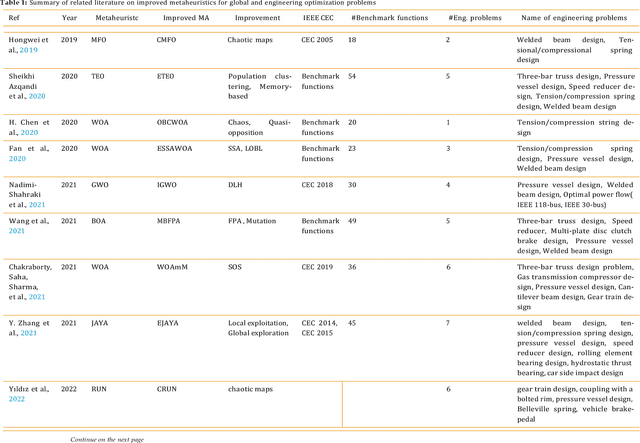

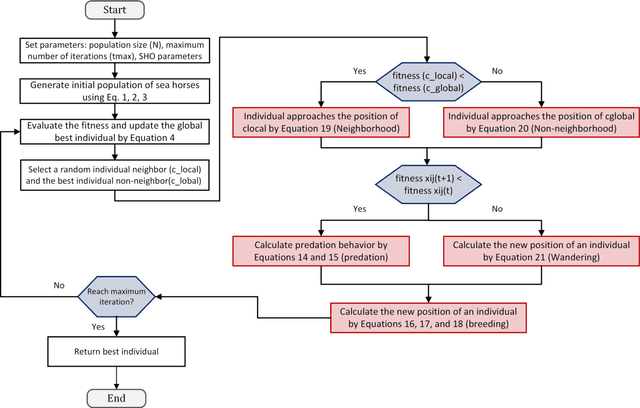
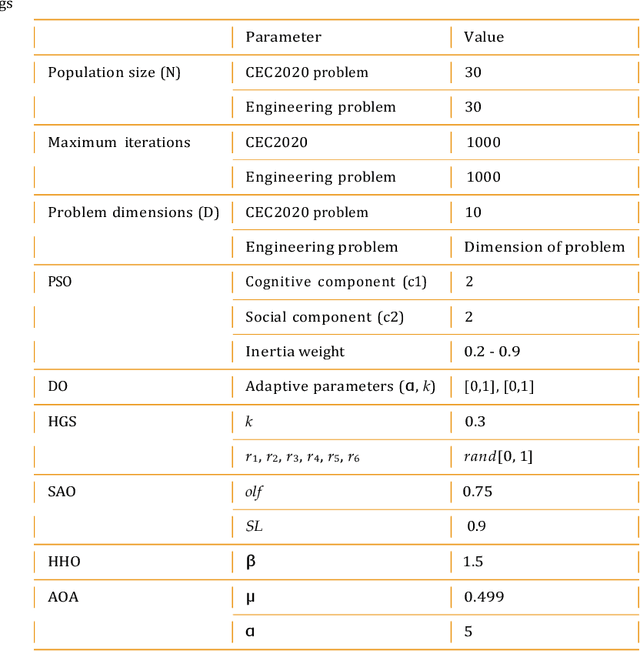
Sea Horse Optimizer (SHO) is a noteworthy metaheuristic algorithm that emulates various intelligent behaviors exhibited by sea horses, encompassing feeding patterns, male reproductive strategies, and intricate movement patterns. To mimic the nuanced locomotion of sea horses, SHO integrates the logarithmic helical equation and Levy flight, effectively incorporating both random movements with substantial step sizes and refined local exploitation. Additionally, the utilization of Brownian motion facilitates a more comprehensive exploration of the search space. This study introduces a robust and high-performance variant of the SHO algorithm named mSHO. The enhancement primarily focuses on bolstering SHO's exploitation capabilities by replacing its original method with an innovative local search strategy encompassing three distinct steps: a neighborhood-based local search, a global non-neighbor-based search, and a method involving circumnavigation of the existing search region. These techniques improve mSHO algorithm's search capabilities, allowing it to navigate the search space and converge toward optimal solutions efficiently. The comprehensive results distinctly establish the supremacy and efficiency of the mSHO method as an exemplary tool for tackling an array of optimization quandaries. The results show that the proposed mSHO algorithm has a total rank of 1 for CEC'2020 test functions. In contrast, the mSHO achieved the best value for the engineering problems, recording a value of 0.012665, 2993.634, 0.01266, 1.724967, 263.8915, 0.032255, 58507.14, 1.339956, and 0.23524 for the pressure vessel design, speed reducer design, tension/compression spring, welded beam design, three-bar truss engineering design, industrial refrigeration system, multi-Product batch plant, cantilever beam problem, multiple disc clutch brake problems, respectively.