 Add to Chrome
 Add to Firefox
 Add to Edge
Optimization is Not Enough: Why Problem Formulation Deserves Equal Attention
Feb 05, 2026
Black-box optimization is increasingly used in engineering design problems where simulation-based evaluations are costly and gradients are unavailable. In this context, the optimization community has largely analyzed algorithm performance in context-free setups, while not enough attention has been devoted to how problem formulation and domain knowledge may affect the optimization outcomes. We address this gap through a case study in the topology optimization of laminated composite structures, formulated as a black-box optimization problem. Specifically, we consider the design of a cantilever beam under a volume constraint, intending to minimize compliance while optimizing both the structural topology and fiber orientations. To assess the impact of problem formulation, we explicitly separate topology and material design variables and compare two strategies: a concurrent approach that optimizes all variables simultaneously without leveraging physical insight, and a sequential approach that optimizes variables of the same nature in stages. Our results show that context-agnostic strategies consistently lead to suboptimal or non-physical designs. In contrast, the sequential strategy yields better-performing and more interpretable solutions. These findings underscore the value of incorporating, when available, domain knowledge into the optimization process and motivate the development of new black-box benchmarks that reward physically informed and context-aware optimization strategies.

MECHBench: A Set of Black-Box Optimization Benchmarks originated from Structural Mechanics
Nov 13, 2025Benchmarking is essential for developing and evaluating black-box optimization algorithms, providing a structured means to analyze their search behavior. Its effectiveness relies on carefully selected problem sets used for evaluation. To date, most established benchmark suites for black-box optimization consist of abstract or synthetic problems that only partially capture the complexities of real-world engineering applications, thereby severely limiting the insights that can be gained for application-oriented optimization scenarios and reducing their practical impact. To close this gap, we propose a new benchmarking suite that addresses it by presenting a curated set of optimization benchmarks rooted in structural mechanics. The current implemented benchmarks are derived from vehicle crashworthiness scenarios, which inherently require the use of gradient-free algorithms due to the non-smooth, highly non-linear nature of the underlying models. Within this paper, the reader will find descriptions of the physical context of each case, the corresponding optimization problem formulations, and clear guidelines on how to employ the suite.
Feasibility-Driven Trust Region Bayesian Optimization
Jun 17, 2025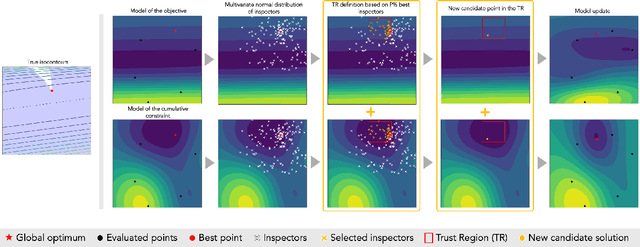
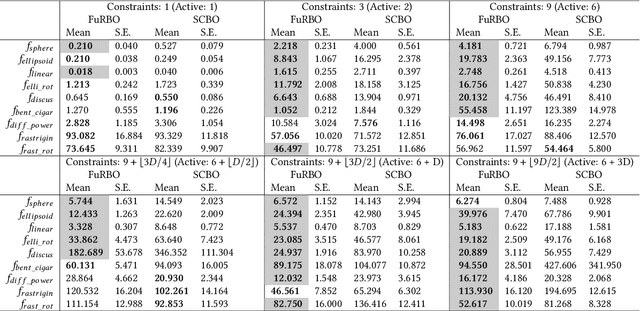
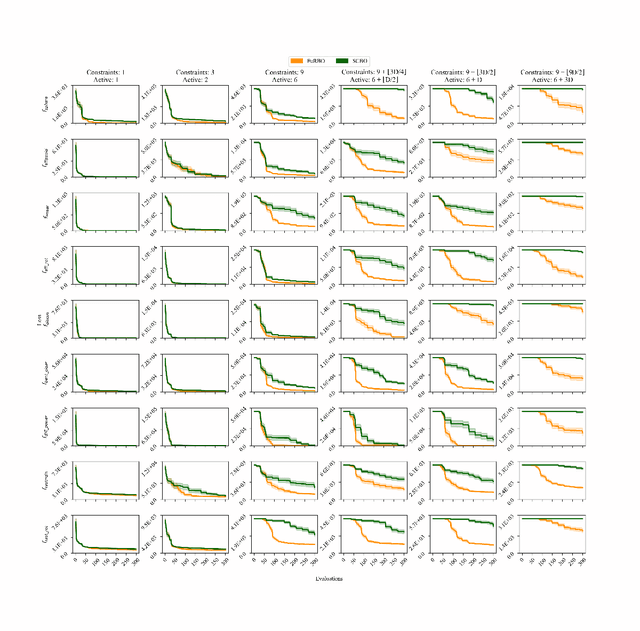
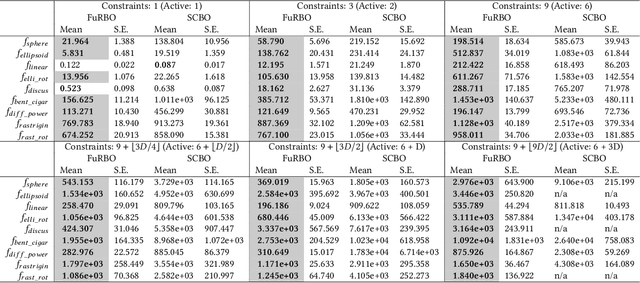
Bayesian optimization is a powerful tool for solving real-world optimization tasks under tight evaluation budgets, making it well-suited for applications involving costly simulations or experiments. However, many of these tasks are also characterized by the presence of expensive constraints whose analytical formulation is unknown and often defined in high-dimensional spaces where feasible regions are small, irregular, and difficult to identify. In such cases, a substantial portion of the optimization budget may be spent just trying to locate the first feasible solution, limiting the effectiveness of existing methods. In this work, we present a Feasibility-Driven Trust Region Bayesian Optimization (FuRBO) algorithm. FuRBO iteratively defines a trust region from which the next candidate solution is selected, using information from both the objective and constraint surrogate models. Our adaptive strategy allows the trust region to shift and resize significantly between iterations, enabling the optimizer to rapidly refocus its search and consistently accelerate the discovery of feasible and good-quality solutions. We empirically demonstrate the effectiveness of FuRBO through extensive testing on the full BBOB-constrained COCO benchmark suite and other physics-inspired benchmarks, comparing it against state-of-the-art baselines for constrained black-box optimization across varying levels of constraint severity and problem dimensionalities ranging from 2 to 60.