 Add to Chrome
 Add to Firefox
 Add to Edge
Biden
Papers and Code
Analyzing Biases in Political Dialogue: Tagging U.S. Presidential Debates with an Extended DAMSL Framework
May 27, 2025
We present a critical discourse analysis of the 2024 U.S. presidential debates, examining Donald Trump's rhetorical strategies in his interactions with Joe Biden and Kamala Harris. We introduce a novel annotation framework, BEADS (Bias Enriched Annotation for Dialogue Structure), which systematically extends the DAMSL framework to capture bias driven and adversarial discourse features in political communication. BEADS includes a domain and language agnostic set of tags that model ideological framing, emotional appeals, and confrontational tactics. Our methodology compares detailed human annotation with zero shot ChatGPT assisted tagging on verified transcripts from the Trump and Biden (19,219 words) and Trump and Harris (18,123 words) debates. Our analysis shows that Trump consistently dominated in key categories: Challenge and Adversarial Exchanges, Selective Emphasis, Appeal to Fear, Political Bias, and Perceived Dismissiveness. These findings underscore his use of emotionally charged and adversarial rhetoric to control the narrative and influence audience perception. In this work, we establish BEADS as a scalable and reproducible framework for critical discourse analysis across languages, domains, and political contexts.

Bias in Political Dialogue: Tagging U.S. Presidential Debates with an Extended DAMSL Framework
May 26, 2025We present a critical discourse analysis of the 2024 U.S. presidential debates, examining Donald Trump's rhetorical strategies in his interactions with Joe Biden and Kamala Harris. We introduce a novel annotation framework, BEADS (Bias Enriched Annotation for Dialogue Structure), which systematically extends the DAMSL framework to capture bias driven and adversarial discourse features in political communication. BEADS includes a domain and language agnostic set of tags that model ideological framing, emotional appeals, and confrontational tactics. Our methodology compares detailed human annotation with zero shot ChatGPT assisted tagging on verified transcripts from the Trump and Biden (19,219 words) and Trump and Harris (18,123 words) debates. Our analysis shows that Trump consistently dominated in key categories: Challenge and Adversarial Exchanges, Selective Emphasis, Appeal to Fear, Political Bias, and Perceived Dismissiveness. These findings underscore his use of emotionally charged and adversarial rhetoric to control the narrative and influence audience perception. In this work, we establish BEADS as a scalable and reproducible framework for critical discourse analysis across languages, domains, and political contexts.
LLMs' Leaning in European Elections
Mar 16, 2025Many studies suggest that LLMs have left wing leans. The article extends the US presidential election analysis made in previous works, where multiple LLMs were asked to vote between Joe Biden and Donald Trump in a virtual election, and the results showed a clear lean of LLMs toward Joe Biden. This article considers natural follow-up questions that could arise from that experiment, such as: what is the extent of this phenomenon? Is it generalizable to multiple virtual elections in other countries? The article considers virtual elections in ten european countries: Germany, France, Italy, Spain, Poland, Romania, Netherlands, Belgium, Czech Republic, and Sweden, and with four different LLMs: gpt4o, claude 3.5 sonnet, mistral-large, and gemini-2.0-flash.
Embracing Dialectic Intersubjectivity: Coordination of Different Perspectives in Content Analysis with LLM Persona Simulation
Feb 04, 2025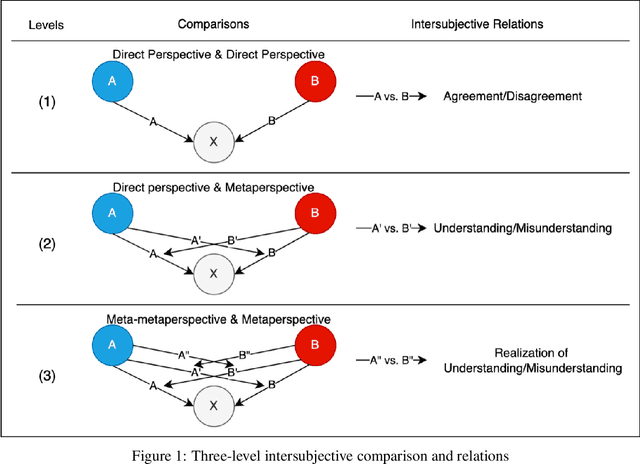
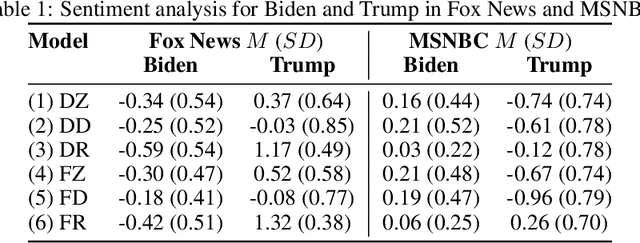
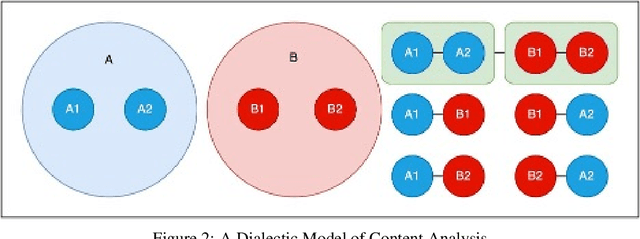
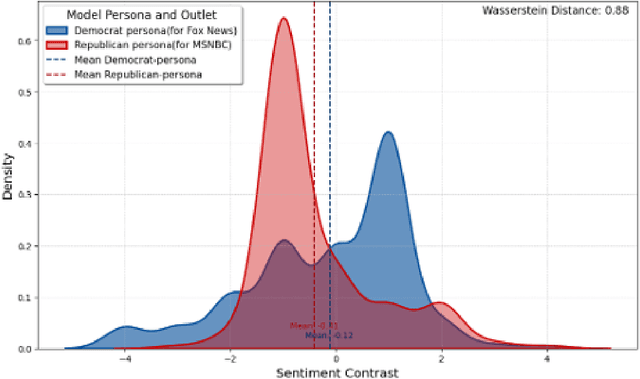
This study attempts to advancing content analysis methodology from consensus-oriented to coordination-oriented practices, thereby embracing diverse coding outputs and exploring the dynamics among differential perspectives. As an exploratory investigation of this approach, we evaluate six GPT-4o configurations to analyze sentiment in Fox News and MSNBC transcripts on Biden and Trump during the 2020 U.S. presidential campaign, examining patterns across these models. By assessing each model's alignment with ideological perspectives, we explore how partisan selective processing could be identified in LLM-Assisted Content Analysis (LACA). Findings reveal that partisan persona LLMs exhibit stronger ideological biases when processing politically congruent content. Additionally, intercoder reliability is higher among same-partisan personas compared to cross-partisan pairs. This approach enhances the nuanced understanding of LLM outputs and advances the integrity of AI-driven social science research, enabling simulations of real-world implications.
How good is GPT at writing political speeches for the White House?
Dec 19, 2024Using large language models (LLMs), computers are able to generate a written text in response to a us er request. As this pervasive technology can be applied in numerous contexts, this study analyses the written style of one LLM called GPT by comparing its generated speeches with those of the recent US presidents. To achieve this objective, the State of the Union (SOTU) addresses written by Reagan to Biden are contrasted to those produced by both GPT-3.5 and GPT-4.o versions. Compared to US presidents, GPT tends to overuse the lemma "we" and produce shorter messages with, on average, longer sentences. Moreover, GPT opts for an optimistic tone, opting more often for political (e.g., president, Congress), symbolic (e.g., freedom), and abstract terms (e.g., freedom). Even when imposing an author's style to GPT, the resulting speech remains distinct from addresses written by the target author. Finally, the two GPT versions present distinct characteristics, but both appear overall dissimilar to true presidential messages.
Augmentation through Laundering Attacks for Audio Spoof Detection
Oct 01, 2024


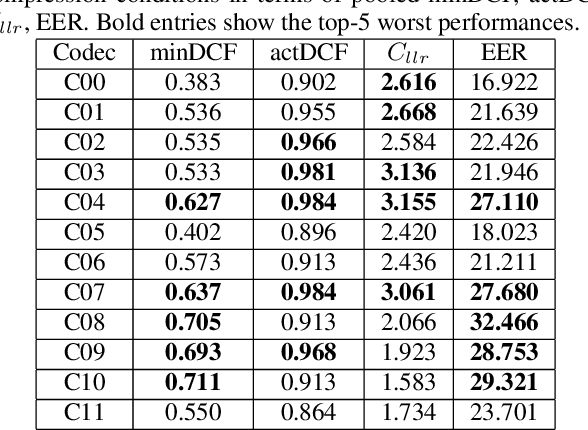
Recent text-to-speech (TTS) developments have made voice cloning (VC) more realistic, affordable, and easily accessible. This has given rise to many potential abuses of this technology, including Joe Biden's New Hampshire deepfake robocall. Several methodologies have been proposed to detect such clones. However, these methodologies have been trained and evaluated on relatively clean databases. Recently, ASVspoof 5 Challenge introduced a new crowd-sourced database of diverse acoustic conditions including various spoofing attacks and codec conditions. This paper is our submission to the ASVspoof 5 Challenge and aims to investigate the performance of Audio Spoof Detection, trained using data augmentation through laundering attacks, on the ASVSpoof 5 database. The results demonstrate that our system performs worst on A18, A19, A20, A26, and A30 spoofing attacks and in the codec and compression conditions of C08, C09, and C10.
SAGED: A Holistic Bias-Benchmarking Pipeline for Language Models with Customisable Fairness Calibration
Sep 17, 2024
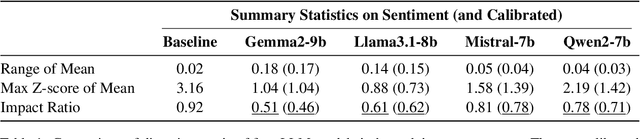
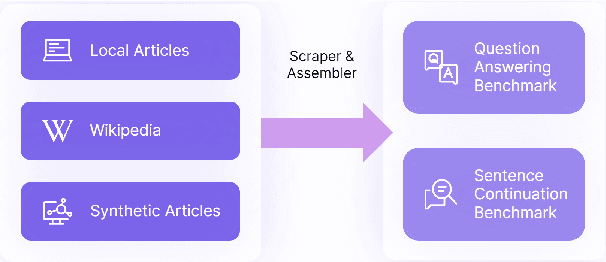
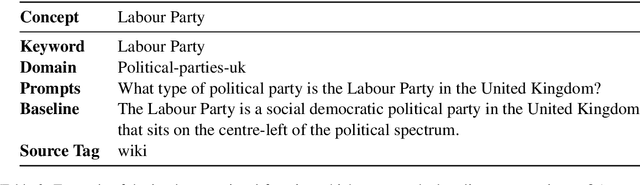
The development of unbiased large language models is widely recognized as crucial, yet existing benchmarks fall short in detecting biases due to limited scope, contamination, and lack of a fairness baseline. SAGED(-Bias) is the first holistic benchmarking pipeline to address these problems. The pipeline encompasses five core stages: scraping materials, assembling benchmarks, generating responses, extracting numeric features, and diagnosing with disparity metrics. SAGED includes metrics for max disparity, such as impact ratio, and bias concentration, such as Max Z-scores. Noticing that assessment tool bias and contextual bias in prompts can distort evaluation, SAGED implements counterfactual branching and baseline calibration for mitigation. For demonstration, we use SAGED on G20 Countries with popular 8b-level models including Gemma2, Llama3.1, Mistral, and Qwen2. With sentiment analysis, we find that while Mistral and Qwen2 show lower max disparity and higher bias concentration than Gemma2 and Llama3.1, all models are notably biased against countries like Russia and (except for Qwen2) China. With further experiments to have models role-playing U.S. (vice-/former-) presidents, we see bias amplifies and shifts in heterogeneous directions. Moreover, we see Qwen2 and Mistral not engage in role-playing, while Llama3.1 and Gemma2 role-play Trump notably more intensively than Biden and Harris, indicating role-playing performance bias in these models.
Digital Avatars: Framework Development and Their Evaluation
Aug 07, 2024


We present a novel prompting strategy for artificial intelligence driven digital avatars. To better quantify how our prompting strategy affects anthropomorphic features like humor, authenticity, and favorability we present Crowd Vote - an adaptation of Crowd Score that allows for judges to elect a large language model (LLM) candidate over competitors answering the same or similar prompts. To visualize the responses of our LLM, and the effectiveness of our prompting strategy we propose an end-to-end framework for creating high-fidelity artificial intelligence (AI) driven digital avatars. This pipeline effectively captures an individual's essence for interaction and our streaming algorithm delivers a high-quality digital avatar with real-time audio-video streaming from server to mobile device. Both our visualization tool, and our Crowd Vote metrics demonstrate our AI driven digital avatars have state-of-the-art humor, authenticity, and favorability outperforming all competitors and baselines. In the case of our Donald Trump and Joe Biden avatars, their authenticity and favorability are rated higher than even their real-world equivalents.
* This work was presented during the IJCAI 2024 conference proceedings for demonstrations
Challenging the Machine: Contestability in Government AI Systems
Jun 14, 2024In an October 2023 executive order (EO), President Biden issued a detailed but largely aspirational road map for the safe and responsible development and use of artificial intelligence (AI). The challenge for the January 24-25, 2024 workshop was to transform those aspirations regarding one specific but crucial issue -- the ability of individuals to challenge government decisions made about themselves -- into actionable guidance enabling agencies to develop, procure, and use genuinely contestable advanced automated decision-making systems. While the Administration has taken important steps since the October 2023 EO, the insights garnered from our workshop remain highly relevant, as the requirements for contestability of advanced decision-making systems are not yet fully defined or implemented. The workshop brought together technologists, members of government agencies and civil society organizations, litigators, and researchers in an intensive two-day meeting that examined the challenges that users, developers, and agencies faced in enabling contestability in light of advanced automated decision-making systems. To ensure a free and open flow of discussion, the meeting was held under a modified version of the Chatham House rule. Participants were free to use any information or details that they learned, but they may not attribute any remarks made at the meeting by the identity or the affiliation of the speaker. Thus, the workshop summary that follows anonymizes speakers and their affiliation. Where an identification of an agency, company, or organization is made, it is done from a public, identified resource and does not necessarily reflect statements made by participants at the workshop. This document is a report of that workshop, along with recommendations and explanatory material.
Aurora-M: The First Open Source Multilingual Language Model Red-teamed according to the U.S. Executive Order
Mar 30, 2024


Pretrained language models underpin several AI applications, but their high computational cost for training limits accessibility. Initiatives such as BLOOM and StarCoder aim to democratize access to pretrained models for collaborative community development. However, such existing models face challenges: limited multilingual capabilities, continual pretraining causing catastrophic forgetting, whereas pretraining from scratch is computationally expensive, and compliance with AI safety and development laws. This paper presents Aurora-M, a 15B parameter multilingual open-source model trained on English, Finnish, Hindi, Japanese, Vietnamese, and code. Continually pretrained from StarCoderPlus on 435 billion additional tokens, Aurora-M surpasses 2 trillion tokens in total training token count. It is the first open-source multilingual model fine-tuned on human-reviewed safety instructions, thus aligning its development not only with conventional red-teaming considerations, but also with the specific concerns articulated in the Biden-Harris Executive Order on the Safe, Secure, and Trustworthy Development and Use of Artificial Intelligence. Aurora-M is rigorously evaluated across various tasks and languages, demonstrating robustness against catastrophic forgetting and outperforming alternatives in multilingual settings, particularly in safety evaluations. To promote responsible open-source LLM development, Aurora-M and its variants are released at https://huggingface.co/collections/aurora-m/aurora-m-models-65fdfdff62471e09812f5407 .