 Add to Chrome
 Add to Firefox
 Add to Edge
CalibratedRubric: Task-Adaptive Rubric Banks for Open-Ended LLM Evaluation
Jul 31, 2026
Reliable evaluation of open-ended LLM outputs requires fine-grained rubrics, yet expert curation is costly and difficult to scale. Existing automated pipelines rely on strict judge unanimity and binary variance filters, which cannot distinguish measurable rubrics from informative ones. We introduce CalibratedRubric, a task-adaptive framework that combines type-specific scoring, Bayesian rubric-measurability filtering, and item response theory (IRT)-based bank assembly. CalibratedRubric estimates each rubric's measurability with a Beta--Bernoulli agreement posterior and uses a submodular information-coverage objective to construct compact rubric banks over the observed capability range. Across financial, healthcare, general, and legal benchmarks, measurability filtering improves human-gold agreement on JudgmentBench from $κ=0.604$ to $0.743$. IRT-based greedy selection improves cross-fitted rank fidelity over random selection across all six evaluated response blocks and requires only 49 rather than 131 rubrics to reach the target correlation on FinResearchBench decision-support tasks. Task-label perturbations further reduce system separation, confirming the practical relevance of task-adaptive scoring. These results support CalibratedRubric as an efficient, uncertainty-aware approach to open-ended LLM evaluation, with calibration gains depending on sufficient judge redundancy.

GAUGE: Grading Agent-Built Financial Models Without a Golden Answer
Jul 27, 2026Financial models combine public disclosures with analyst assumptions to produce forecasts and valuations. While some components can be checked mechanically, forecasts, discount rates, and target prices often admit multiple reasonable answers. Existing benchmarks nevertheless tend to grade such outputs against a single expert reference. Using independently built analyst models for the same companies, we find that across 108 directed pairs covering 65 companies, the median single-reference score is 0.33, 92.6% score below 0.70, and no same-vintage pair agrees on implied price within 10%. Point-tolerance grading can therefore penalize disagreement already present among professionals. We introduce GAUGE, a benchmark for evaluating agent-built valuation models against observed analyst practice rather than a single point answer. GAUGE uses 1,001 vendor-classified analyst workbooks and a 196-task evaluation set, with a three-layer observed-practice envelope, 56 auditable facets, eight validity gates, and deterministic structural checks. We validate the benchmark with a 55-participant known-groups study, company-grouped cross-fitting, and judge-stability audits. On the failure-aware score $φ_0$, senior analysts average 88.3, juniors 66.0, and finance students 43.2. Across 24 agents and 1,011 scored generations, the best agent scores 53.4, above the student mean but below every senior and most juniors. It passes 93% of mechanical facets and 78% of judgment facets, with a fleet-median gap of 26 points. Current agents are substantially stronger at model construction than valuation judgment. We release the methodology, a gated de-identified data tier, a controlled training split, a versioned 48-task evaluation core, and a withheld refresh pool.
FinResearchBench II: A Deep Research Benchmark with Consensus-Derived Gold Rubrics for Distinguishing Financial Report Quality
Jul 14, 2026Deep research agents are increasingly used to produce long-form financial reports, yet large-scale evaluation remains bottlenecked by the need for human experts to define and execute high-quality rubrics. We address this problem by proposing a scalable pipeline for generating high-quality rubrics without human experts in the final loop. We build a financial deep research benchmark from 104 real-world user queries and automatically synthesize 14,450 query-specific candidate rubrics from model-generated reports. To justify removing human experts from rubric execution, we compare rubric judgments from three human experts with those from a three-LLM judge panel on a sampled subset, and show that LLM-based evaluation is sufficiently consistent with human evaluation to replace it for large-scale rubric screening, including 98.67\% label-level agreement on jointly unanimous items. We then derive consensus-derived gold rubrics through two filters: a strict consistency filter, which keeps a rubric only if the three LLM judges unanimously agree on every report under the same query, and a distinguishability filter, which keeps a rubric only if it assigns at least one majority-yes and at least one majority-no label across the evaluated systems. This process retains 3,687 consistency-passed rubrics, of which 2,600 remain distinguishable and form the final set of consensus-derived gold rubrics. Using this final rubric set, we obtain clearly differentiated rankings across 10 deep research systems, with item-level pass rates ranging from 58.58\% to 22.23\%. More broadly, because the pipeline removes human-expert execution from rubric generation and evaluation, it is naturally scalable for benchmark evaluation, automatic system comparison, and future studies of evaluation-driven system improvement.
From Knowing to Doing: A Memory-Controlled Benchmark for LLM Trading Agents on Stock Markets
May 27, 2026Evaluating whether large language model (LLM) agents can profit in capital markets is increasingly framed as end-to-end trading: place an agent in a historical market, let it trade, and measure portfolio returns. This setup is vulnerable to two evaluation failures. First, long backtests often overlap with the knowledge cutoffs of frontier LLMs, allowing memorized tickers, dates, prices, and market narratives to substitute for investment reasoning. Second, raw returns are a noisy proxy for stock-selection ability, since positive performance may come from market beta, style exposure, or favorable regimes rather than genuine alpha. We introduce KTD-Fin (Knowing-To-Doing Financial Benchmark), an end-to-end stock-market trading benchmark that addresses both issues. KTD-Fin uses a data-side masking protocol to anonymize key identifiers and calendar information consistently across prompts and tools, separating historical market memory from investment decision-making. It also incorporates a Barra-style performance attribution framework that decomposes portfolio returns into market, style, and stock-selection alpha components. Across ten frontier LLM agents evaluated on the Chinese CSI300 over a 2024--2026 window, masking substantially changes agent rationales, pushing them towards anonymized factor-based reasoning. Attribution analysis further shows that LLM agents' cumulative returns under leakage-controlled evaluation are largely explained by passive market and style exposure, with limited evidence of persistent stock-selection alpha. These findings suggest that financial LLM benchmarks should evaluate not only whether an agent makes money, but also whether the source of returns reflects transferable investment skill. We release KTD-Fin as a reproducible template for leakage-controlled and attribution-aware evaluation of LLM trading agents.
Trade-R1: Bridging Verifiable Rewards to Stochastic Environments via Process-Level Reasoning Verification
Jan 08, 2026Reinforcement Learning (RL) has enabled Large Language Models (LLMs) to achieve remarkable reasoning in domains like mathematics and coding, where verifiable rewards provide clear signals. However, extending this paradigm to financial decision is challenged by the market's stochastic nature: rewards are verifiable but inherently noisy, causing standard RL to degenerate into reward hacking. To address this, we propose Trade-R1, a model training framework that bridges verifiable rewards to stochastic environments via process-level reasoning verification. Our key innovation is a verification method that transforms the problem of evaluating reasoning over lengthy financial documents into a structured Retrieval-Augmented Generation (RAG) task. We construct a triangular consistency metric, assessing pairwise alignment between retrieved evidence, reasoning chains, and decisions to serve as a validity filter for noisy market returns. We explore two reward integration strategies: Fixed-effect Semantic Reward (FSR) for stable alignment signals, and Dynamic-effect Semantic Reward (DSR) for coupled magnitude optimization. Experiments on different country asset selection demonstrate that our paradigm reduces reward hacking, with DSR achieving superior cross-market generalization while maintaining the highest reasoning consistency.
Alpha-R1: Alpha Screening with LLM Reasoning via Reinforcement Learning
Dec 29, 2025Signal decay and regime shifts pose recurring challenges for data-driven investment strategies in non-stationary markets. Conventional time-series and machine learning approaches, which rely primarily on historical correlations, often struggle to generalize when the economic environment changes. While large language models (LLMs) offer strong capabilities for processing unstructured information, their potential to support quantitative factor screening through explicit economic reasoning remains underexplored. Existing factor-based methods typically reduce alphas to numerical time series, overlooking the semantic rationale that determines when a factor is economically relevant. We propose Alpha-R1, an 8B-parameter reasoning model trained via reinforcement learning for context-aware alpha screening. Alpha-R1 reasons over factor logic and real-time news to evaluate alpha relevance under changing market conditions, selectively activating or deactivating factors based on contextual consistency. Empirical results across multiple asset pools show that Alpha-R1 consistently outperforms benchmark strategies and exhibits improved robustness to alpha decay. The full implementation and resources are available at https://github.com/FinStep-AI/Alpha-R1.
Fin-R1: A Large Language Model for Financial Reasoning through Reinforcement Learning
Mar 21, 2025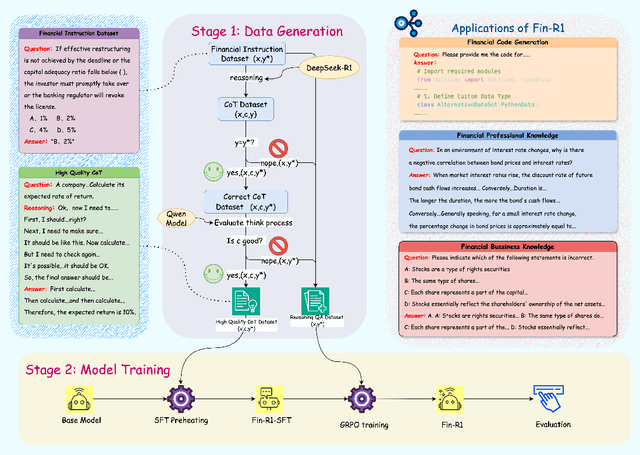
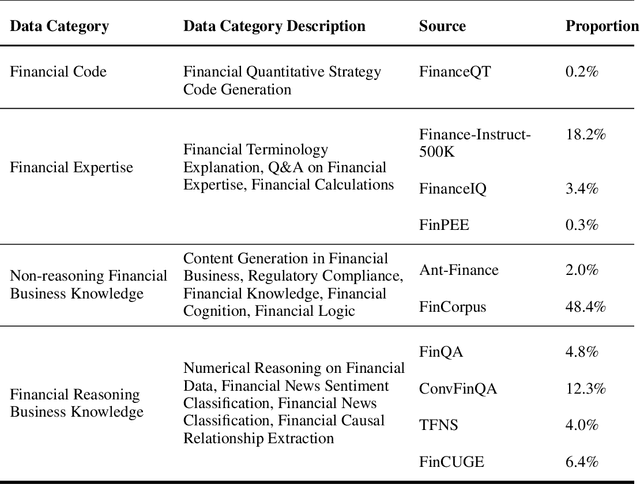
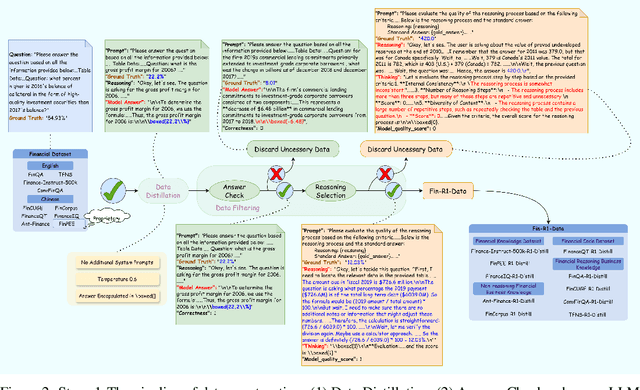
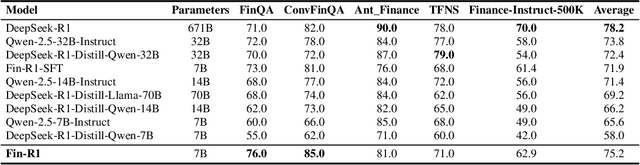
Reasoning large language models are rapidly evolving across various domains. However, their capabilities in handling complex financial tasks still require in-depth exploration. In this paper, we introduce Fin-R1, a reasoning large language model specifically designed for the financial sector. Fin-R1 is built using a two-stage architecture, leveraging a financial reasoning dataset distilled and processed based on DeepSeek-R1. Through supervised fine-tuning (SFT) and reinforcement learning (RL) training, it demonstrates performance close to DeepSeek-R1 with a parameter size of 7 billion across a range of financial reasoning tasks. It achieves the state-of-the-art (SOTA) in the FinQA and ConvFinQA tasks between those LLMs in our evaluation, surpassing larger models in other tasks as well. Fin-R1 showcases strong reasoning and decision-making capabilities, providing solutions to various problems encountered in the financial domain. Our code is available at https://github.com/SUFE-AIFLM-Lab/Fin-R1.