 Add to Chrome
 Add to Firefox
 Add to Edge
CogRail: Benchmarking VLMs in Cognitive Intrusion Perception for Intelligent Railway Transportation Systems
Jan 14, 2026
Accurate and early perception of potential intrusion targets is essential for ensuring the safety of railway transportation systems. However, most existing systems focus narrowly on object classification within fixed visual scopes and apply rule-based heuristics to determine intrusion status, often overlooking targets that pose latent intrusion risks. Anticipating such risks requires the cognition of spatial context and temporal dynamics for the object of interest (OOI), which presents challenges for conventional visual models. To facilitate deep intrusion perception, we introduce a novel benchmark, CogRail, which integrates curated open-source datasets with cognitively driven question-answer annotations to support spatio-temporal reasoning and prediction. Building upon this benchmark, we conduct a systematic evaluation of state-of-the-art visual-language models (VLMs) using multimodal prompts to identify their strengths and limitations in this domain. Furthermore, we fine-tune VLMs for better performance and propose a joint fine-tuning framework that integrates three core tasks, position perception, movement prediction, and threat analysis, facilitating effective adaptation of general-purpose foundation models into specialized models tailored for cognitive intrusion perception. Extensive experiments reveal that current large-scale multimodal models struggle with the complex spatial-temporal reasoning required by the cognitive intrusion perception task, underscoring the limitations of existing foundation models in this safety-critical domain. In contrast, our proposed joint fine-tuning framework significantly enhances model performance by enabling targeted adaptation to domain-specific reasoning demands, highlighting the advantages of structured multi-task learning in improving both accuracy and interpretability. Code will be available at https://github.com/Hub-Tian/CogRail.

An optimization method for out-of-distribution anomaly detection models
Feb 02, 2023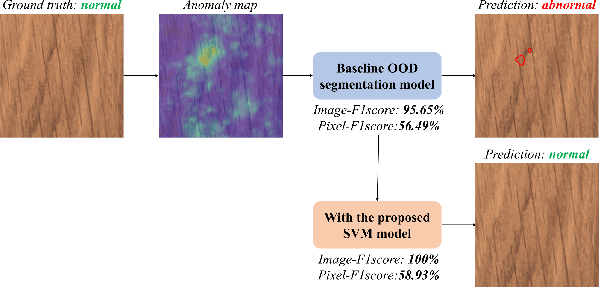
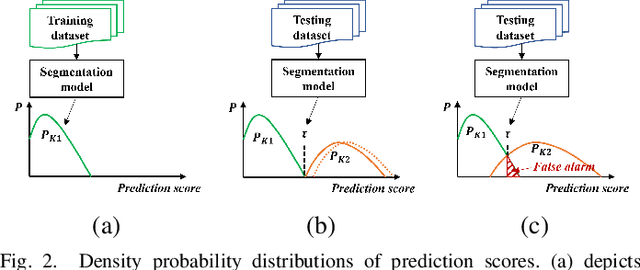
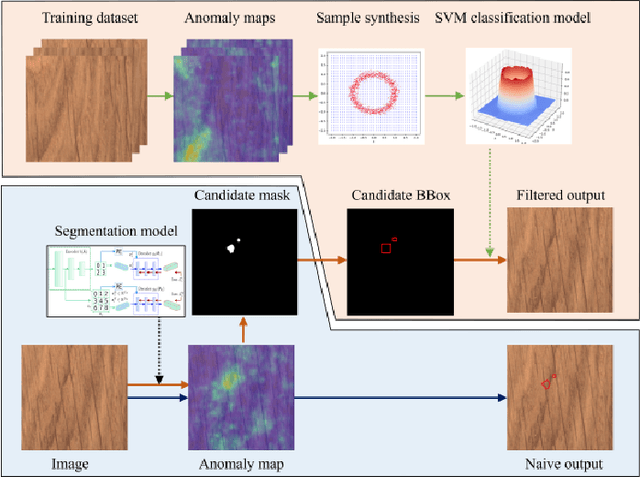
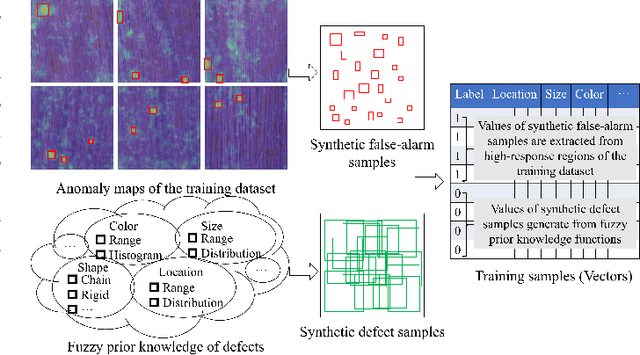
Frequent false alarms impede the promotion of unsupervised anomaly detection algorithms in industrial applications. Potential characteristics of false alarms depending on the trained detector are revealed by investigating density probability distributions of prediction scores in the out-of-distribution anomaly detection tasks. An SVM-based classifier is exploited as a post-processing module to identify false alarms from the anomaly map at the object level. Besides, a sample synthesis strategy is devised to incorporate fuzzy prior knowledge on the specific application in the anomaly-free training dataset. Experimental results illustrate that the proposed method comprehensively improves the performances of two segmentation models at both image and pixel levels on two industrial applications.