 Add to Chrome
 Add to Firefox
 Add to Edge
Test Time Training for Supervised Causal Learning
May 28, 2026
Supervised Causal Learning (SCL) has shown promise in causal discovery by framing it as a supervised learning problem. However, it suffers from significant out-of-distribution generalization challenges. We reveal three limitations of previous SCL practices: a significant performance gap between synthetic benchmarks and real-world data, fragility to distribution shifts, and failure in compositional generalization, collectively questioning its real-world applicability. To address this, we propose Test-Time Training for Supervised Causal Learning (TTT-SCL), a novel framework that dynamically generates training sets explicitly aligned with any specific test instance. We demonstrate the correlation between TTT-SCL and score-based methods, and design an efficient module for generating training sets based on the classic scoring function. Experiments on synthetic benchmarks, pseudo-real and real-world datasets demonstrate that TTT-SCL significantly outperforms existing SCL and traditional causal discovery methods.

Molecule-dynamic-based Aging Clock and Aging Roadmap Forecast with Sundial
Jan 04, 2025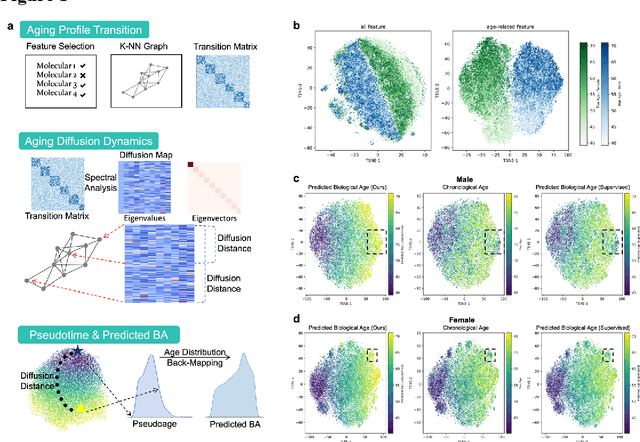
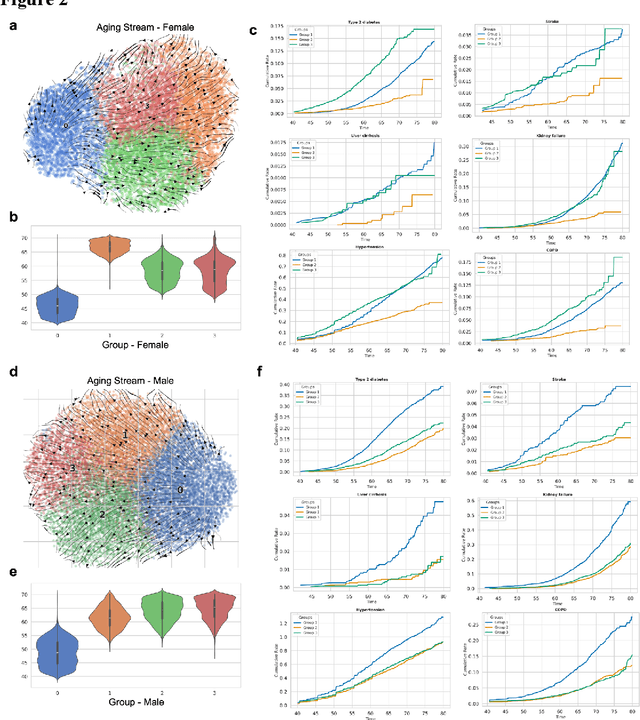
Addressing the unavoidable bias inherent in supervised aging clocks, we introduce Sundial, a novel framework that models molecular dynamics through a diffusion field, capturing both the population-level aging process and the individual-level relative aging order. Sundial enables unbiasedestimation of biological age and the forecast of aging roadmap. Fasteraging individuals from Sundial exhibit a higher disease risk compared to those identified from supervised aging clocks. This framework opens new avenues for exploring key topics, including age- and sex-specific aging dynamics and faster yet healthy aging paths.
Deep Causal Learning: Representation, Discovery and Inference
Nov 07, 2022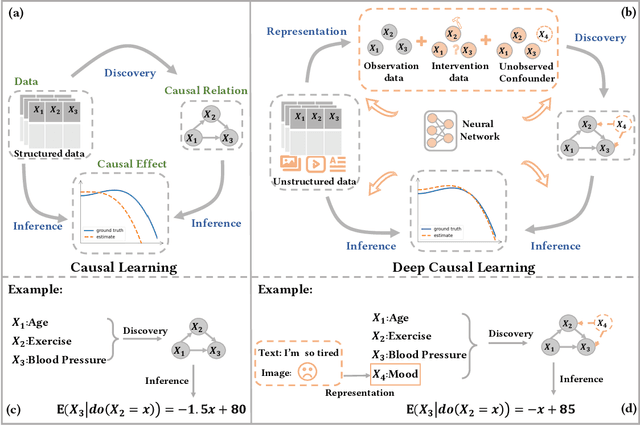
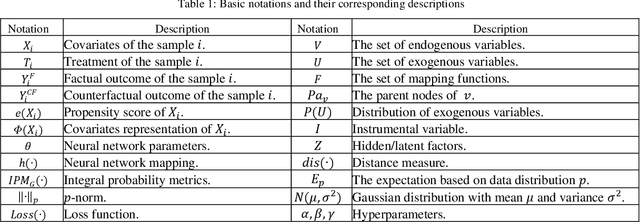

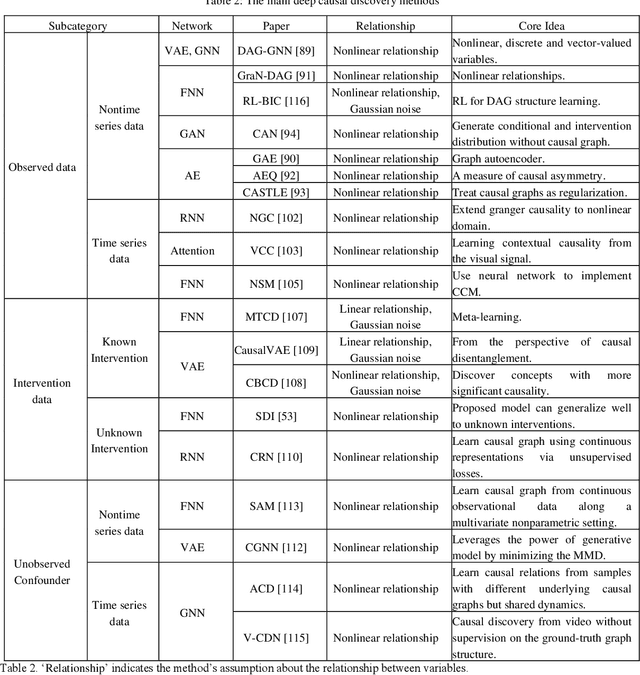
Causal learning has attracted much attention in recent years because causality reveals the essential relationship between things and indicates how the world progresses. However, there are many problems and bottlenecks in traditional causal learning methods, such as high-dimensional unstructured variables, combinatorial optimization problems, unknown intervention, unobserved confounders, selection bias and estimation bias. Deep causal learning, that is, causal learning based on deep neural networks, brings new insights for addressing these problems. While many deep learning-based causal discovery and causal inference methods have been proposed, there is a lack of reviews exploring the internal mechanism of deep learning to improve causal learning. In this article, we comprehensively review how deep learning can contribute to causal learning by addressing conventional challenges from three aspects: representation, discovery, and inference. We point out that deep causal learning is important for the theoretical extension and application expansion of causal science and is also an indispensable part of general artificial intelligence. We conclude the article with a summary of open issues and potential directions for future work.