 Add to Chrome
 Add to Firefox
 Add to Edge
Retrieval Grounding Latent Reasoning for Dense Retrieval
Aug 14, 2026
Reasoning-intensive retrieval requires text representations to capture not only semantic similarity, but also the reasoning needed to determine relevance under a given retrieval instruction. Existing reasoning-enhanced embedding models improve retrieval by incorporating reasoning information into dense representations, yet their supervision is typically dominated by the final retrieval objective. As a result, latent reasoning trajectories may learn shortcut reasoning patterns that preserve retrieval performance without producing meaningful incremental retrieval gains. We propose Retrieval Grounding Latent Reasoning (RGLT), a latent reasoning framework for dense retrieval that explicitly connects intermediate latent transitions with retrieval improvements. RGLT performs non-autoregressive reasoning in hidden space through an instruction-conditioned latent reasoning trajectory constructed from silent tokens. It combines process-supervised explicit-to-implicit distillation with retrieval-grounded supervision, using stage-wise CoT reconstruction to shape intermediate latent states and retrieval-effect credit to optimize incremental retrieval gains across the latent reasoning trajectories. Experiments on reasoning-intensive retrieval benchmarks show that RGLT consistently outperforms strong baselines while preserving efficient embedding inference.

Deep Causal Learning: Representation, Discovery and Inference
Nov 07, 2022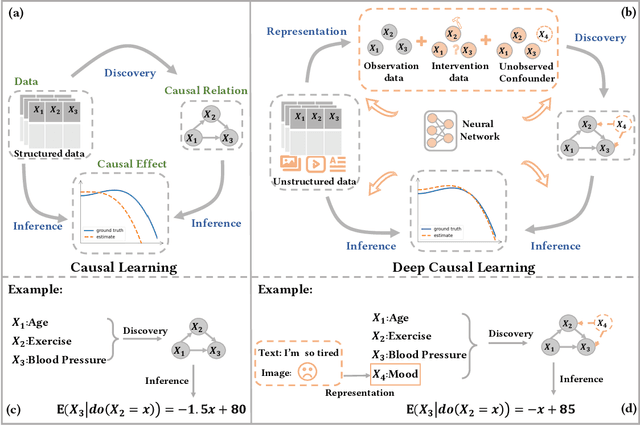

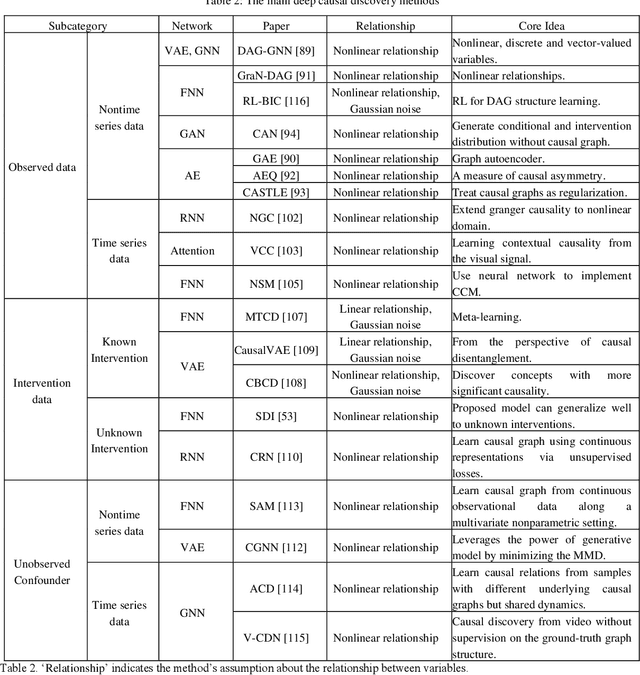
Causal learning has attracted much attention in recent years because causality reveals the essential relationship between things and indicates how the world progresses. However, there are many problems and bottlenecks in traditional causal learning methods, such as high-dimensional unstructured variables, combinatorial optimization problems, unknown intervention, unobserved confounders, selection bias and estimation bias. Deep causal learning, that is, causal learning based on deep neural networks, brings new insights for addressing these problems. While many deep learning-based causal discovery and causal inference methods have been proposed, there is a lack of reviews exploring the internal mechanism of deep learning to improve causal learning. In this article, we comprehensively review how deep learning can contribute to causal learning by addressing conventional challenges from three aspects: representation, discovery, and inference. We point out that deep causal learning is important for the theoretical extension and application expansion of causal science and is also an indispensable part of general artificial intelligence. We conclude the article with a summary of open issues and potential directions for future work.