 Add to Chrome
 Add to Firefox
 Add to Edge
Chronos: Learning Temporal Dynamics of Reasoning Chains for Test-Time Scaling
Feb 01, 2026
Test-Time Scaling (TTS) has emerged as an effective paradigm for improving the reasoning performance of large language models (LLMs). However, existing methods -- most notably majority voting and heuristic token-level scoring -- treat reasoning traces or tokens equally, thereby being susceptible to substantial variations in trajectory quality and localized logical failures. In this work, we introduce \textbf{Chronos}, a lightweight and plug-and-play chronological reasoning scorer that models each trajectory as a time series. Specifically, Chronos learns to capture trajectory features of token probabilities, assigns quality scores accordingly, and employs a weighted voting mechanism. Extensive evaluations on both in-domain and out-of-domain benchmarks demonstrate that Chronos consistently delivers substantial gains across a variety of models, with negligible computational overhead. Notably, Chronos@128 achieves relative improvements of 34.21\% over Pass@1 and 22.70\% over Maj@128 on HMMT25 using Qwen3-4B-Thinking-2507, highlighting its effectiveness.

Aerial Path Online Planning for Urban Scene Updation
May 02, 2025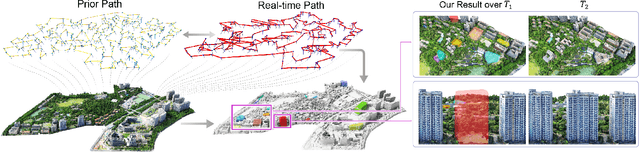

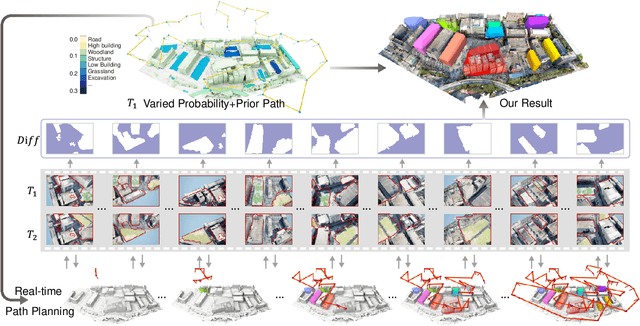
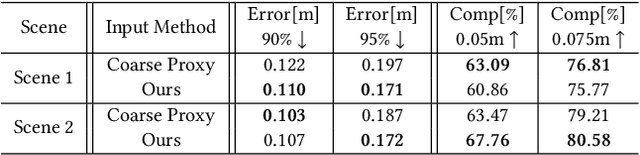
We present the first scene-update aerial path planning algorithm specifically designed for detecting and updating change areas in urban environments. While existing methods for large-scale 3D urban scene reconstruction focus on achieving high accuracy and completeness, they are inefficient for scenarios requiring periodic updates, as they often re-explore and reconstruct entire scenes, wasting significant time and resources on unchanged areas. To address this limitation, our method leverages prior reconstructions and change probability statistics to guide UAVs in detecting and focusing on areas likely to have changed. Our approach introduces a novel changeability heuristic to evaluate the likelihood of changes, driving the planning of two flight paths: a prior path informed by static priors and a dynamic real-time path that adapts to newly detected changes. The framework integrates surface sampling and candidate view generation strategies, ensuring efficient coverage of change areas with minimal redundancy. Extensive experiments on real-world urban datasets demonstrate that our method significantly reduces flight time and computational overhead, while maintaining high-quality updates comparable to full-scene re-exploration and reconstruction. These contributions pave the way for efficient, scalable, and adaptive UAV-based scene updates in complex urban environments.