 Add to Chrome
 Add to Firefox
 Add to Edge
PAMF: Prior-Aware Multimodal Fusion for Incomplete Time Series Data
Jun 04, 2026
In healthcare, multimodal time series tasks often operate on incomplete observations in practice, for example when ECG segments are lost because electrodes detach or an entire respiratory channel is unavailable during overnight monitoring. Such missingness typically appears in two structurally distinct patterns: within-modality missing, where values are absent within an otherwise observed modality, and modality-level missing, where an entire modality is unavailable. Existing methods typically represent unobserved data implicitly through masks or missing embeddings, without learning instance-specific missing information, and most are designed for only one missingness pattern. A natural approach is to explicitly estimate the missing data; however, existing imputation methods treat missingness uniformly despite their different structural priors, and the imputation process is often isolated from downstream tasks, preventing downstream tasks from guiding imputation toward more informative representations. To address these limitations, we present PAMF, a multimodal time-series framework that explicitly handles different missingness patterns while coupling imputation with downstream prediction through prior-aware flow matching and weight sharing. Specifically, the method initializes the flow-matching source state with type-specific priors to distinguish two missing types. It further connects imputation and classification through architecturally matched encoders with weight sharing, transferring task-relevant representations into the imputation process. Experiments on multiple multimodal healthcare time-series benchmarks show that the proposed method achieves the strongest overall downstream performance across diverse datasets and missing settings compared with existing baselines.

TRACE: A Temporal Conditional Estimation for Multimodal Time Series Foundation Models
Jun 04, 2026Time series foundation models (TS-FMs) aim to learn generalizable temporal representations that can be adapted to a wide range of downstream tasks. In real-world multimodal settings, time series are frequently affected by temporal misalignment and partial modality missingness, where different modalities are observed at heterogeneous time scales or are partially absent. Existing approaches typically rely on naive imputation or masking strategies, which fail to account for cross-modal dependencies and often lead to misaligned or degraded representations. We propose TRACE, a conditional estimation paradigm for multimodal time series foundation model pipelines under missingness and irregular sampling, allowing incomplete target modalities to be systematically inferred from available auxiliary modalities. We evaluate TRACE on diverse multimodal benchmarks spanning healthcare and affective computing, including the MIMIC-IV clinical dataset and the CMU-MOSI and CMU-MOSEI benchmarks for multimodal sentiment analysis. Across a range of downstream prediction tasks and missing-modality settings, TRACE consistently outperforms prior multimodal fusion approaches, demonstrating improved robustness to severe modality missingness and more reliable cross-modal representations.
Conditional Imputation for Within-Modality Missingness in Multi-Modal Federated Learning
Apr 25, 2026Multimodal Federated Learning (MMFL) enables privacy-preserving collaborative training, but real-world clinical applications often suffer from within-modality missingness caused by sensor intermittency or irregular sampling. Existing methods implicitly represent unobserved data via architectural alignment or missing embeddings, often failing to recover the true distribution and yielding sub-optimal performance. We propose CondI, a federated framework explicitly addressing this missingness using conditional diffusion models. CondI employs a two-phase training pipeline: first, imputing unobserved temporal components using available multimodal context and conditional embeddings; second, optimizing modality-specific extractors and joint embedding spaces. During inference, imputed raw data pass through trained extractors to generate robust features, providing a holistic representation for downstream tasks. Explicit data imputation ensures models operate on complete semantic structures, significantly enhancing resilience against severe data incompleteness. Experiments on three clinical datasets (PTB-XL, SLEEP-EDF, MIMIC-IV) demonstrate CondI achieves comparable results to state-of-the-art baselines. Code: https://github.com/ZhengWugeng/CondI
Implet: A Post-hoc Subsequence Explainer for Time Series Models
May 13, 2025Explainability in time series models is crucial for fostering trust, facilitating debugging, and ensuring interpretability in real-world applications. In this work, we introduce Implet, a novel post-hoc explainer that generates accurate and concise subsequence-level explanations for time series models. Our approach identifies critical temporal segments that significantly contribute to the model's predictions, providing enhanced interpretability beyond traditional feature-attribution methods. Based on it, we propose a cohort-based (group-level) explanation framework designed to further improve the conciseness and interpretability of our explanations. We evaluate Implet on several standard time-series classification benchmarks, demonstrating its effectiveness in improving interpretability. The code is available at https://github.com/LbzSteven/implet
Benchmarking Counterfactual Interpretability in Deep Learning Models for Time Series Classification
Aug 22, 2024The popularity of deep learning methods in the time series domain boosts interest in interpretability studies, including counterfactual (CF) methods. CF methods identify minimal changes in instances to alter the model predictions. Despite extensive research, no existing work benchmarks CF methods in the time series domain. Additionally, the results reported in the literature are inconclusive due to the limited number of datasets and inadequate metrics. In this work, we redesign quantitative metrics to accurately capture desirable characteristics in CFs. We specifically redesign the metrics for sparsity and plausibility and introduce a new metric for consistency. Combined with validity, generation time, and proximity, we form a comprehensive metric set. We systematically benchmark 6 different CF methods on 20 univariate datasets and 10 multivariate datasets with 3 different classifiers. Results indicate that the performance of CF methods varies across metrics and among different models. Finally, we provide case studies and a guideline for practical usage.
ChaosMining: A Benchmark to Evaluate Post-Hoc Local Attribution Methods in Low SNR Environments
Jun 17, 2024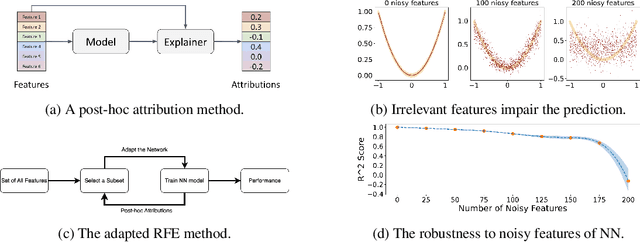

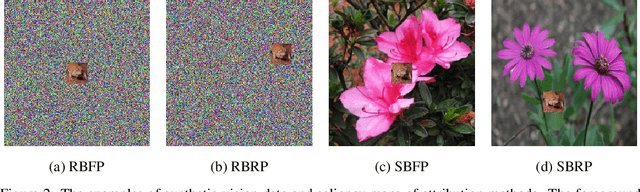

In this study, we examine the efficacy of post-hoc local attribution methods in identifying features with predictive power from irrelevant ones in domains characterized by a low signal-to-noise ratio (SNR), a common scenario in real-world machine learning applications. We developed synthetic datasets encompassing symbolic functional, image, and audio data, incorporating a benchmark on the {\it (Model \(\times\) Attribution\(\times\) Noise Condition)} triplet. By rigorously testing various classic models trained from scratch, we gained valuable insights into the performance of these attribution methods in multiple conditions. Based on these findings, we introduce a novel extension to the notable recursive feature elimination (RFE) algorithm, enhancing its applicability for neural networks. Our experiments highlight its strengths in prediction and feature selection, alongside limitations in scalability. Further details and additional minor findings are included in the appendix, with extensive discussions. The codes and resources are available at \href{https://github.com/geshijoker/ChaosMining/}{URL}.