 Add to Chrome
 Add to Firefox
 Add to Edge
Multi-scale Decomposed Convolution Refinement Network for Visible-Infrared Person Re-Identification
Aug 17, 2026
Visible-infrared person re-identification (VI-ReID) suffers from cross-modal discrepancies and limited discriminative capabilities, leading to suboptimal recognition performance. Current approaches exhibit limitations in semantic mining, cross-modal fusion and feature constraints. To tackle these challenges, we propose MDCRNet, a Multi-scale Decomposed Convolution Refinement Network that enhances cross-modal feature learning and discriminative metric learning. Specifically, we introduce a Hierarchical Learning Module (HLM) containing four Hierarchical Decomposed Convolution Attention (HDCA) modules, each equipped with lightweight channel attention and multi-scale spatial perception blocks to capture multi-scale spatial dependencies. Moreover, we develop a Joint Discriminative Metric Loss (JDML) incorporating a novel Granularity Discriminative Loss (GDL) that simultaneously optimizes intra-identity compactness and inter-identity separability across modalities. Extensive experiments on SYSU-MM01 and RegDB datasets demonstrate that MDCRNet achieves state-of-the-art performance on both benchmarks. Code is available at https://github.com/Kevin-zms/MDCRNet.

Deep learning-derived arterial input function
May 30, 2025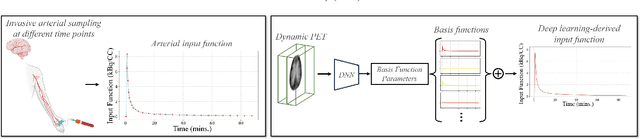

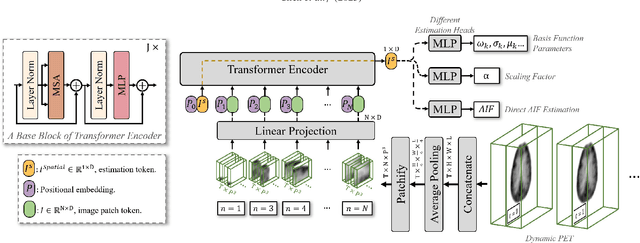
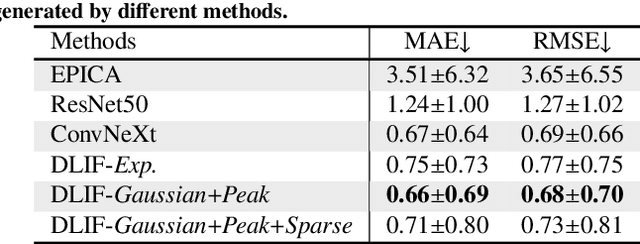
Dynamic positron emission tomography (PET) imaging combined with radiotracer kinetic modeling is a powerful technique for visualizing biological processes in the brain, offering valuable insights into brain functions and neurological disorders such as Alzheimer's and Parkinson's diseases. Accurate kinetic modeling relies heavily on the use of a metabolite-corrected arterial input function (AIF), which typically requires invasive and labor-intensive arterial blood sampling. While alternative non-invasive approaches have been proposed, they often compromise accuracy or still necessitate at least one invasive blood sampling. In this study, we present the deep learning-derived arterial input function (DLIF), a deep learning framework capable of estimating a metabolite-corrected AIF directly from dynamic PET image sequences without any blood sampling. We validated DLIF using existing dynamic PET patient data. We compared DLIF and resulting parametric maps against ground truth measurements. Our evaluation shows that DLIF achieves accurate and robust AIF estimation. By leveraging deep learning's ability to capture complex temporal dynamics and incorporating prior knowledge of typical AIF shapes through basis functions, DLIF provides a rapid, accurate, and entirely non-invasive alternative to traditional AIF measurement methods.