 Add to Chrome
 Add to Firefox
 Add to Edge
StreetForward: Perceiving Dynamic Street with Feedforward Causal Attention
Mar 20, 2026
Feedforward reconstruction is crucial for autonomous driving applications, where rapid scene reconstruction enables efficient utilization of large-scale driving datasets in closed-loop simulation and other downstream tasks, eliminating the need for time-consuming per-scene optimization. We present StreetForward, a pose-free and tracker-free feedforward framework for dynamic street reconstruction. Building upon the alternating attention mechanism from Visual Geometry Grounded Transformer (VGGT), we propose a simple yet effective temporal mask attention module that captures dynamic motion information from image sequences and produces motion-aware latent representations. Static content and dynamic instances are represented uniformly with 3D Gaussian Splatting, and are optimized jointly by cross-frame rendering with spatio-temporal consistency, allowing the model to infer per-pixel velocities and produce high-fidelity novel views at new poses and times. We train and evaluate our model on the Waymo Open Dataset, demonstrating superior performance on novel view synthesis and depth estimation compared to existing methods. Furthermore, zero-shot inference on CARLA and other datasets validates the generalization capability of our approach. More visualizations are available on our project page: https://streetforward.github.io.

SGD: Street View Synthesis with Gaussian Splatting and Diffusion Prior
Mar 29, 2024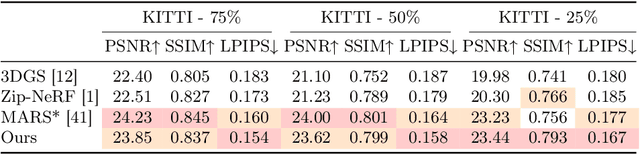
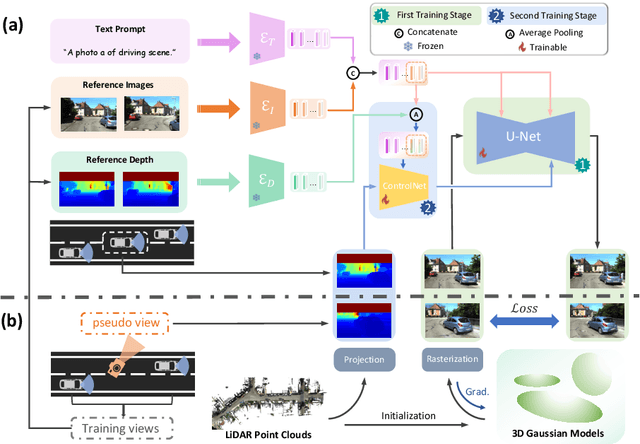
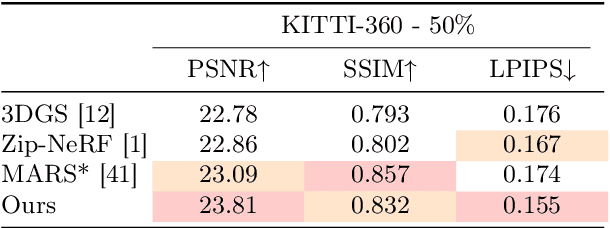

Novel View Synthesis (NVS) for street scenes play a critical role in the autonomous driving simulation. The current mainstream technique to achieve it is neural rendering, such as Neural Radiance Fields (NeRF) and 3D Gaussian Splatting (3DGS). Although thrilling progress has been made, when handling street scenes, current methods struggle to maintain rendering quality at the viewpoint that deviates significantly from the training viewpoints. This issue stems from the sparse training views captured by a fixed camera on a moving vehicle. To tackle this problem, we propose a novel approach that enhances the capacity of 3DGS by leveraging prior from a Diffusion Model along with complementary multi-modal data. Specifically, we first fine-tune a Diffusion Model by adding images from adjacent frames as condition, meanwhile exploiting depth data from LiDAR point clouds to supply additional spatial information. Then we apply the Diffusion Model to regularize the 3DGS at unseen views during training. Experimental results validate the effectiveness of our method compared with current state-of-the-art models, and demonstrate its advance in rendering images from broader views.
HiCAST: Highly Customized Arbitrary Style Transfer with Adapter Enhanced Diffusion Models
Jan 11, 2024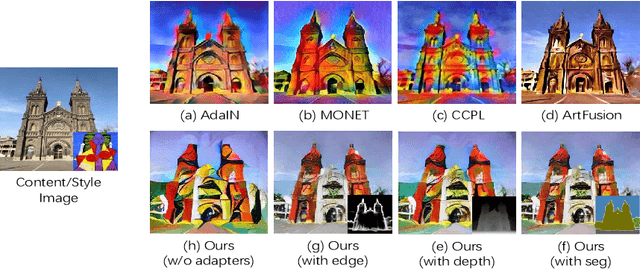


The goal of Arbitrary Style Transfer (AST) is injecting the artistic features of a style reference into a given image/video. Existing methods usually focus on pursuing the balance between style and content, whereas ignoring the significant demand for flexible and customized stylization results and thereby limiting their practical application. To address this critical issue, a novel AST approach namely HiCAST is proposed, which is capable of explicitly customizing the stylization results according to various source of semantic clues. In the specific, our model is constructed based on Latent Diffusion Model (LDM) and elaborately designed to absorb content and style instance as conditions of LDM. It is characterized by introducing of \textit{Style Adapter}, which allows user to flexibly manipulate the output results by aligning multi-level style information and intrinsic knowledge in LDM. Lastly, we further extend our model to perform video AST. A novel learning objective is leveraged for video diffusion model training, which significantly improve cross-frame temporal consistency in the premise of maintaining stylization strength. Qualitative and quantitative comparisons as well as comprehensive user studies demonstrate that our HiCAST outperforms the existing SoTA methods in generating visually plausible stylization results.