 Add to Chrome
 Add to Firefox
 Add to Edge
ScienceFlow: A long-horizon agent for ML research, scientific discovery and beyond
Aug 14, 2026
Enabling LLM agents to sustain productive, stable, and goal-aligned research over extended horizons is a central challenge for autonomous machine learning and scientific discovery, as progress hinges on continuously managing evolving state, exploration decisions, and computational resources. Pioneering autoresearch agents, despite great success, still lack mechanisms for continuity, recovery from dead ends, and value-driven compute allocation, which inherently undermines overall search efficiency, wastes computational resources, and lowers the chance of ultimate success. To bridge this gap, we introduce ScienceFlow, an end-to-end autoresearch agent framework that organizes long-horizon research work into research segments grounded in executable workspaces. It represents research progress as recoverable executable states, enabling efficient exploration, revision, and execution. Transitions between research segments are governed by Executable-State Transition through Re-Anchoring (ESTRA), which selects either the live state or an archived state as the next anchor and determines whether to continue or redirect the research trajectory. An evidence-aware execution controller allocates resources to physical jobs based on resource availability, remaining budget, and validated progress. We evaluate ScienceFlow on tasks spanning machine learning, scientific modeling, and mathematical optimization. Results on diverse long-horizon benchmarks demonstrate its ability to sustain effective research processes, highlighted by a SOTA 70.22 percent Any-Medal score on the full MLE-bench within a 24-hour budget, outperforming prior reported results by 4.92 percentage points. The efficacy of ScienceFlow further demonstrates that efficient state management, adaptive exploration, and objective-aligned execution are critical for scaling autonomous research beyond short-horizon interactions.

Vision Meets WiFi: Physics-Grounded Estimation of Volumetric Mechanical Properties
Aug 07, 2026Estimating volumetric mechanical properties, including Young's modulus, Poisson's ratio, and density at each voxel, is intrinsically ambiguous from vision alone, as visually similar objects may have substantially different material compositions and physical behavior. Existing approaches predict these properties independently across voxels, overlooking the piecewise-constant material structure of real objects and producing noisy or inconsistent estimates for voxels that share the same material, while lacking an explicit mechanism to resolve visual ambiguity. We introduce ViWi (Vision Meets WiFi), an object-centric framework for volumetric mechanical-property estimation. ViWi represents each object using a compact set of material slots that aggregate evidence from voxels with a shared material identity and produce coherent slot-level property predictions. To complement visual appearance, ViWi incorporates a compact RF descriptor generated through WiFi-band electromagnetic simulation using permittivity and conductivity. The RF descriptor conditions the material slots with global composition cues that may be unavailable from images, while visual features preserve voxel-level spatial localization. Across volumetric mechanical-property and mass-estimation benchmarks, ViWi improves over the prior state of the art on four of six per-voxel metrics, while its vision-only variant improves all mass-estimation metrics. These results demonstrate that combining object-centric material structure with complementary RF evidence enables more accurate and physically coherent volumetric property estimation beyond what is possible from visual appearance alone.
Hista and Numca: Estimate State Value Effectively for LLM Reinforcement Learning
May 28, 2026Reinforcement learning (RL) refines large language models (LLMs) by directly optimizing model behavior through reward signals. While accurate state value estimation is critical for stable training in classical RL, it remains an underexplored challenge in LLM post-training. In this work, we introduce the State Value Estimation Benchmark (SVEB) to assess state estimation within existing RL frameworks and show that critics in standard approaches like PPO collapse to a coarse group-average baseline. To address this, we propose two techniques: Numca, which leverages numerical spans as gradable milestones for state value estimation, and Hista, a framework that uses LLM's hidden states as representation to weighted average disjoint rollouts and their return. Extensive experiments demonstrate that both methods yield more accurate state value estimates and enhance training performance across different RL algorithms and model sizes without incurring significant computational overhead.
Learning Design-Score Manifold to Guide Diffusion Models for Offline Optimization
Jun 06, 2025Optimizing complex systems, from discovering therapeutic drugs to designing high-performance materials, remains a fundamental challenge across science and engineering, as the underlying rules are often unknown and costly to evaluate. Offline optimization aims to optimize designs for target scores using pre-collected datasets without system interaction. However, conventional approaches may fail beyond training data, predicting inaccurate scores and generating inferior designs. This paper introduces ManGO, a diffusion-based framework that learns the design-score manifold, capturing the design-score interdependencies holistically. Unlike existing methods that treat design and score spaces in isolation, ManGO unifies forward prediction and backward generation, attaining generalization beyond training data. Key to this is its derivative-free guidance for conditional generation, coupled with adaptive inference-time scaling that dynamically optimizes denoising paths. Extensive evaluations demonstrate that ManGO outperforms 24 single- and 10 multi-objective optimization methods across diverse domains, including synthetic tasks, robot control, material design, DNA sequence, and real-world engineering optimization.
Proximalized Preference Optimization for Diverse Feedback Types: A Decomposed Perspective on DPO
May 29, 2025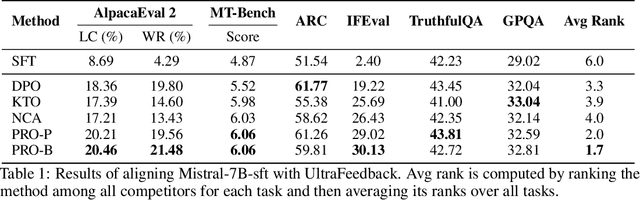
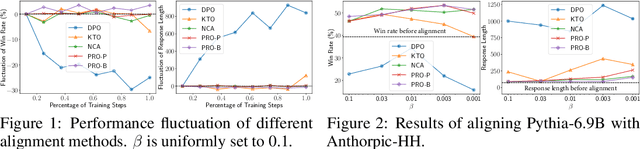
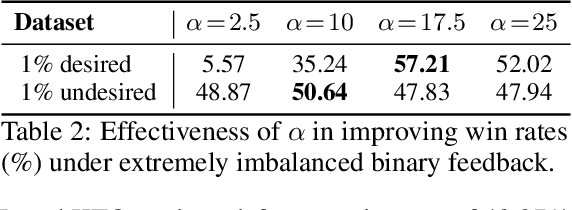

Direct alignment methods typically optimize large language models (LLMs) by contrasting the likelihoods of preferred versus dispreferred responses. While effective in steering LLMs to match relative preference, these methods are frequently noted for decreasing the absolute likelihoods of example responses. As a result, aligned models tend to generate outputs that deviate from the expected patterns, exhibiting reward-hacking effect even without a reward model. This undesired consequence exposes a fundamental limitation in contrastive alignment, which we characterize as likelihood underdetermination. In this work, we revisit direct preference optimization (DPO) -- the seminal direct alignment method -- and demonstrate that its loss theoretically admits a decomposed reformulation. The reformulated loss not only broadens applicability to a wider range of feedback types, but also provides novel insights into the underlying cause of likelihood underdetermination. Specifically, the standard DPO implementation implicitly oversimplifies a regularizer in the reformulated loss, and reinstating its complete version effectively resolves the underdetermination issue. Leveraging these findings, we introduce PRoximalized PReference Optimization (PRO), a unified method to align with diverse feeback types, eliminating likelihood underdetermination through an efficient approximation of the complete regularizer. Comprehensive experiments show the superiority of PRO over existing methods in scenarios involving pairwise, binary and scalar feedback.
Generative Models in Decision Making: A Survey
Feb 25, 2025In recent years, the exceptional performance of generative models in generative tasks has sparked significant interest in their integration into decision-making processes. Due to their ability to handle complex data distributions and their strong model capacity, generative models can be effectively incorporated into decision-making systems by generating trajectories that guide agents toward high-reward state-action regions or intermediate sub-goals. This paper presents a comprehensive review of the application of generative models in decision-making tasks. We classify seven fundamental types of generative models: energy-based models, generative adversarial networks, variational autoencoders, normalizing flows, diffusion models, generative flow networks, and autoregressive models. Regarding their applications, we categorize their functions into three main roles: controllers, modelers and optimizers, and discuss how each role contributes to decision-making. Furthermore, we examine the deployment of these models across five critical real-world decision-making scenarios. Finally, we summarize the strengths and limitations of current approaches and propose three key directions for advancing next-generation generative directive models: high-performance algorithms, large-scale generalized decision-making models, and self-evolving and adaptive models.
Causal Coordinated Concurrent Reinforcement Learning
Jan 31, 2024In this work, we propose a novel algorithmic framework for data sharing and coordinated exploration for the purpose of learning more data-efficient and better performing policies under a concurrent reinforcement learning (CRL) setting. In contrast to other work which make the assumption that all agents act under identical environments, we relax this restriction and instead consider the formulation where each agent acts within an environment which shares a global structure but also exhibits individual variations. Our algorithm leverages a causal inference algorithm in the form of Additive Noise Model - Mixture Model (ANM-MM) in extracting model parameters governing individual differentials via independence enforcement. We propose a new data sharing scheme based on a similarity measure of the extracted model parameters and demonstrate superior learning speeds on a set of autoregressive, pendulum and cart-pole swing-up tasks and finally, we show the effectiveness of diverse action selection between common agents under a sparse reward setting. To the best of our knowledge, this is the first work in considering non-identical environments in CRL and one of the few works which seek to integrate causal inference with reinforcement learning (RL).
Causal Discovery by Kernel Deviance Measures with Heterogeneous Transforms
Jan 31, 2024The discovery of causal relationships in a set of random variables is a fundamental objective of science and has also recently been argued as being an essential component towards real machine intelligence. One class of causal discovery techniques are founded based on the argument that there are inherent structural asymmetries between the causal and anti-causal direction which could be leveraged in determining the direction of causation. To go about capturing these discrepancies between cause and effect remains to be a challenge and many current state-of-the-art algorithms propose to compare the norms of the kernel mean embeddings of the conditional distributions. In this work, we argue that such approaches based on RKHS embeddings are insufficient in capturing principal markers of cause-effect asymmetry involving higher-order structural variabilities of the conditional distributions. We propose Kernel Intrinsic Invariance Measure with Heterogeneous Transform (KIIM-HT) which introduces a novel score measure based on heterogeneous transformation of RKHS embeddings to extract relevant higher-order moments of the conditional densities for causal discovery. Inference is made via comparing the score of each hypothetical cause-effect direction. Tests and comparisons on a synthetic dataset, a two-dimensional synthetic dataset and the real-world benchmark dataset T\"ubingen Cause-Effect Pairs verify our approach. In addition, we conduct a sensitivity analysis to the regularization parameter to faithfully compare previous work to our method and an experiment with trials on varied hyperparameter values to showcase the robustness of our algorithm.
Efficient Robust Bayesian Optimization for Arbitrary Uncertain Inputs
Nov 03, 2023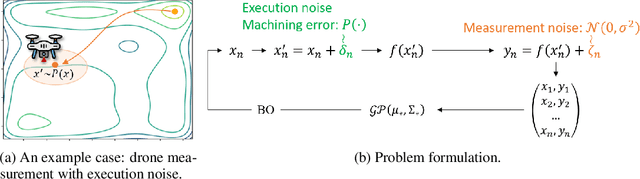
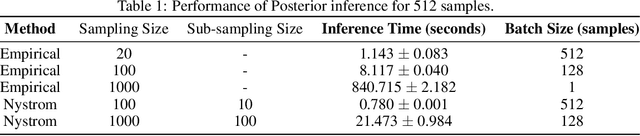
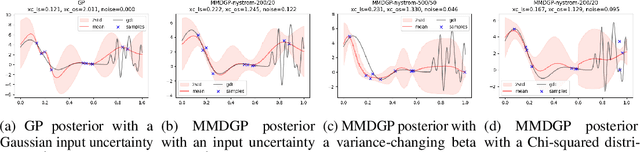
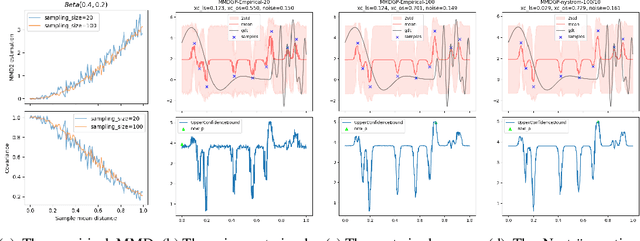
Bayesian Optimization (BO) is a sample-efficient optimization algorithm widely employed across various applications. In some challenging BO tasks, input uncertainty arises due to the inevitable randomness in the optimization process, such as machining errors, execution noise, or contextual variability. This uncertainty deviates the input from the intended value before evaluation, resulting in significant performance fluctuations in the final result. In this paper, we introduce a novel robust Bayesian Optimization algorithm, AIRBO, which can effectively identify a robust optimum that performs consistently well under arbitrary input uncertainty. Our method directly models the uncertain inputs of arbitrary distributions by empowering the Gaussian Process with the Maximum Mean Discrepancy (MMD) and further accelerates the posterior inference via Nystrom approximation. Rigorous theoretical regret bound is established under MMD estimation error and extensive experiments on synthetic functions and real problems demonstrate that our approach can handle various input uncertainties and achieve state-of-the-art performance.
Convergence guarantee for consistency models
Aug 22, 2023
We provide the first convergence guarantees for the Consistency Models (CMs), a newly emerging type of one-step generative models that can generate comparable samples to those generated by Diffusion Models. Our main result is that, under the basic assumptions on score-matching errors, consistency errors and smoothness of the data distribution, CMs can efficiently sample from any realistic data distribution in one step with small $W_2$ error. Our results (1) hold for $L^2$-accurate score and consistency assumption (rather than $L^\infty$-accurate); (2) do note require strong assumptions on the data distribution such as log-Sobelev inequality; (3) scale polynomially in all parameters; and (4) match the state-of-the-art convergence guarantee for score-based generative models (SGMs). We also provide the result that the Multistep Consistency Sampling procedure can further reduce the error comparing to one step sampling, which support the original statement of "Consistency Models, Yang Song 2023". Our result further imply a TV error guarantee when take some Langevin-based modifications to the output distributions.