 Add to Chrome
 Add to Firefox
 Add to Edge
A Hybrid Framework for Blood Vessel Morphology Classification: Discrete Geometry-based Tortuosity Feature Measurement, Information Gain-based Feature Selection, and Random Forest Classification
Jul 15, 2026
Subjective visual grading of blood vessel tortuosity relies heavily on clinical experience, while traditional distance-based indices often fail to adequately characterize three-dimensional spatial deformation. Because abnormal internal carotid artery morphology may be clinically relevant to cerebrovascular assessment and stroke-risk evaluation, objective and reproducible quantification of vascular tortuosity is of considerable importance. To address this limitation, we propose a mathematical framework for the morphological classification of the internal carotid artery (ICA-C1) segment. The framework integrates discrete geometric feature measurement, Information Gain-based feature selection, and Random Forest classification. An initial set of 13 tortuosity features is extracted from the corresponding 379 clinical vascular centerlines using discrete geometric methods and subsequently reduced to a six-feature subset consisting of $\mathcal{TI}$, $\mathcal{AC}$, $\mathcal{TC}$, $\mathcal{AC}/\mathcal{AT}$, $\mathcal{AT}$, and $\mathcal{TT}$. The framework is evaluated in two classification tasks. For binary classification of non-severe and severe tortuosity, the RF model achieves a Macro-F1 score of 0.9206. For ternary morphological grading into straight, low-tortuosity, and high-tortuosity groups, it achieves a Macro-F1 score of 0.8626. The results indicate that elongation- and curvature-related features provide strong discriminatory information for basic screening, whereas torsion-related features contribute additional information for more detailed morphological classification. Based on the RF feature-importance values, we further define a Morphological Risk Index (MRI), which provides a direct numerical reference for vascular morphology and may facilitate more objective and consistent clinical assessment.

Data-Free Privacy-Preserving for LLMs via Model Inversion and Selective Unlearning
Jan 22, 2026Large language models (LLMs) exhibit powerful capabilities but risk memorizing sensitive personally identifiable information (PII) from their training data, posing significant privacy concerns. While machine unlearning techniques aim to remove such data, they predominantly depend on access to the training data. This requirement is often impractical, as training data in real-world deployments is commonly proprietary or inaccessible. To address this limitation, we propose Data-Free Selective Unlearning (DFSU), a novel privacy-preserving framework that removes sensitive PII from an LLM without requiring its training data. Our approach first synthesizes pseudo-PII through language model inversion, then constructs token-level privacy masks for these synthetic samples, and finally performs token-level selective unlearning via a contrastive mask loss within a low-rank adaptation (LoRA) subspace. Extensive experiments on the AI4Privacy PII-Masking dataset using Pythia models demonstrate that our method effectively removes target PII while maintaining model utility.
Moirai: Towards Optimal Placement for Distributed Inference on Heterogeneous Devices
Dec 26, 2023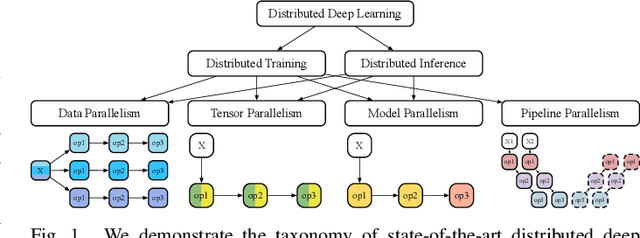
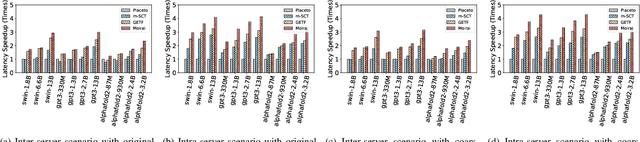
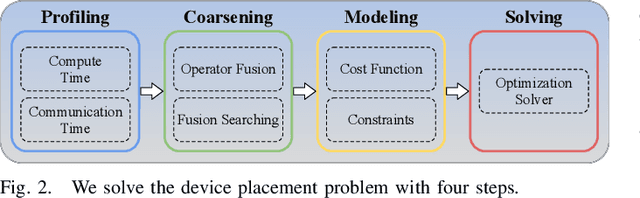
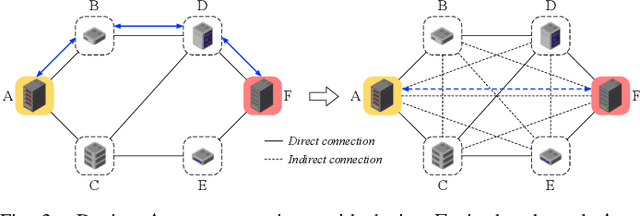
The escalating size of Deep Neural Networks (DNNs) has spurred a growing research interest in hosting and serving DNN models across multiple devices. A number of studies have been reported to partition a DNN model across devices, providing device placement solutions. The methods appeared in the literature, however, either suffer from poor placement performance due to the exponential search space or miss an optimal placement as a consequence of the reduced search space with limited heuristics. Moreover, these methods have ignored the runtime inter-operator optimization of a computation graph when coarsening the graph, which degrades the end-to-end inference performance. This paper presents Moirai that better exploits runtime inter-operator fusion in a model to render a coarsened computation graph, reducing the search space while maintaining the inter-operator optimization provided by inference backends. Moirai also generalizes the device placement algorithm from multiple perspectives by considering inference constraints and device heterogeneity.Extensive experimental evaluation with 11 large DNNs demonstrates that Moirai outperforms the state-of-the-art counterparts, i.e., Placeto, m-SCT, and GETF, up to 4.28$\times$ in reduction of the end-to-end inference latency. Moirai code is anonymously released at \url{https://github.com/moirai-placement/moirai}.