 Add to Chrome
 Add to Firefox
 Add to Edge
A Hybrid Framework for Blood Vessel Morphology Classification: Discrete Geometry-based Tortuosity Feature Measurement, Information Gain-based Feature Selection, and Random Forest Classification
Jul 15, 2026
Subjective visual grading of blood vessel tortuosity relies heavily on clinical experience, while traditional distance-based indices often fail to adequately characterize three-dimensional spatial deformation. Because abnormal internal carotid artery morphology may be clinically relevant to cerebrovascular assessment and stroke-risk evaluation, objective and reproducible quantification of vascular tortuosity is of considerable importance. To address this limitation, we propose a mathematical framework for the morphological classification of the internal carotid artery (ICA-C1) segment. The framework integrates discrete geometric feature measurement, Information Gain-based feature selection, and Random Forest classification. An initial set of 13 tortuosity features is extracted from the corresponding 379 clinical vascular centerlines using discrete geometric methods and subsequently reduced to a six-feature subset consisting of $\mathcal{TI}$, $\mathcal{AC}$, $\mathcal{TC}$, $\mathcal{AC}/\mathcal{AT}$, $\mathcal{AT}$, and $\mathcal{TT}$. The framework is evaluated in two classification tasks. For binary classification of non-severe and severe tortuosity, the RF model achieves a Macro-F1 score of 0.9206. For ternary morphological grading into straight, low-tortuosity, and high-tortuosity groups, it achieves a Macro-F1 score of 0.8626. The results indicate that elongation- and curvature-related features provide strong discriminatory information for basic screening, whereas torsion-related features contribute additional information for more detailed morphological classification. Based on the RF feature-importance values, we further define a Morphological Risk Index (MRI), which provides a direct numerical reference for vascular morphology and may facilitate more objective and consistent clinical assessment.

Music Style Transfer With Diffusion Model
Apr 23, 2024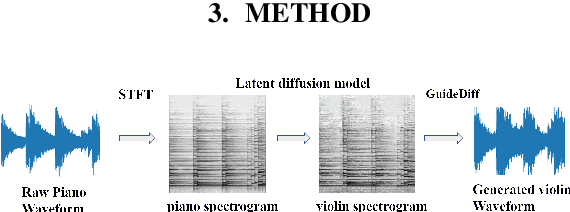
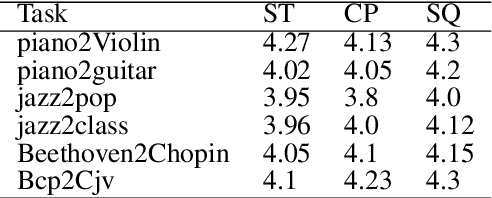
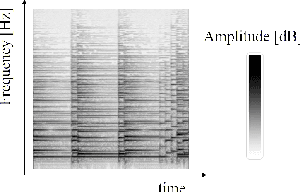
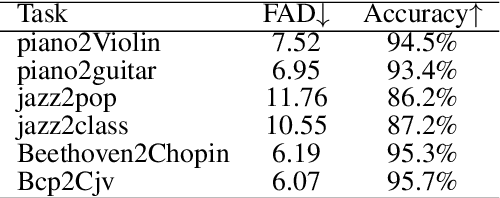
Previous studies on music style transfer have mainly focused on one-to-one style conversion, which is relatively limited. When considering the conversion between multiple styles, previous methods required designing multiple modes to disentangle the complex style of the music, resulting in large computational costs and slow audio generation. The existing music style transfer methods generate spectrograms with artifacts, leading to significant noise in the generated audio. To address these issues, this study proposes a music style transfer framework based on diffusion models (DM) and uses spectrogram-based methods to achieve multi-to-multi music style transfer. The GuideDiff method is used to restore spectrograms to high-fidelity audio, accelerating audio generation speed and reducing noise in the generated audio. Experimental results show that our model has good performance in multi-mode music style transfer compared to the baseline and can generate high-quality audio in real-time on consumer-grade GPUs.
* 8 pages, 6 figures, ICMC 2023
Enhancing Steganographic Text Extraction: Evaluating the Impact of NLP Models on Accuracy and Semantic Coherence
Feb 29, 2024

This study discusses a new method combining image steganography technology with Natural Language Processing (NLP) large models, aimed at improving the accuracy and robustness of extracting steganographic text. Traditional Least Significant Bit (LSB) steganography techniques face challenges in accuracy and robustness of information extraction when dealing with complex character encoding, such as Chinese characters. To address this issue, this study proposes an innovative LSB-NLP hybrid framework. This framework integrates the advanced capabilities of NLP large models, such as error detection, correction, and semantic consistency analysis, as well as information reconstruction techniques, thereby significantly enhancing the robustness of steganographic text extraction. Experimental results show that the LSB-NLP hybrid framework excels in improving the extraction accuracy of steganographic text, especially in handling Chinese characters. The findings of this study not only confirm the effectiveness of combining image steganography technology and NLP large models but also propose new ideas for research and application in the field of information hiding. The successful implementation of this interdisciplinary approach demonstrates the great potential of integrating image steganography technology with natural language processing technology in solving complex information processing problems.