 Add to Chrome
 Add to Firefox
 Add to Edge
When Coordination Becomes a Threat: Communication Attacks in LLM-Controlled Multi-Robot Systems
Aug 07, 2026
Large Language Models (LLMs) are increasingly used as high-level planners in embodied multi-robot systems, enabling robots to interpret natural language instructions and coordinate executable actions. Yet, this growing reliance on LLM planners also raises security concerns. Prior work has focused mainly on individual robots, while communication risks in multi-robot collaboration remain insufficiently understood. Existing multi-robot studies are further limited to preliminary analysis under the Decentralized Multi-agent System (DMAS) architecture, so it remains unclear whether these risks persist across other common communication architectures and how attacker access settings shape their propagation. To fill this gap, we formulate two communication attacks corresponding to distinct attacker access settings: the External Entry Point Attack and the Privileged In-System Attack. We evaluate both attacks across DMAS, HMAS-1, and HMAS-2 using three LLMs and five embodied multi-robot tasks. Results show that unsafe information can turn into unsafe actions across all three architectures: DMAS reaches a 96.7\% entry endorsement rate and a 100\% post endorsement activation rate, HMAS-1 reaches a 97.8\% unsafe action success rate, and HMAS-2 triggers 88.3\% of task defined unsafe action slots. To mitigate risks from trusted information flow, we introduce the Claim Provenance and Verification (CPV) Gate, which verifies communicated claims before downstream reuse and reduces the violation rate from 70.0\% to 36.6\%.

Real-Time Quantized Image Super-Resolution on Mobile NPUs, Mobile AI 2021 Challenge: Report
May 17, 2021
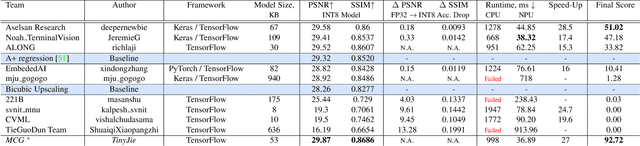
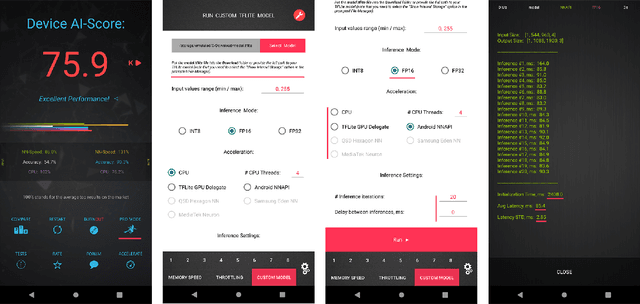
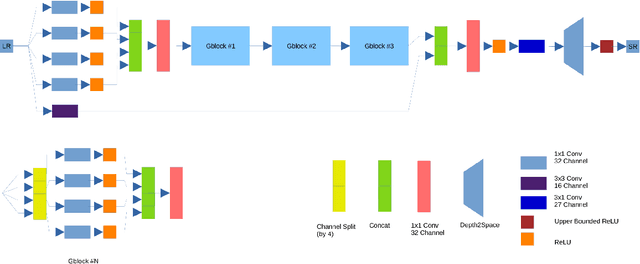
Image super-resolution is one of the most popular computer vision problems with many important applications to mobile devices. While many solutions have been proposed for this task, they are usually not optimized even for common smartphone AI hardware, not to mention more constrained smart TV platforms that are often supporting INT8 inference only. To address this problem, we introduce the first Mobile AI challenge, where the target is to develop an end-to-end deep learning-based image super-resolution solutions that can demonstrate a real-time performance on mobile or edge NPUs. For this, the participants were provided with the DIV2K dataset and trained quantized models to do an efficient 3X image upscaling. The runtime of all models was evaluated on the Synaptics VS680 Smart Home board with a dedicated NPU capable of accelerating quantized neural networks. The proposed solutions are fully compatible with all major mobile AI accelerators and are capable of reconstructing Full HD images under 40-60 ms while achieving high fidelity results. A detailed description of all models developed in the challenge is provided in this paper.