 Add to Chrome
 Add to Firefox
 Add to Edge
FunnelCausalNet: Funnel-aware Joint Conversion-Revenue Uplift for Multi-tier Coupon Allocation
Aug 12, 2026
Coupon campaigns seek to lift both conversion and revenue, but gross merchandise value (GMV) follows a deterministic funnel from conversion to conditional order value and is zero-inflated and heavy-tailed. We propose FunnelCausalNet, an uplift estimator coupling a binary conversion head with a nonnegative conditional-value head through $μ_{\mathrm{gmv}}=μ_{\mathrm{conv}}μ_{\mathrm{val}}$. Under explicit RCT, support, rate-gap, and cross-head covariance-control assumptions, an idealized leading-order MSE comparison identifies a regime in which funnel composition can reduce pointwise variance; this is a heuristic, not a guarantee for the shared-representation neural model. The estimator is paired with marginal split-conformal CATE summaries, combined through a Bonferroni union as audit bands, and a Lagrangian budgeted allocator using RCT-anchored estimates for subsidy-aware ROI accounting. On semi-synthetic multi-tier Criteo-MT7, FunnelCausalNet's mean AUUC_GMV is within one seed standard deviation of the leading feature-interaction baseline among eleven baselines, while a controlled ablation reduces GMV effect error versus direct GMV regression by 18--48% across tested zero-inflation regimes. On de-identified industrial Hotel-Coupon RCT logs with about 4.9 million hold-out exposure records per seed, expected-outcome evaluation sweeps full LP frontiers; FunnelCausalNet has the best seed-averaged mean DeltaROI at all seven correlated anchors from 10% to 60%, which we treat as descriptive frontier consistency rather than independent significance. On sparse binary-spend public benchmarks, revenue-focused rankers can dominate uplift-curve proxies, defining an explicit regime boundary.

Reinforcement Learning Within the Classical Robotics Stack: A Case Study in Robot Soccer
Dec 12, 2024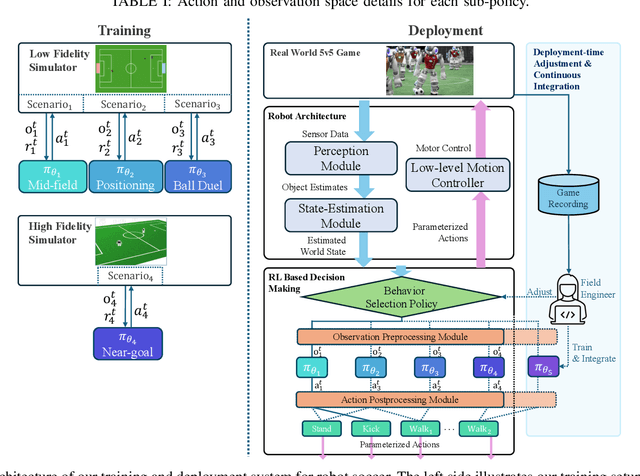
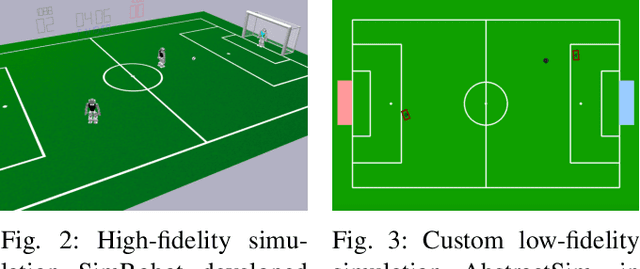

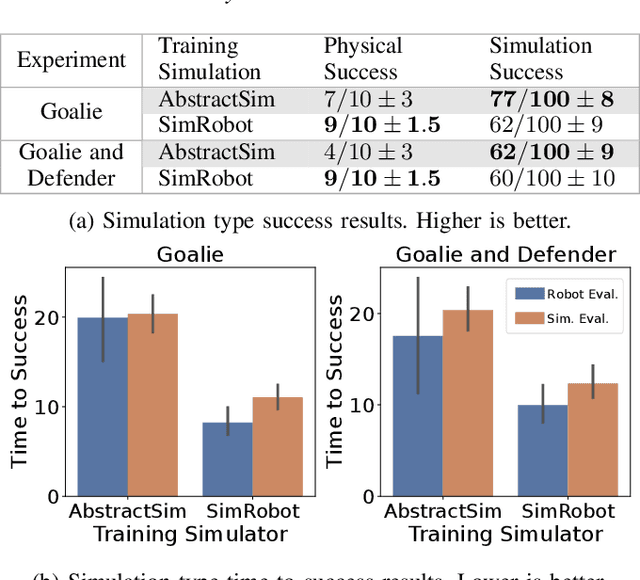
Robot decision-making in partially observable, real-time, dynamic, and multi-agent environments remains a difficult and unsolved challenge. Model-free reinforcement learning (RL) is a promising approach to learning decision-making in such domains, however, end-to-end RL in complex environments is often intractable. To address this challenge in the RoboCup Standard Platform League (SPL) domain, we developed a novel architecture integrating RL within a classical robotics stack, while employing a multi-fidelity sim2real approach and decomposing behavior into learned sub-behaviors with heuristic selection. Our architecture led to victory in the 2024 RoboCup SPL Challenge Shield Division. In this work, we fully describe our system's architecture and empirically analyze key design decisions that contributed to its success. Our approach demonstrates how RL-based behaviors can be integrated into complete robot behavior architectures.
Automated Detection of Myopic Maculopathy in MMAC 2023: Achievements in Classification, Segmentation, and Spherical Equivalent Prediction
Jan 08, 2024Myopic macular degeneration is the most common complication of myopia and the primary cause of vision loss in individuals with pathological myopia. Early detection and prompt treatment are crucial in preventing vision impairment due to myopic maculopathy. This was the focus of the Myopic Maculopathy Analysis Challenge (MMAC), in which we participated. In task 1, classification of myopic maculopathy, we employed the contrastive learning framework, specifically SimCLR, to enhance classification accuracy by effectively capturing enriched features from unlabeled data. This approach not only improved the intrinsic understanding of the data but also elevated the performance of our classification model. For Task 2 (segmentation of myopic maculopathy plus lesions), we have developed independent segmentation models tailored for different lesion segmentation tasks and implemented a test-time augmentation strategy to further enhance the model's performance. As for Task 3 (prediction of spherical equivalent), we have designed a deep regression model based on the data distribution of the dataset and employed an integration strategy to enhance the model's prediction accuracy. The results we obtained are promising and have allowed us to position ourselves in the Top 6 of the classification task, the Top 2 of the segmentation task, and the Top 1 of the prediction task. The code is available at \url{https://github.com/liyihao76/MMAC_LaTIM_Solution}.