 Add to Chrome
 Add to Firefox
 Add to Edge
Ling and Ring 2.6 Technical Report: Efficient and Instant Agentic Intelligence at Trillion-Parameter Scale
Jun 13, 2026
Efficient and scalable agentic intelligence requires models that can deliver both low-latency responses and strong reasoning capabilities while remaining practical to train, serve, and deploy. In this report, we present Ling-2.6 and Ring-2.6, a family of models designed to address this challenge at scale. Ling-2.6 is optimized for instant response generation and high capability per output token, whereas Ring-2.6 is tailored for deeper reasoning and more advanced agentic workflows. Instead of training from scratch, we upgrade the Ling-2.0 base model through architectural migration pre-training and large-scale post-training. This upgrade is guided by a unified co-design of model architecture, optimization objectives, serving systems, and agent training environments, enabling improvements in both model capability and deployment efficiency. At the architectural level, we introduce a hybrid linear attention design that integrates Lightning Attention with MLA, improving the efficiency of long-context training and decoding. To further enhance token efficiency, we optimize capability per output token through Evolutionary Chain-of-Thought, Linguistic Unit Policy Optimization, bidirectional preference alignment, and shortest-correct-response distillation. For agentic capabilities, we propose KPop, a reinforcement learning framework designed to support stable training of Ring-2.6-1T on large-scale environment-grounded data. KPop improves training efficiency through asynchronous scheduling across coding, search, tool use, and workflow execution, enabling scalable learning from complex agent-environment interactions. Together, Ling-2.6 and Ring-2.6 provide a practical pathway toward efficient, scalable, and open agentic systems. We open-source all checkpoints in the 2.6 family to support further research and development in practical agentic intelligence.

ROMAS: A Role-Based Multi-Agent System for Database monitoring and Planning
Dec 18, 2024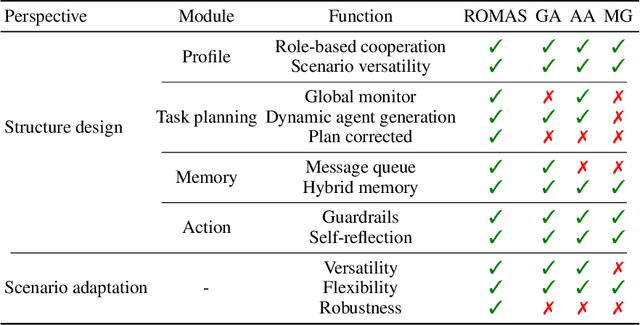
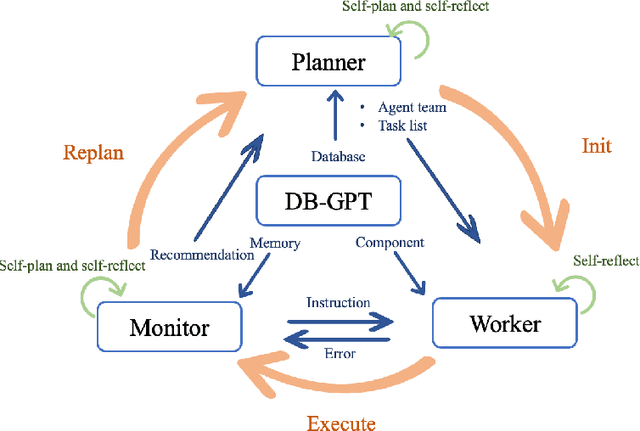
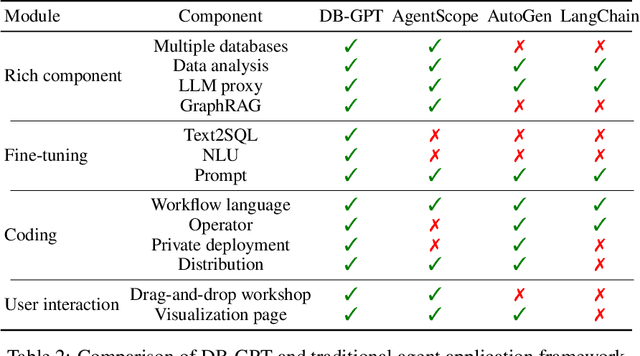
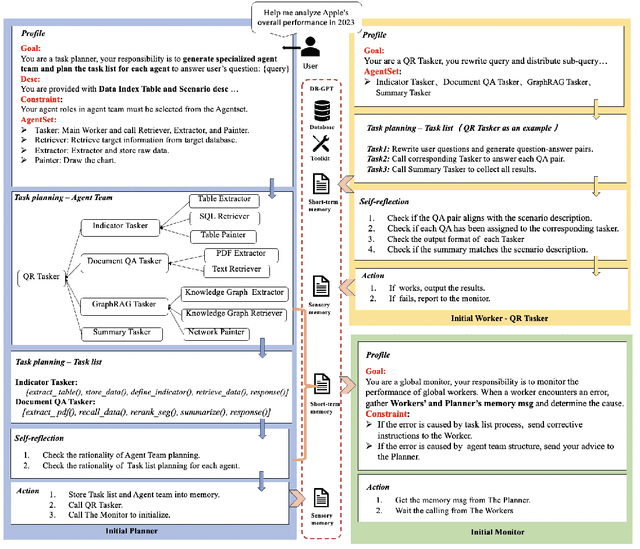
In recent years, Large Language Models (LLMs) have demonstrated remarkable capabilities in data analytics when integrated with Multi-Agent Systems (MAS). However, these systems often struggle with complex tasks that involve diverse functional requirements and intricate data processing challenges, necessitating customized solutions that lack broad applicability. Furthermore, current MAS fail to emulate essential human-like traits such as self-planning, self-monitoring, and collaborative work in dynamic environments, leading to inefficiencies and resource wastage. To address these limitations, we propose ROMAS, a novel Role-Based M ulti-A gent System designed to adapt to various scenarios while enabling low code development and one-click deployment. ROMAS has been effectively deployed in DB-GPT [Xue et al., 2023a, 2024b], a well-known project utilizing LLM-powered database analytics, showcasing its practical utility in real-world scenarios. By integrating role-based collaborative mechanisms for self-monitoring and self-planning, and leveraging existing MAS capabilities to enhance database interactions, ROMAS offers a more effective and versatile solution. Experimental evaluations of ROMAS demonstrate its superiority across multiple scenarios, highlighting its potential to advance the field of multi-agent data analytics.