 Add to Chrome
 Add to Firefox
 Add to Edge
HOCA-Bench: Beyond Semantic Perception to Predictive World Modeling via Hegelian Ontological-Causal Anomalies
Feb 23, 2026
Video-LLMs have improved steadily on semantic perception, but they still fall short on predictive world modeling, which is central to physically grounded intelligence. We introduce HOCA-Bench, a benchmark that frames physical anomalies through a Hegelian lens. HOCA-Bench separates anomalies into two types: ontological anomalies, where an entity violates its own definition or persistence, and causal anomalies, where interactions violate physical relations. Using state-of-the-art generative video models as adversarial simulators, we build a testbed of 1,439 videos (3,470 QA pairs). Evaluations on 17 Video-LLMs show a clear cognitive lag: models often identify static ontological violations (e.g., shape mutations) but struggle with causal mechanisms (e.g., gravity or friction), with performance dropping by more than 20% on causal tasks. System-2 "Thinking" modes improve reasoning, but they do not close the gap, suggesting that current architectures recognize visual patterns more readily than they apply basic physical laws.

MME: A Comprehensive Evaluation Benchmark for Multimodal Large Language Models
Jul 02, 2023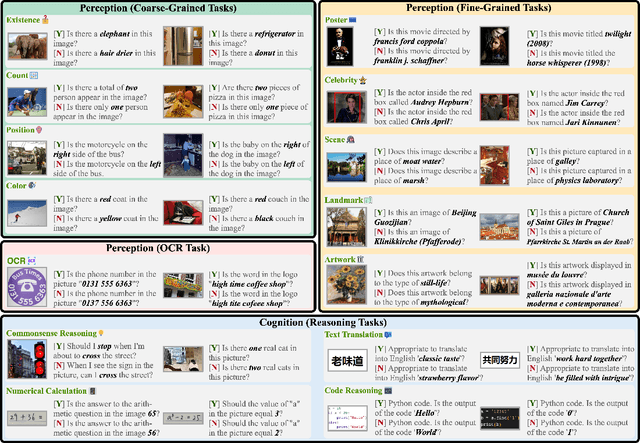
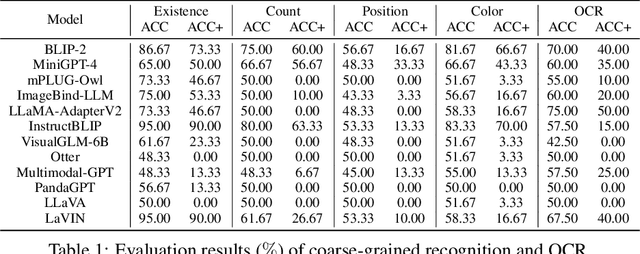
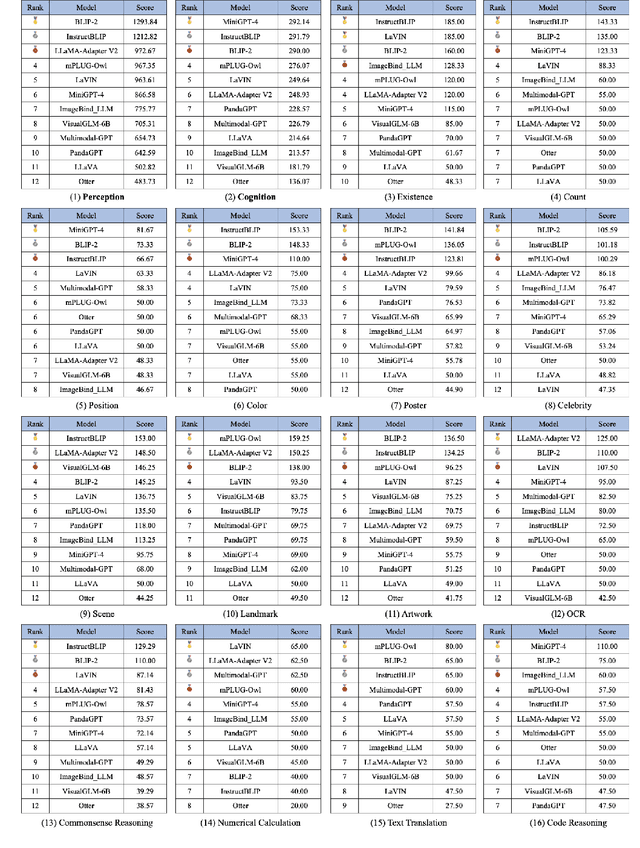
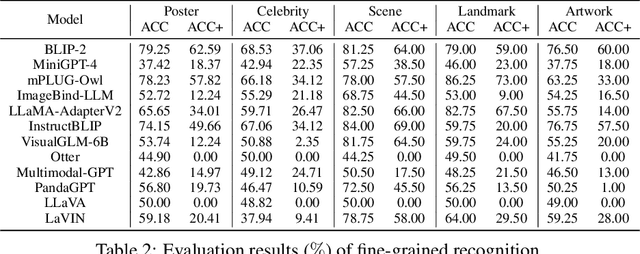
Multimodal Large Language Model (MLLM) relies on the powerful LLM to perform multimodal tasks, showing amazing emergent abilities in recent studies, such as writing poems based on an image. However, it is difficult for these case studies to fully reflect the performance of MLLM, lacking a comprehensive evaluation. In this paper, we fill in this blank, presenting the first MLLM Evaluation benchmark MME. It measures both perception and cognition abilities on a total of 14 subtasks. In order to avoid data leakage that may arise from direct use of public datasets for evaluation, the annotations of instruction-answer pairs are all manually designed. The concise instruction design allows us to fairly compare MLLMs, instead of struggling in prompt engineering. Besides, with such an instruction, we can also easily carry out quantitative statistics. A total of 12 advanced MLLMs are comprehensively evaluated on our MME, which not only suggests that existing MLLMs still have a large room for improvement, but also reveals the potential directions for the subsequent model optimization.