 Add to Chrome
 Add to Firefox
 Add to Edge
CipherSight: Robust Website Fingerprinting via Record-Resource Semantic Supervision under Distribution Shifts
Aug 14, 2026
HTTPS website fingerprinting (WF) aims to identify visited websites from metadata observable in encrypted traffic. However, real-world deployments introduce a significant out-of-distribution (OOD) problem caused by temporal and geographic changes, while previously unseen websites are common in open-world scenarios. Existing methods primarily learn from raw TCP packet sequences and struggle to capture stable and generalizable website representations, resulting in performance degradation under practical conditions. We propose CipherSight, a TLS-record-based hierarchical framework for robust HTTPS WF. Unlike existing approaches that rely on TCP packet sequences and are sensitive to transport-layer artifacts, CipherSight learns website representations from TLS records by jointly encoding multiple record-level attributes. It introduces a hierarchical architecture that captures both intra-flow dependencies among TLS records and inter-flow interactions across concurrent flows, enabling the model to exploit structural patterns in HTTPS traffic. Besides, to learn robust representations, CipherSight employs a masked record modeling (MRM) task to capture contextual traffic semantics and leverages fine-grained record-resource annotations as privileged supervision through structure-aware objectives and semantic distillation. Experiments show that CipherSight achieves 95.41% accuracy across more than 2,000 website classes in the closed-world setting and maintains over 90% accuracy under both temporal and geographic drift, consistently outperforming all evaluated baselines.

ResAware: Cross-Environment Website Fingerprinting via Resource-Privileged Distillation
Jun 16, 2026While Website Fingerprinting (WF) attacks achieve high accuracy in controlled laboratory settings, they often degrade substantially in real-world environments due to spatio-temporal drift, browser heterogeneity, proxy obfuscation and etc. This limitation stems from their sole reliance on low-level traffic features that are noisy and highly sensitive to environmental perturbations. To address this problem, we propose \textbf{ResAware}, a cross-environment resource-aware distillation framework under a \textit{training-rich/inference-poor} asymmetric setting. Specifically, ResAware trains a teacher model on resource-level features, and then distills the resulting privileged knowledge into a student model through heterogeneous knowledge distillation. At deployment time, the student model performs inference using only encrypted traffic, incurring zero additional cost. We evaluate ResAware on a large-scale dataset collected over five months from six globally distributed vantage points, comprising more than $160{,}000$ paired samples. The results show that ResAware significantly enhances the cross-environment robustness of diverse WF baselines. Under a 150-day temporal drift, for example, ResAware improves the F1-score of Var-CNN from $72.77\%$ to $81.49\%$ and the open-world $TPR@1\%FPR$ from $22.40\%$ to $27.20\%$. Our results demonstrate that resource-level supervision improves WF robustness without expanding online observation capabilities.
Hybrid Multi-stage Decoding for Few-shot NER with Entity-aware Contrastive Learning
Apr 10, 2024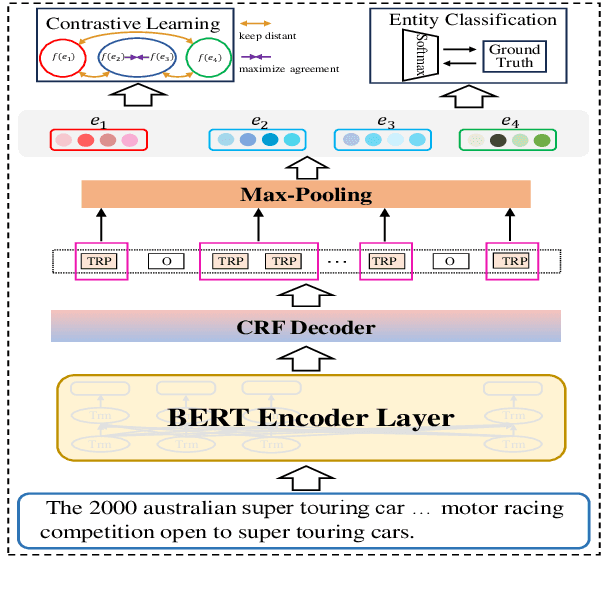
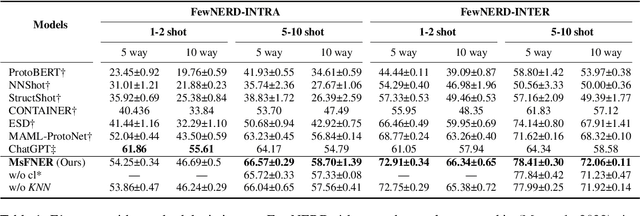
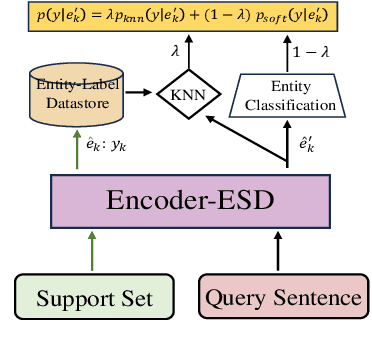
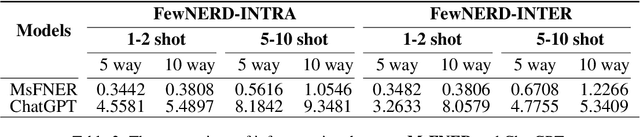
Few-shot named entity recognition can identify new types of named entities based on a few labeled examples. Previous methods employing token-level or span-level metric learning suffer from the computational burden and a large number of negative sample spans. In this paper, we propose the Hybrid Multi-stage Decoding for Few-shot NER with Entity-aware Contrastive Learning (MsFNER), which splits the general NER into two stages: entity-span detection and entity classification. There are 3 processes for introducing MsFNER: training, finetuning, and inference. In the training process, we train and get the best entity-span detection model and the entity classification model separately on the source domain using meta-learning, where we create a contrastive learning module to enhance entity representations for entity classification. During finetuning, we finetune the both models on the support dataset of target domain. In the inference process, for the unlabeled data, we first detect the entity-spans, then the entity-spans are jointly determined by the entity classification model and the KNN. We conduct experiments on the open FewNERD dataset and the results demonstrate the advance of MsFNER.