 Add to Chrome
 Add to Firefox
 Add to Edge
CipherSight: Robust Website Fingerprinting via Record-Resource Semantic Supervision under Distribution Shifts
Aug 14, 2026
HTTPS website fingerprinting (WF) aims to identify visited websites from metadata observable in encrypted traffic. However, real-world deployments introduce a significant out-of-distribution (OOD) problem caused by temporal and geographic changes, while previously unseen websites are common in open-world scenarios. Existing methods primarily learn from raw TCP packet sequences and struggle to capture stable and generalizable website representations, resulting in performance degradation under practical conditions. We propose CipherSight, a TLS-record-based hierarchical framework for robust HTTPS WF. Unlike existing approaches that rely on TCP packet sequences and are sensitive to transport-layer artifacts, CipherSight learns website representations from TLS records by jointly encoding multiple record-level attributes. It introduces a hierarchical architecture that captures both intra-flow dependencies among TLS records and inter-flow interactions across concurrent flows, enabling the model to exploit structural patterns in HTTPS traffic. Besides, to learn robust representations, CipherSight employs a masked record modeling (MRM) task to capture contextual traffic semantics and leverages fine-grained record-resource annotations as privileged supervision through structure-aware objectives and semantic distillation. Experiments show that CipherSight achieves 95.41% accuracy across more than 2,000 website classes in the closed-world setting and maintains over 90% accuracy under both temporal and geographic drift, consistently outperforming all evaluated baselines.

Implicit Federated In-context Learning For Task-Specific LLM Fine-Tuning
Nov 10, 2025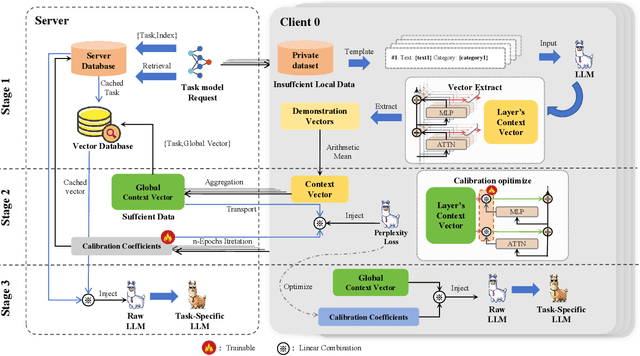

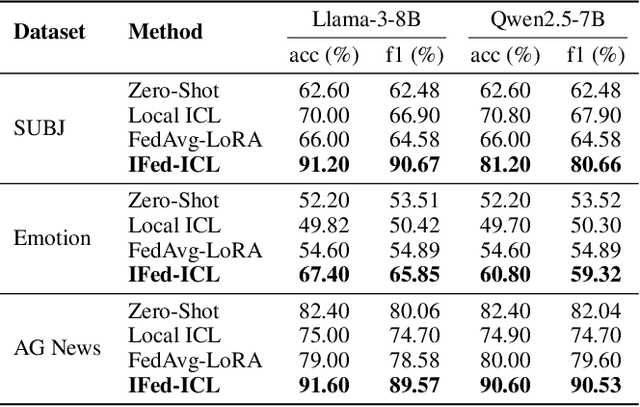

As large language models continue to develop and expand, the extensive public data they rely on faces the risk of depletion. Consequently, leveraging private data within organizations to enhance the performance of large models has emerged as a key challenge. The federated learning paradigm, combined with model fine-tuning techniques, effectively reduces the number of trainable parameters. However,the necessity to process high-dimensional feature spaces results in substantial overall computational overhead. To address this issue, we propose the Implicit Federated In-Context Learning (IFed-ICL) framework. IFed-ICL draws inspiration from federated learning to establish a novel distributed collaborative paradigm, by converting client local context examples into implicit vector representations, it enables distributed collaborative computation during the inference phase and injects model residual streams to enhance model performance. Experiments demonstrate that our proposed method achieves outstanding performance across multiple text classification tasks. Compared to traditional methods, IFed-ICL avoids the extensive parameter updates required by conventional fine-tuning methods while reducing data transmission and local computation at the client level in federated learning. This enables efficient distributed context learning using local private-domain data, significantly improving model performance on specific tasks.
FedDCT: A Dynamic Cross-Tier Federated Learning Scheme in Wireless Communication Networks
Jul 10, 2023With the rapid proliferation of Internet of Things (IoT) devices and the growing concern for data privacy among the public, Federated Learning (FL) has gained significant attention as a privacy-preserving machine learning paradigm. FL enables the training of a global model among clients without exposing local data. However, when a federated learning system runs on wireless communication networks, limited wireless resources, heterogeneity of clients, and network transmission failures affect its performance and accuracy. In this study, we propose a novel dynamic cross-tier FL scheme, named FedDCT to increase training accuracy and performance in wireless communication networks. We utilize a tiering algorithm that dynamically divides clients into different tiers according to specific indicators and assigns specific timeout thresholds to each tier to reduce the training time required. To improve the accuracy of the model without increasing the training time, we introduce a cross-tier client selection algorithm that can effectively select the tiers and participants. Simulation experiments show that our scheme can make the model converge faster and achieve a higher accuracy in wireless communication networks.