 Add to Chrome
 Add to Firefox
 Add to Edge
Pano2World: End-to-End 3D Generation via Unified Multi-View Sequences
Jul 01, 2026
A single panorama captures the full visual sphere from one camera center, yet confines users to looking around in place without enabling true scene exploration. Converting a single panorama into a persistent, renderable 3D representation for free-viewpoint navigation has attracted growing interest; existing methods either adopt iterative per-view completion that propagates inpainting results to update the underlying geometry, leading to progressive error accumulation and cumbersome multi-step pipelines, or leverage the temporal consistency priors of video generation models, yet the continuous-trajectory constraint intrinsic to such models limits their flexibility in covering scenes from multiple directions simultaneously. We present Pano2World, which takes a single indoor panorama as input and directly outputs a persistent, explorable 3D Gaussian scene. Given the source panorama, Pano2World first reconstructs a coarse 3D Gaussian proxy and renders it at adaptively sampled nearby poses to obtain geometrically aligned guidance panoramas; a panoramic diffusion model then jointly denoises all target views via View-Aware Attention Routing, where each target view simultaneously receives geometric constraints from its corresponding guidance panorama and global semantic guidance from the source panorama, naturally enforcing cross-view consistency. To avoid the information loss incurred by decoding the multi-view hidden features formed during joint denoising back to the pixel domain via VAE, we introduce Latent Feature Adapter, a geometry-aware bridge module that directly distills these hidden features into a scene latent, subsequently decoded into the final 3D Gaussian scene. Experiments demonstrate that Pano2World significantly outperforms existing methods on the multi-position panoramic novel-view synthesis benchmark.

You Only Gaussian Once: Controllable 3D Gaussian Splatting for Ultra-Densely Sampled Scenes
Apr 23, 20263D Gaussian Splatting (3DGS) has revolutionized neural rendering, yet existing methods remain predominantly research prototypes ill-suited for production-level deployment. We identify a critical "Industry-Academia Gap" hindering real-world application: unpredictable resource consumption from heuristic Gaussian growth, the "sparsity shield" of current benchmarks that rewards hallucination over physical fidelity, and severe multi-sensor data pollution. To bridge this gap, we propose YOGO (You Only Gaussian Once), a system-level framework that reformulates the stochastic growth process into a deterministic, budget-aware equilibrium. YOGO integrates a novel budget controller for hardware-constrained resource allocation and an availability-registration protocol for robust multi-sensor fusion. To push the boundaries of reconstruction fidelity, we introduce Immersion v1.0, the first ultra-dense indoor dataset specifically designed to break the "sparsity shield." By providing saturated viewpoint coverage, Immersion v1.0 forces algorithms to focus on extreme physical fidelity rather than viewpoint interpolation, and enables the community to focus on the upper limits of high-fidelity reconstruction. Extensive experiments demonstrate that YOGO achieves state-of-the-art visual quality while maintaining a strictly deterministic profile, establishing a new standard for production-grade 3DGS. To facilitate reproducibility, part scenes of Immersion v1.0 dataset and source code of YOGO has been publicly released. The project link is https://jjrcn.github.io/YOGO/.
Sensitivity-LoRA: Low-Load Sensitivity-Based Fine-Tuning for Large Language Models
Sep 11, 2025Large Language Models (LLMs) have transformed both everyday life and scientific research. However, adapting LLMs from general-purpose models to specialized tasks remains challenging, particularly in resource-constrained environments. Low-Rank Adaptation (LoRA), a prominent method within Parameter-Efficient Fine-Tuning (PEFT), has emerged as a promising approach to LLMs by approximating model weight updates using low-rank decomposition. However, LoRA is limited by its uniform rank ( r ) allocation to each incremental matrix, and existing rank allocation techniques aimed at addressing this issue remain computationally inefficient, complex, and unstable, hindering practical applications. To address these limitations, we propose Sensitivity-LoRA, an efficient fine-tuning method that dynamically allocates ranks to weight matrices based on both their global and local sensitivities. It leverages the second-order derivatives (Hessian Matrix) of the loss function to effectively capture weight sensitivity, enabling optimal rank allocation with minimal computational overhead. Our experimental results have demonstrated robust effectiveness, efficiency and stability of Sensitivity-LoRA across diverse tasks and benchmarks.
MonoLSS: Learnable Sample Selection For Monocular 3D Detection
Dec 22, 2023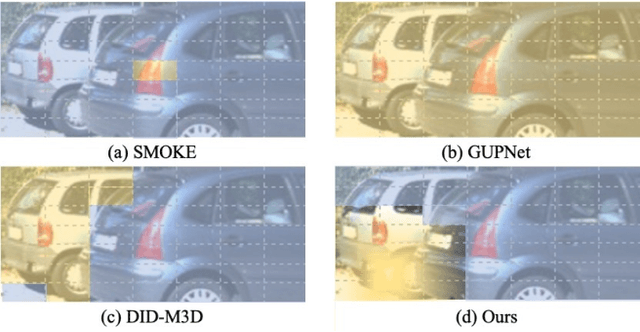
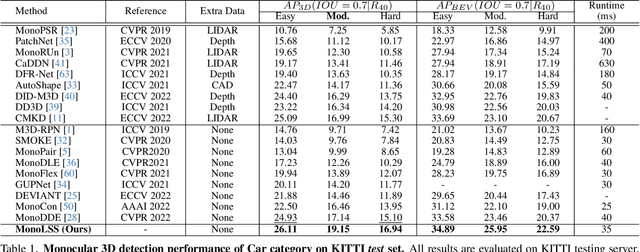
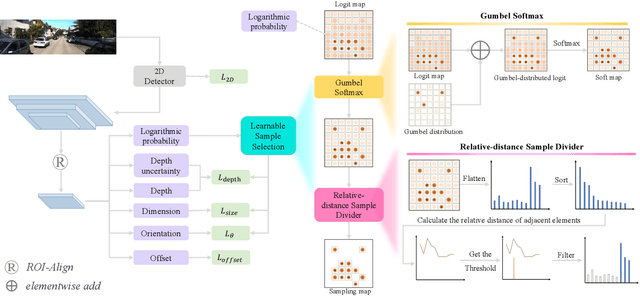
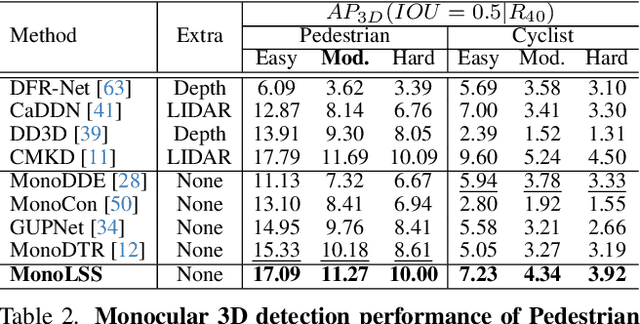
In the field of autonomous driving, monocular 3D detection is a critical task which estimates 3D properties (depth, dimension, and orientation) of objects in a single RGB image. Previous works have used features in a heuristic way to learn 3D properties, without considering that inappropriate features could have adverse effects. In this paper, sample selection is introduced that only suitable samples should be trained to regress the 3D properties. To select samples adaptively, we propose a Learnable Sample Selection (LSS) module, which is based on Gumbel-Softmax and a relative-distance sample divider. The LSS module works under a warm-up strategy leading to an improvement in training stability. Additionally, since the LSS module dedicated to 3D property sample selection relies on object-level features, we further develop a data augmentation method named MixUp3D to enrich 3D property samples which conforms to imaging principles without introducing ambiguity. As two orthogonal methods, the LSS module and MixUp3D can be utilized independently or in conjunction. Sufficient experiments have shown that their combined use can lead to synergistic effects, yielding improvements that transcend the mere sum of their individual applications. Leveraging the LSS module and the MixUp3D, without any extra data, our method named MonoLSS ranks 1st in all three categories (Car, Cyclist, and Pedestrian) on KITTI 3D object detection benchmark, and achieves competitive results on both the Waymo dataset and KITTI-nuScenes cross-dataset evaluation. The code is included in the supplementary material and will be released to facilitate related academic and industrial studies.