 Add to Chrome
 Add to Firefox
 Add to Edge
PECKER: A Precisely Efficient Critical Knowledge Erasure Recipe For Machine Unlearning in Diffusion Models
Apr 07, 2026
Machine unlearning (MU) has become a critical technique for GenAI models' safe and compliant operation. While existing MU methods are effective, most impose prohibitive training time and computational overhead. Our analysis suggests the root cause lies in poorly directed gradient updates, which reduce training efficiency and destabilize convergence. To mitigate these issues, we propose PECKER, an efficient MU approach that matches or outperforms prevailing methods. Within a distillation framework, PECKER introduces a saliency mask to prioritize updates to parameters that contribute most to forgetting the targeted data, thereby reducing unnecessary gradient computation and shortening overall training time without sacrificing unlearning efficacy. Our method generates samples that unlearn related class or concept more quickly, while closely aligning with the true image distribution on CIFAR-10 and STL-10 datasets, achieving shorter training times for both class forgetting and concept forgetting.

Generating Long-form Story Using Dynamic Hierarchical Outlining with Memory-Enhancement
Dec 18, 2024Long-form story generation task aims to produce coherent and sufficiently lengthy text, essential for applications such as novel writingand interactive storytelling. However, existing methods, including LLMs, rely on rigid outlines or lack macro-level planning, making it difficult to achieve both contextual consistency and coherent plot development in long-form story generation. To address this issues, we propose Dynamic Hierarchical Outlining with Memory-Enhancement long-form story generation method, named DOME, to generate the long-form story with coherent content and plot. Specifically, the Dynamic Hierarchical Outline(DHO) mechanism incorporates the novel writing theory into outline planning and fuses the plan and writing stages together, improving the coherence of the plot by ensuring the plot completeness and adapting to the uncertainty during story generation. A Memory-Enhancement Module (MEM) based on temporal knowledge graphs is introduced to store and access the generated content, reducing contextual conflicts and improving story coherence. Finally, we propose a Temporal Conflict Analyzer leveraging temporal knowledge graphs to automatically evaluate the contextual consistency of long-form story. Experiments demonstrate that DOME significantly improves the fluency, coherence, and overall quality of generated long stories compared to state-of-the-art methods.
PROMPT-SAW: Leveraging Relation-Aware Graphs for Textual Prompt Compression
Mar 30, 2024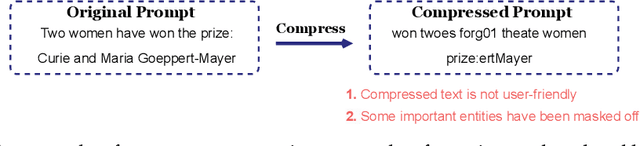
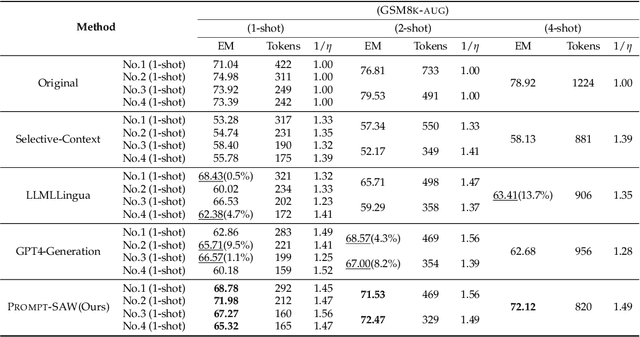
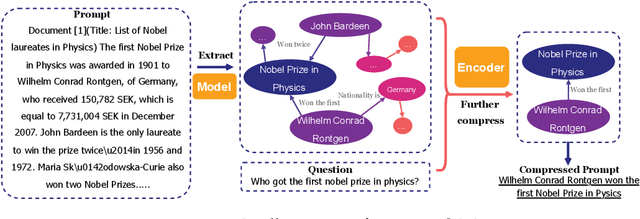
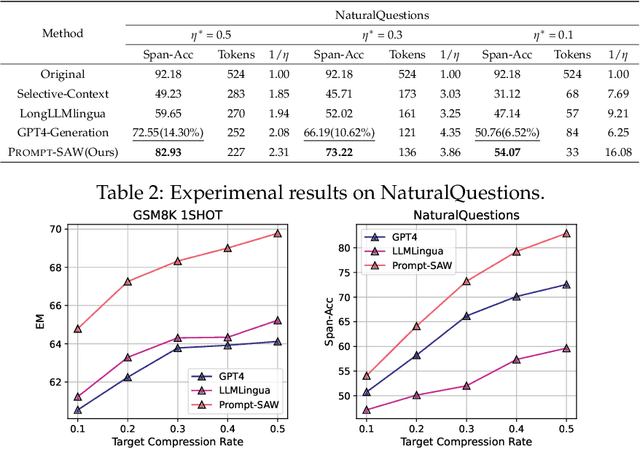
Large language models (LLMs) have shown exceptional abilities for multiple different natural language processing tasks. While prompting is a crucial tool for LLM inference, we observe that there is a significant cost associated with exceedingly lengthy prompts. Existing attempts to compress lengthy prompts lead to sub-standard results in terms of readability and interpretability of the compressed prompt, with a detrimental impact on prompt utility. To address this, we propose PROMPT-SAW: Prompt compresSion via Relation AWare graphs, an effective strategy for prompt compression over task-agnostic and task-aware prompts. PROMPT-SAW uses the prompt's textual information to build a graph, later extracts key information elements in the graph to come up with the compressed prompt. We also propose GSM8K-AUG, i.e., an extended version of the existing GSM8k benchmark for task-agnostic prompts in order to provide a comprehensive evaluation platform. Experimental evaluation using benchmark datasets shows that prompts compressed by PROMPT-SAW are not only better in terms of readability, but they also outperform the best-performing baseline models by up to 14.3 and 13.7 respectively for task-aware and task-agnostic settings while compressing the original prompt text by 33.0 and 56.7.