 Add to Chrome
 Add to Firefox
 Add to Edge
DexRepNet++: Learning Dexterous Robotic Manipulation with Geometric and Spatial Hand-Object Representations
Feb 25, 2026
Robotic dexterous manipulation is a challenging problem due to high degrees of freedom (DoFs) and complex contacts of multi-fingered robotic hands. Many existing deep reinforcement learning (DRL) based methods aim at improving sample efficiency in high-dimensional output action spaces. However, existing works often overlook the role of representations in achieving generalization of a manipulation policy in the complex input space during the hand-object interaction. In this paper, we propose DexRep, a novel hand-object interaction representation to capture object surface features and spatial relations between hands and objects for dexterous manipulation skill learning. Based on DexRep, policies are learned for three dexterous manipulation tasks, i.e. grasping, in-hand reorientation, bimanual handover, and extensive experiments are conducted to verify the effectiveness. In simulation, for grasping, the policy learned with 40 objects achieves a success rate of 87.9% on more than 5000 unseen objects of diverse categories, significantly surpassing existing work trained with thousands of objects; for the in-hand reorientation and handover tasks, the policies also boost the success rates and other metrics of existing hand-object representations by 20% to 40%. The grasp policies with DexRep are deployed to the real world under multi-camera and single-camera setups and demonstrate a small sim-to-real gap.
* Accepted by IEEE Transactions on Robotics (T-RO), 2026

VTAO-BiManip: Masked Visual-Tactile-Action Pre-training with Object Understanding for Bimanual Dexterous Manipulation
Jan 07, 2025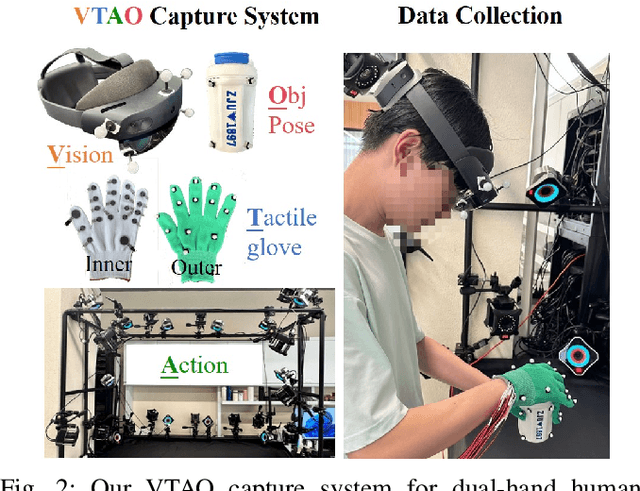
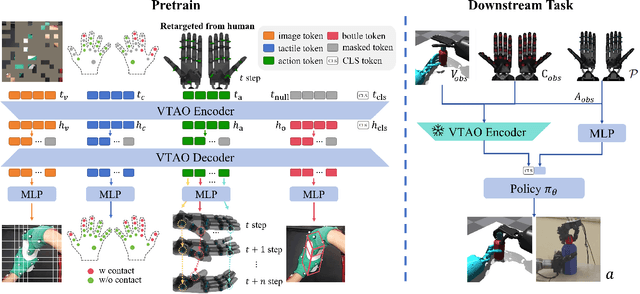
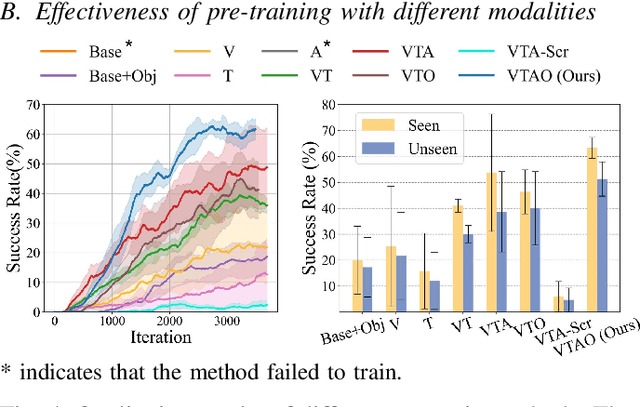
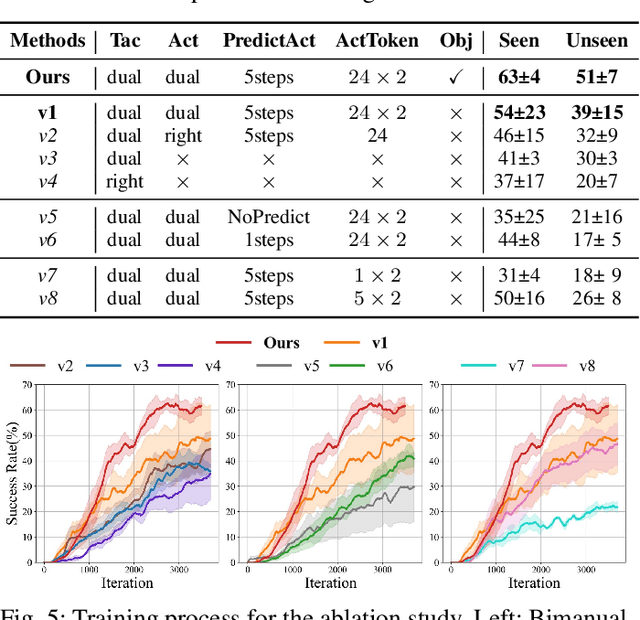
Bimanual dexterous manipulation remains significant challenges in robotics due to the high DoFs of each hand and their coordination. Existing single-hand manipulation techniques often leverage human demonstrations to guide RL methods but fail to generalize to complex bimanual tasks involving multiple sub-skills. In this paper, we introduce VTAO-BiManip, a novel framework that combines visual-tactile-action pretraining with object understanding to facilitate curriculum RL to enable human-like bimanual manipulation. We improve prior learning by incorporating hand motion data, providing more effective guidance for dual-hand coordination than binary tactile feedback. Our pretraining model predicts future actions as well as object pose and size using masked multimodal inputs, facilitating cross-modal regularization. To address the multi-skill learning challenge, we introduce a two-stage curriculum RL approach to stabilize training. We evaluate our method on a bottle-cap unscrewing task, demonstrating its effectiveness in both simulated and real-world environments. Our approach achieves a success rate that surpasses existing visual-tactile pretraining methods by over 20%.
DexRepNet: Learning Dexterous Robotic Grasping Network with Geometric and Spatial Hand-Object Representations
Mar 20, 2023


Robotic dexterous grasping is a challenging problem due to the high degree of freedom (DoF) and complex contacts of multi-fingered robotic hands. Existing deep reinforcement learning (DRL) based methods leverage human demonstrations to reduce sample complexity due to the high dimensional action space with dexterous grasping. However, less attention has been paid to hand-object interaction representations for high-level generalization. In this paper, we propose a novel geometric and spatial hand-object interaction representation, named DexRep, to capture dynamic object shape features and the spatial relations between hands and objects during grasping. DexRep comprises Occupancy Feature for rough shapes within sensing range by moving hands, Surface Feature for changing hand-object surface distances, and Local-Geo Feature for local geometric surface features most related to potential contacts. Based on the new representation, we propose a dexterous deep reinforcement learning method to learn a generalizable grasping policy DexRepNet. Experimental results show that our method outperforms baselines using existing representations for robotic grasping dramatically both in grasp success rate and convergence speed. It achieves a 93% grasping success rate on seen objects and higher than 80% grasping success rates on diverse objects of unseen categories in both simulation and real-world experiments.