 Add to Chrome
 Add to Firefox
 Add to Edge
Reward Hacking in the Era of Large Models: Mechanisms, Emergent Misalignment, Challenges
Apr 15, 2026
Reinforcement Learning from Human Feedback (RLHF) and related alignment paradigms have become central to steering large language models (LLMs) and multimodal large language models (MLLMs) toward human-preferred behaviors. However, these approaches introduce a systemic vulnerability: reward hacking, where models exploit imperfections in learned reward signals to maximize proxy objectives without fulfilling true task intent. As models scale and optimization intensifies, such exploitation manifests as verbosity bias, sycophancy, hallucinated justification, benchmark overfitting, and, in multimodal settings, perception--reasoning decoupling and evaluator manipulation. Recent evidence further suggests that seemingly benign shortcut behaviors can generalize into broader forms of misalignment, including deception and strategic gaming of oversight mechanisms. In this survey, we propose the Proxy Compression Hypothesis (PCH) as a unifying framework for understanding reward hacking. We formalize reward hacking as an emergent consequence of optimizing expressive policies against compressed reward representations of high-dimensional human objectives. Under this view, reward hacking arises from the interaction of objective compression, optimization amplification, and evaluator--policy co-adaptation. This perspective unifies empirical phenomena across RLHF, RLAIF, and RLVR regimes, and explains how local shortcut learning can generalize into broader forms of misalignment, including deception and strategic manipulation of oversight mechanisms. We further organize detection and mitigation strategies according to how they intervene on compression, amplification, or co-adaptation dynamics. By framing reward hacking as a structural instability of proxy-based alignment under scale, we highlight open challenges in scalable oversight, multimodal grounding, and agentic autonomy.

TRIP-Bench: A Benchmark for Long-Horizon Interactive Agents in Real-World Scenarios
Feb 02, 2026As LLM-based agents are deployed in increasingly complex real-world settings, existing benchmarks underrepresent key challenges such as enforcing global constraints, coordinating multi-tool reasoning, and adapting to evolving user behavior over long, multi-turn interactions. To bridge this gap, we introduce \textbf{TRIP-Bench}, a long-horizon benchmark grounded in realistic travel-planning scenarios. TRIP-Bench leverages real-world data, offers 18 curated tools and 40+ travel requirements, and supports automated evaluation. It includes splits of varying difficulty; the hard split emphasizes long and ambiguous interactions, style shifts, feasibility changes, and iterative version revision. Dialogues span up to 15 user turns, can involve 150+ tool calls, and may exceed 200k tokens of context. Experiments show that even advanced models achieve at most 50\% success on the easy split, with performance dropping below 10\% on hard subsets. We further propose \textbf{GTPO}, an online multi-turn reinforcement learning method with specialized reward normalization and reward differencing. Applied to Qwen2.5-32B-Instruct, GTPO improves constraint satisfaction and interaction robustness, outperforming Gemini-3-Pro in our evaluation. We expect TRIP-Bench to advance practical long-horizon interactive agents, and GTPO to provide an effective online RL recipe for robust long-horizon training.
BatCoder: Self-Supervised Bidirectional Code-Documentation Learning via Back-Translation
Jan 30, 2026Training LLMs for code-related tasks typically depends on high-quality code-documentation pairs, which are costly to curate and often scarce for niche programming languages. We introduce BatCoder, a self-supervised reinforcement learning framework designed to jointly optimize code generation and documentation production. BatCoder employs a back-translation strategy: a documentation is first generated from code, and then the generated documentation is used to reconstruct the original code. The semantic similarity between the original and reconstructed code serves as an implicit reward, enabling reinforcement learning to improve the model's performance both in generating code from documentation and vice versa. This approach allows models to be trained using only code, substantially increasing the available training examples. Evaluated on HumanEval and MBPP with a 7B model, BatCoder achieved 83.5% and 81.0% pass@1, outperforming strong open-source baselines. Moreover, the framework demonstrates consistent scaling with respect to both training corpus size and model capacity.
Controllable Memory Usage: Balancing Anchoring and Innovation in Long-Term Human-Agent Interaction
Jan 08, 2026As LLM-based agents are increasingly used in long-term interactions, cumulative memory is critical for enabling personalization and maintaining stylistic consistency. However, most existing systems adopt an ``all-or-nothing'' approach to memory usage: incorporating all relevant past information can lead to \textit{Memory Anchoring}, where the agent is trapped by past interactions, while excluding memory entirely results in under-utilization and the loss of important interaction history. We show that an agent's reliance on memory can be modeled as an explicit and user-controllable dimension. We first introduce a behavioral metric of memory dependence to quantify the influence of past interactions on current outputs. We then propose \textbf{Stee}rable \textbf{M}emory Agent, \texttt{SteeM}, a framework that allows users to dynamically regulate memory reliance, ranging from a fresh-start mode that promotes innovation to a high-fidelity mode that closely follows interaction history. Experiments across different scenarios demonstrate that our approach consistently outperforms conventional prompting and rigid memory masking strategies, yielding a more nuanced and effective control for personalized human-agent collaboration.
CSSG: Measuring Code Similarity with Semantic Graphs
Jan 07, 2026Existing code similarity metrics, such as BLEU, CodeBLEU, and TSED, largely rely on surface-level string overlap or abstract syntax tree structures, and often fail to capture deeper semantic relationships between programs.We propose CSSG (Code Similarity using Semantic Graphs), a novel metric that leverages program dependence graphs to explicitly model control dependencies and variable interactions, providing a semantics-aware representation of code.Experiments on the CodeContests+ dataset show that CSSG consistently outperforms existing metrics in distinguishing more similar code from less similar code under both monolingual and cross-lingual settings, demonstrating that dependency-aware graph representations offer a more effective alternative to surface-level or syntax-based similarity measures.
RECAST: Strengthening LLMs' Complex Instruction Following with Constraint-Verifiable Data
May 25, 2025Large language models (LLMs) are increasingly expected to tackle complex tasks, driven by their expanding applications and users' growing proficiency in crafting sophisticated prompts. However, as the number of explicitly stated requirements increases (particularly more than 10 constraints), LLMs often struggle to accurately follow such complex instructions. To address this challenge, we propose RECAST, a novel framework for synthesizing datasets where each example incorporates far more constraints than those in existing benchmarks. These constraints are extracted from real-world prompt-response pairs to ensure practical relevance. RECAST enables automatic verification of constraint satisfaction via rule-based validators for quantitative constraints and LLM-based validators for qualitative ones. Using this framework, we construct RECAST-30K, a large-scale, high-quality dataset comprising 30k instances spanning 15 constraint types. Experimental results demonstrate that models fine-tuned on RECAST-30K show substantial improvements in following complex instructions. Moreover, the verifiability provided by RECAST enables the design of reward functions for reinforcement learning, which further boosts model performance on complex and challenging tasks.
Towards Biologically Plausible Computing: A Comprehensive Comparison
Jun 23, 2024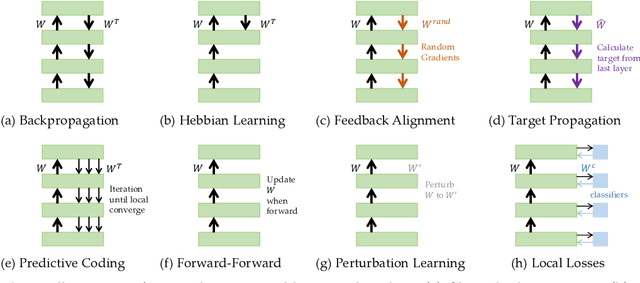

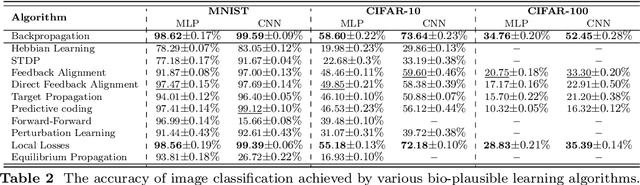

Backpropagation is a cornerstone algorithm in training neural networks for supervised learning, which uses a gradient descent method to update network weights by minimizing the discrepancy between actual and desired outputs. Despite its pivotal role in propelling deep learning advancements, the biological plausibility of backpropagation is questioned due to its requirements for weight symmetry, global error computation, and dual-phase training. To address this long-standing challenge, many studies have endeavored to devise biologically plausible training algorithms. However, a fully biologically plausible algorithm for training multilayer neural networks remains elusive, and interpretations of biological plausibility vary among researchers. In this study, we establish criteria for biological plausibility that a desirable learning algorithm should meet. Using these criteria, we evaluate a range of existing algorithms considered to be biologically plausible, including Hebbian learning, spike-timing-dependent plasticity, feedback alignment, target propagation, predictive coding, forward-forward algorithm, perturbation learning, local losses, and energy-based learning. Additionally, we empirically evaluate these algorithms across diverse network architectures and datasets. We compare the feature representations learned by these algorithms with brain activity recorded by non-invasive devices under identical stimuli, aiming to identify which algorithm can most accurately replicate brain activity patterns. We are hopeful that this study could inspire the development of new biologically plausible algorithms for training multilayer networks, thereby fostering progress in both the fields of neuroscience and machine learning.