 Add to Chrome
 Add to Firefox
 Add to Edge
ToolVerse: Unlocking Massive Environments and Long-Horizon Tasks for Agentic Reinforcement Learning
Jul 17, 2026
While LLM agents demonstrate strong reasoning abilities in compact and well-defined scenarios, they struggle to maintain robustness and effectiveness when faced with large-scale, diverse, and dynamic real-world environments that demand seamless tool integration. To address this gap, we introduce ToolVerse, a comprehensive framework that scales up agentic RL environments and enables agents to perform complex long-horizon reasoning in Tool-Integrated Reasoning (TIR) tasks. First, ToolVerse automatically builds the massive executable agent training environments from nearly 400 real-world Model Context Protocols (MCPs) that contain about 4500 tools. Second, we propose a task design strategy based on a tool dependency graph, utilizing Dynamic Unlocking Sampling Algorithm to generate long-horizon tasks, and produce GUST (Graph Unlocking Sampling Tasks) dataset. Third, to alleviate the credit assigment problem in long-horizon agentic RL, we propose a fine-grained Turn-Aware Relative Advantage algorithm. We conduct extensive Agentic RL training using ToolVerse and evaluate our framework on serveral agentic benchmarks. Experimental results demonstrate that our framework significantly strengthens LLMs' capabilities in long-horizon tool use, achieving a marked performance boost and showcasing robust reasoning within dynamic environments.

TRIP-Bench: A Benchmark for Long-Horizon Interactive Agents in Real-World Scenarios
Feb 02, 2026As LLM-based agents are deployed in increasingly complex real-world settings, existing benchmarks underrepresent key challenges such as enforcing global constraints, coordinating multi-tool reasoning, and adapting to evolving user behavior over long, multi-turn interactions. To bridge this gap, we introduce \textbf{TRIP-Bench}, a long-horizon benchmark grounded in realistic travel-planning scenarios. TRIP-Bench leverages real-world data, offers 18 curated tools and 40+ travel requirements, and supports automated evaluation. It includes splits of varying difficulty; the hard split emphasizes long and ambiguous interactions, style shifts, feasibility changes, and iterative version revision. Dialogues span up to 15 user turns, can involve 150+ tool calls, and may exceed 200k tokens of context. Experiments show that even advanced models achieve at most 50\% success on the easy split, with performance dropping below 10\% on hard subsets. We further propose \textbf{GTPO}, an online multi-turn reinforcement learning method with specialized reward normalization and reward differencing. Applied to Qwen2.5-32B-Instruct, GTPO improves constraint satisfaction and interaction robustness, outperforming Gemini-3-Pro in our evaluation. We expect TRIP-Bench to advance practical long-horizon interactive agents, and GTPO to provide an effective online RL recipe for robust long-horizon training.
Multi-Step Visual Reasoning with Visual Tokens Scaling and Verification
Jun 08, 2025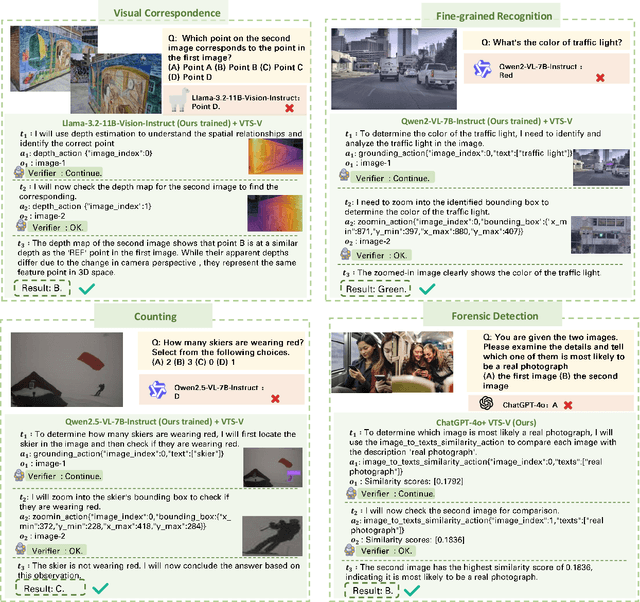
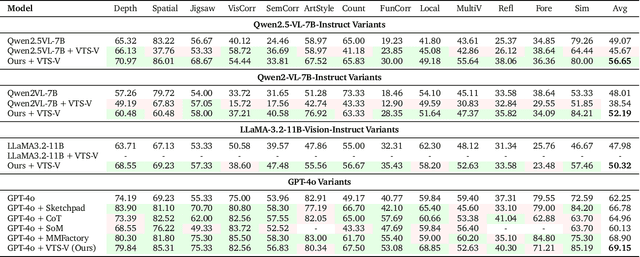
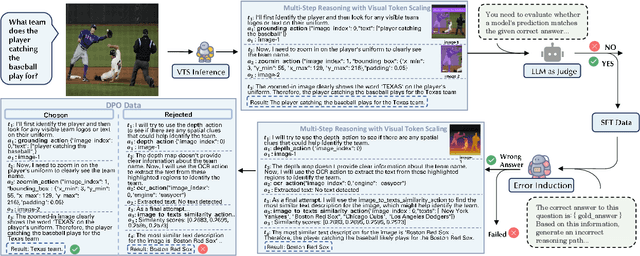
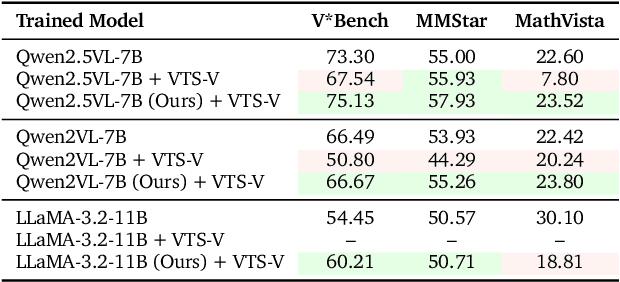
Multi-modal large language models (MLLMs) have achieved remarkable capabilities by integrating visual perception with language understanding, enabling applications such as image-grounded dialogue, visual question answering, and scientific analysis. However, most MLLMs adopt a static inference paradigm, encoding the entire image into fixed visual tokens upfront, which limits their ability to iteratively refine understanding or adapt to context during inference. This contrasts sharply with human perception, which is dynamic, selective, and feedback-driven. In this work, we introduce a novel framework for inference-time visual token scaling that enables MLLMs to perform iterative, verifier-guided reasoning over visual content. We formulate the problem as a Markov Decision Process, involving a reasoner that proposes visual actions and a verifier, which is trained via multi-step Direct Preference Optimization (DPO), that evaluates these actions and determines when reasoning should terminate. To support this, we present a new dataset, VTS, comprising supervised reasoning trajectories (VTS-SFT) and preference-labeled reasoning comparisons (VTS-DPO). Our method significantly outperforms existing approaches across diverse visual reasoning benchmarks, offering not only improved accuracy but also more interpretable and grounded reasoning processes. These results demonstrate the promise of dynamic inference mechanisms for enabling fine-grained, context-aware visual reasoning in next-generation MLLMs.