 Add to Chrome
 Add to Firefox
 Add to Edge
HarnessWAM: Bridging Prediction and Deliberation in World Action Models
Aug 10, 2026
World Action Models (WAMs) jointly learn environmental dynamics and robot actions, introducing priors over physical evolution into embodied control. However, finite-horizon prediction and action generation are insufficient for complex embodied tasks that require global planning, cross-stage state maintenance, execution verification, and failure recovery. We refer to this mismatch as the prediction-deliberation gap of WAMs. To address this gap, we propose HarnessWAM, an agentic framework for WAMs. HarnessWAM employs a vision-language-model-based Task Manager to maintain an evidence-grounded scene belief and a structured task graph. A capability-conditioned executable-space projection further constrains open-ended semantic plans into sequences of atomic skills that satisfy task dependencies, embodiment-state constraints, and the capability boundary of the underlying WAM. During execution, HarnessWAM operates through an event-driven, dual-timescale feedback loop: a lightweight progress estimator continuously provides high-frequency execution evidence, while the Task Manager deliberates at salient milestones by jointly considering the current observation, task state, and interaction history to determine whether to advance the task, acquire additional observations, revise the plan, or initiate local recovery. This mechanism enables the robot to recover its state after a subtask failure and resume execution without discarding previously acquired scene knowledge. HarnessWAM achieves state-of-the-art full-task and subtask success rates of 59.6% and 69.9% on RoboMemArena, and an SR of 23.7% on RoboCerebra Ideal. These results demonstrate that model-external structured state maintenance and closed-loop agentic decision making can effectively extend the local control capabilities of WAMs into embodied task execution that is plannable, verifiable, and recoverable.

UniVAD v2: Unified Visual Anomaly Detection via Support-Conditioned Boundary Construction
Jun 29, 2026Unified visual anomaly detection seeks to train a single detector that can be deployed across categories, domains, and application scenarios. In the few-shot transfer regime, the key challenge is to estimate an episode-specific boundary for an unseen target category from a small support set. Existing approaches mainly infer this boundary from normal-side evidence and provide limited abnormal-side evidence for deployment-specific tolerance. Within the normal side, they often struggle to jointly capture local correspondences and global support-query relations, making their boundaries less reliable for unseen anomalies. To address these issues, we propose UniVAD v2, a two-sided support-conditioned boundary construction framework for unified visual anomaly detection. Built on the component-patch divide-and-conquer framework of UniVAD, UniVAD v2 strengthens the normal side with an Optimal Transport-based Relational Modeling module (OTRM), which complements retrieval with support-query matching through transport-style allocation, and an Adaptive Coordination mechanism for Retrieval and Relational Modeling (ACRRM), which estimates episode-conditioned reliabilities to fuse the two sources of evidence. On the abnormal side, a Few-Shot Abnormal Reference module (FAR) converts optional abnormal references into rejection-side evidence for boundary adjustment. Experiments on six datasets spanning industrial, logical, and medical anomaly detection demonstrate strong cross-domain generalization. Under the 1N-shot protocol, UniVAD v2 improves the mean image-level AUC over UniVAD from 83.0\% to 84.5\%, and further reaches 85.7\% in the 1N+1A-shot setting. On the MVTec-AD Severity Split (MVTec-AD-SS), UniVAD v2 achieves 96.2\% image-level AUC and 96.9\% pixel-level AUC, showing that abnormal references enable controllable boundary customization without retraining.
DIM-WAM: World-Action Modeling with Diverse Historical Event Memory
Jun 26, 2026World-action models have shown promising robot-manipulation performance by jointly predicting future visual states and actions. However, existing methods mainly rely on short-term history and short-horizon future prediction, which is insufficient for long-horizon tasks whose correct execution depends on earlier observations and task progress. Such temporally dependent tasks require effective use of complementary temporal information, including recent local context, cross-stage historical events, immediate future dynamics, and global task progress. To address long-term forgetting and poor awareness of the global task state, we introduce DiM-WAM, a memory-augmented world-action model that integrates multi-scale historical context, local future dynamics, and global task progress. The memory extracts compact visual event information from real observations, updates multiple memory banks through independent similarity-based merging, and then reads the bank-identity- and time-embedded long-term context to condition video and action denoising. A progress-supervision objective further encourages memory tokens to encode not only completed historical events but also the current task stage and its implications for the remaining task. On RMBench, DiM-WAM raises average success from 28.4% with LingBot-VA to 69.8%, exceeding the explicit-memory Mem-0 baseline at 42.0%. On four real-world Franka tasks, it improves average stage success from 70.7% to 91.5% and full-task success from 52.5% to 80.0%. Project page: https://wangkai-casia.github.io/dim-wam/{\texttt{https://wangkai-casia.github.io/dim-wam/}}.
AnomalyMoE: Towards a Language-free Generalist Model for Unified Visual Anomaly Detection
Aug 08, 2025Anomaly detection is a critical task across numerous domains and modalities, yet existing methods are often highly specialized, limiting their generalizability. These specialized models, tailored for specific anomaly types like textural defects or logical errors, typically exhibit limited performance when deployed outside their designated contexts. To overcome this limitation, we propose AnomalyMoE, a novel and universal anomaly detection framework based on a Mixture-of-Experts (MoE) architecture. Our key insight is to decompose the complex anomaly detection problem into three distinct semantic hierarchies: local structural anomalies, component-level semantic anomalies, and global logical anomalies. AnomalyMoE correspondingly employs three dedicated expert networks at the patch, component, and global levels, and is specialized in reconstructing features and identifying deviations at its designated semantic level. This hierarchical design allows a single model to concurrently understand and detect a wide spectrum of anomalies. Furthermore, we introduce an Expert Information Repulsion (EIR) module to promote expert diversity and an Expert Selection Balancing (ESB) module to ensure the comprehensive utilization of all experts. Experiments on 8 challenging datasets spanning industrial imaging, 3D point clouds, medical imaging, video surveillance, and logical anomaly detection demonstrate that AnomalyMoE establishes new state-of-the-art performance, significantly outperforming specialized methods in their respective domains.
FiLo++: Zero-/Few-Shot Anomaly Detection by Fused Fine-Grained Descriptions and Deformable Localization
Jan 17, 2025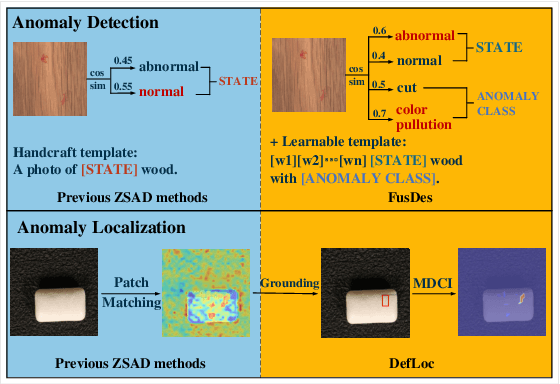
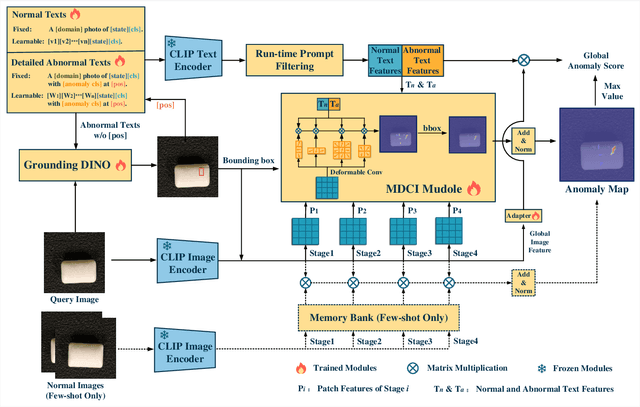
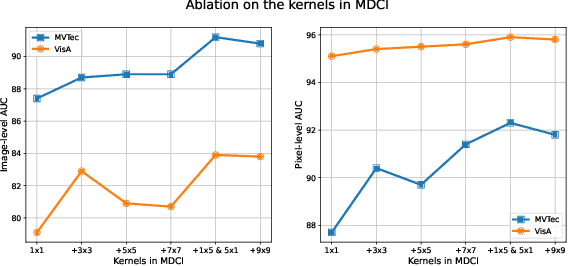
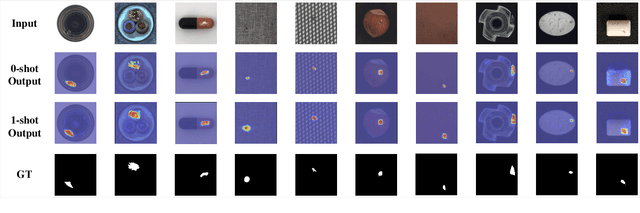
Anomaly detection methods typically require extensive normal samples from the target class for training, limiting their applicability in scenarios that require rapid adaptation, such as cold start. Zero-shot and few-shot anomaly detection do not require labeled samples from the target class in advance, making them a promising research direction. Existing zero-shot and few-shot approaches often leverage powerful multimodal models to detect and localize anomalies by comparing image-text similarity. However, their handcrafted generic descriptions fail to capture the diverse range of anomalies that may emerge in different objects, and simple patch-level image-text matching often struggles to localize anomalous regions of varying shapes and sizes. To address these issues, this paper proposes the FiLo++ method, which consists of two key components. The first component, Fused Fine-Grained Descriptions (FusDes), utilizes large language models to generate anomaly descriptions for each object category, combines both fixed and learnable prompt templates and applies a runtime prompt filtering method, producing more accurate and task-specific textual descriptions. The second component, Deformable Localization (DefLoc), integrates the vision foundation model Grounding DINO with position-enhanced text descriptions and a Multi-scale Deformable Cross-modal Interaction (MDCI) module, enabling accurate localization of anomalies with various shapes and sizes. In addition, we design a position-enhanced patch matching approach to improve few-shot anomaly detection performance. Experiments on multiple datasets demonstrate that FiLo++ achieves significant performance improvements compared with existing methods. Code will be available at https://github.com/CASIA-IVA-Lab/FiLo.
UniVAD: A Training-free Unified Model for Few-shot Visual Anomaly Detection
Dec 05, 2024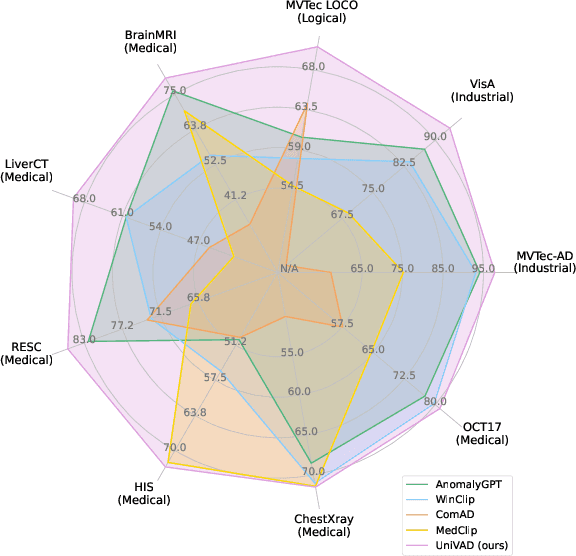
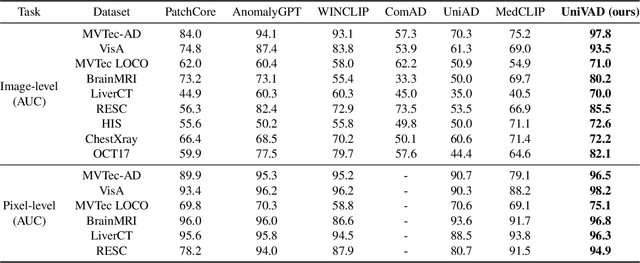

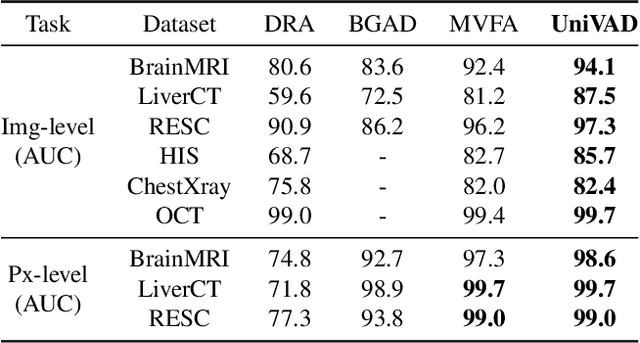
Visual Anomaly Detection (VAD) aims to identify abnormal samples in images that deviate from normal patterns, covering multiple domains, including industrial, logical, and medical fields. Due to the domain gaps between these fields, existing VAD methods are typically tailored to each domain, with specialized detection techniques and model architectures that are difficult to generalize across different domains. Moreover, even within the same domain, current VAD approaches often follow a "one-category-one-model" paradigm, requiring large amounts of normal samples to train class-specific models, resulting in poor generalizability and hindering unified evaluation across domains. To address this issue, we propose a generalized few-shot VAD method, UniVAD, capable of detecting anomalies across various domains, such as industrial, logical, and medical anomalies, with a training-free unified model. UniVAD only needs few normal samples as references during testing to detect anomalies in previously unseen objects, without training on the specific domain. Specifically, UniVAD employs a Contextual Component Clustering ($C^3$) module based on clustering and vision foundation models to segment components within the image accurately, and leverages Component-Aware Patch Matching (CAPM) and Graph-Enhanced Component Modeling (GECM) modules to detect anomalies at different semantic levels, which are aggregated to produce the final detection result. We conduct experiments on nine datasets spanning industrial, logical, and medical fields, and the results demonstrate that UniVAD achieves state-of-the-art performance in few-shot anomaly detection tasks across multiple domains, outperforming domain-specific anomaly detection models. The code will be made publicly available.
FiLo: Zero-Shot Anomaly Detection by Fine-Grained Description and High-Quality Localization
Apr 21, 2024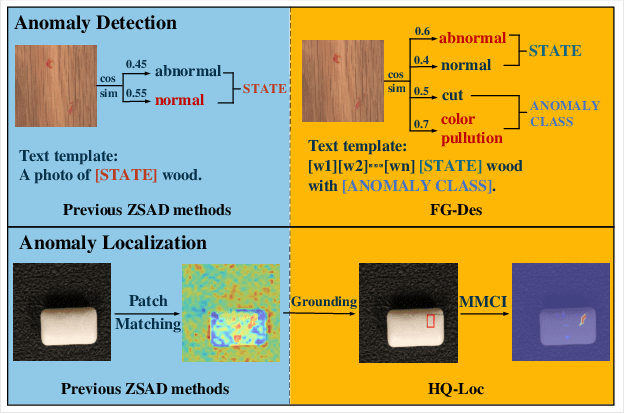
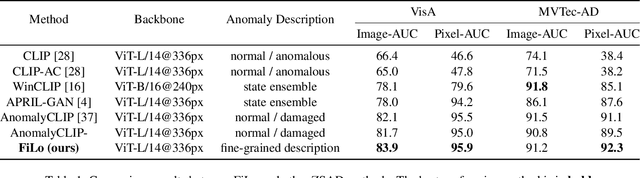
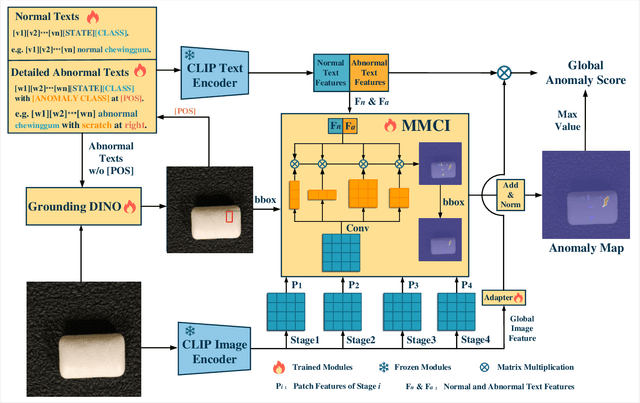
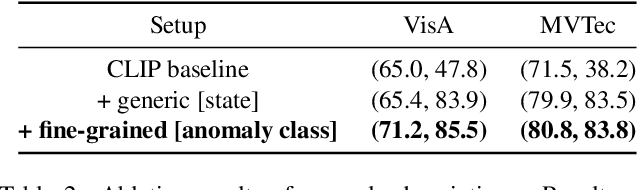
Zero-shot anomaly detection (ZSAD) methods entail detecting anomalies directly without access to any known normal or abnormal samples within the target item categories. Existing approaches typically rely on the robust generalization capabilities of multimodal pretrained models, computing similarities between manually crafted textual features representing "normal" or "abnormal" semantics and image features to detect anomalies and localize anomalous patches. However, the generic descriptions of "abnormal" often fail to precisely match diverse types of anomalies across different object categories. Additionally, computing feature similarities for single patches struggles to pinpoint specific locations of anomalies with various sizes and scales. To address these issues, we propose a novel ZSAD method called FiLo, comprising two components: adaptively learned Fine-Grained Description (FG-Des) and position-enhanced High-Quality Localization (HQ-Loc). FG-Des introduces fine-grained anomaly descriptions for each category using Large Language Models (LLMs) and employs adaptively learned textual templates to enhance the accuracy and interpretability of anomaly detection. HQ-Loc, utilizing Grounding DINO for preliminary localization, position-enhanced text prompts, and Multi-scale Multi-shape Cross-modal Interaction (MMCI) module, facilitates more accurate localization of anomalies of different sizes and shapes. Experimental results on datasets like MVTec and VisA demonstrate that FiLo significantly improves the performance of ZSAD in both detection and localization, achieving state-of-the-art performance with an image-level AUC of 83.9% and a pixel-level AUC of 95.9% on the VisA dataset.
AnomalyGPT: Detecting Industrial Anomalies using Large Vision-Language Models
Sep 13, 2023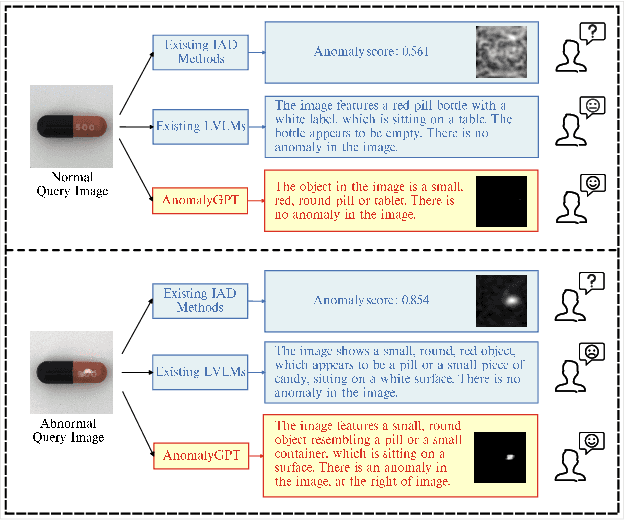

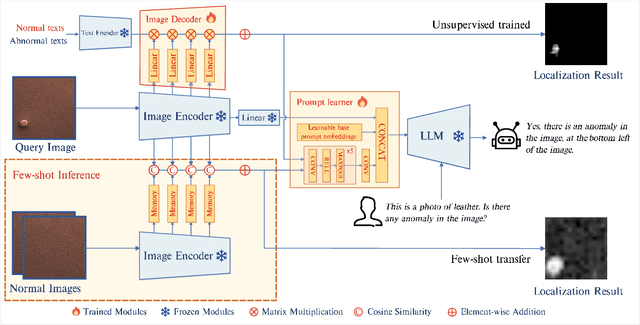
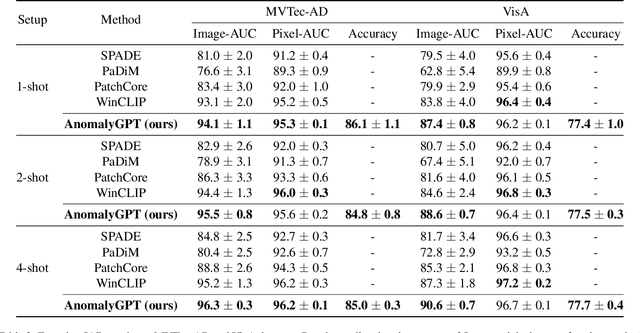
Large Vision-Language Models (LVLMs) such as MiniGPT-4 and LLaVA have demonstrated the capability of understanding images and achieved remarkable performance in various visual tasks. Despite their strong abilities in recognizing common objects due to extensive training datasets, they lack specific domain knowledge and have a weaker understanding of localized details within objects, which hinders their effectiveness in the Industrial Anomaly Detection (IAD) task. On the other hand, most existing IAD methods only provide anomaly scores and necessitate the manual setting of thresholds to distinguish between normal and abnormal samples, which restricts their practical implementation. In this paper, we explore the utilization of LVLM to address the IAD problem and propose AnomalyGPT, a novel IAD approach based on LVLM. We generate training data by simulating anomalous images and producing corresponding textual descriptions for each image. We also employ an image decoder to provide fine-grained semantic and design a prompt learner to fine-tune the LVLM using prompt embeddings. Our AnomalyGPT eliminates the need for manual threshold adjustments, thus directly assesses the presence and locations of anomalies. Additionally, AnomalyGPT supports multi-turn dialogues and exhibits impressive few-shot in-context learning capabilities. With only one normal shot, AnomalyGPT achieves the state-of-the-art performance with an accuracy of 86.1%, an image-level AUC of 94.1%, and a pixel-level AUC of 95.3% on the MVTec-AD dataset. Code is available at https://github.com/CASIA-IVA-Lab/AnomalyGPT.