 Add to Chrome
 Add to Firefox
 Add to Edge
ComPASS: Towards Personalized Agentic Social Support via Tool-Augmented Companionship
Apr 20, 2026
Developing compassionate interactive systems requires agents to not only understand user emotions but also provide diverse, substantive support. While recent works explore empathetic dialogue generation, they remain limited in response form and content, struggling to satisfy diverse needs across users and contexts. To address this, we explore empowering agents with external tools to execute diverse actions. Grounded in the psychological concept of "social support", this paradigm delivers substantive, human-like companionship. Specifically, we first design a dozen user-centric tools simulating various multimedia applications, which can cover different types of social support behaviors in human-agent interaction scenarios. We then construct ComPASS-Bench, the first personalized social support benchmark for LLM-based agents, via multi-step automated synthesis and manual refinement. Based on ComPASS-Bench, we further synthesize tool use records to fine-tune the Qwen3-8B model, yielding a task-specific ComPASS-Qwen. Comprehensive evaluations across two settings reveal that while the evaluated LLMs can generate valid tool-calling requests with high success rates, significant gaps remain in final response quality. Moreover, tool-augmented responses achieve better overall performance than directly producing conversational empathy. Notably, our trained ComPASS-Qwen demonstrates substantial improvements over its base model, achieving comparable performance to several large-scale models. Our code and data are available at https://github.com/hzp3517/ComPASS.

Mem-PAL: Towards Memory-based Personalized Dialogue Assistants for Long-term User-Agent Interaction
Nov 17, 2025With the rise of smart personal devices, service-oriented human-agent interactions have become increasingly prevalent. This trend highlights the need for personalized dialogue assistants that can understand user-specific traits to accurately interpret requirements and tailor responses to individual preferences. However, existing approaches often overlook the complexities of long-term interactions and fail to capture users' subjective characteristics. To address these gaps, we present PAL-Bench, a new benchmark designed to evaluate the personalization capabilities of service-oriented assistants in long-term user-agent interactions. In the absence of available real-world data, we develop a multi-step LLM-based synthesis pipeline, which is further verified and refined by human annotators. This process yields PAL-Set, the first Chinese dataset comprising multi-session user logs and dialogue histories, which serves as the foundation for PAL-Bench. Furthermore, to improve personalized service-oriented interactions, we propose H$^2$Memory, a hierarchical and heterogeneous memory framework that incorporates retrieval-augmented generation to improve personalized response generation. Comprehensive experiments on both our PAL-Bench and an external dataset demonstrate the effectiveness of the proposed memory framework.
Adaptive Temporal Motion Guided Graph Convolution Network for Micro-expression Recognition
Jun 13, 2024Micro-expressions serve as essential cues for understanding individuals' genuine emotional states. Recognizing micro-expressions attracts increasing research attention due to its various applications in fields such as business negotiation and psychotherapy. However, the intricate and transient nature of micro-expressions poses a significant challenge to their accurate recognition. Most existing works either neglect temporal dependencies or suffer from redundancy issues in clip-level recognition. In this work, we propose a novel framework for micro-expression recognition, named the Adaptive Temporal Motion Guided Graph Convolution Network (ATM-GCN). Our framework excels at capturing temporal dependencies between frames across the entire clip, thereby enhancing micro-expression recognition at the clip level. Specifically, the integration of Adaptive Temporal Motion layers empowers our method to aggregate global and local motion features inherent in micro-expressions. Experimental results demonstrate that ATM-GCN not only surpasses existing state-of-the-art methods, particularly on the Composite dataset, but also achieves superior performance on the latest micro-expression dataset CAS(ME)$^3$.
ECR-Chain: Advancing Generative Language Models to Better Emotion-Cause Reasoners through Reasoning Chains
May 17, 2024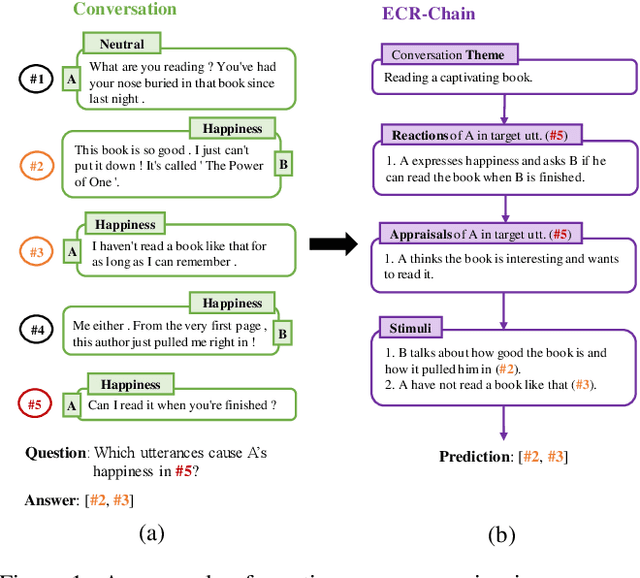
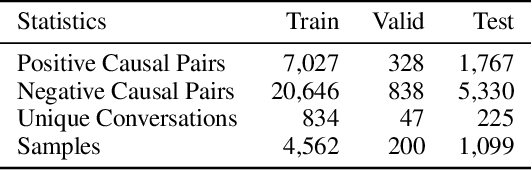
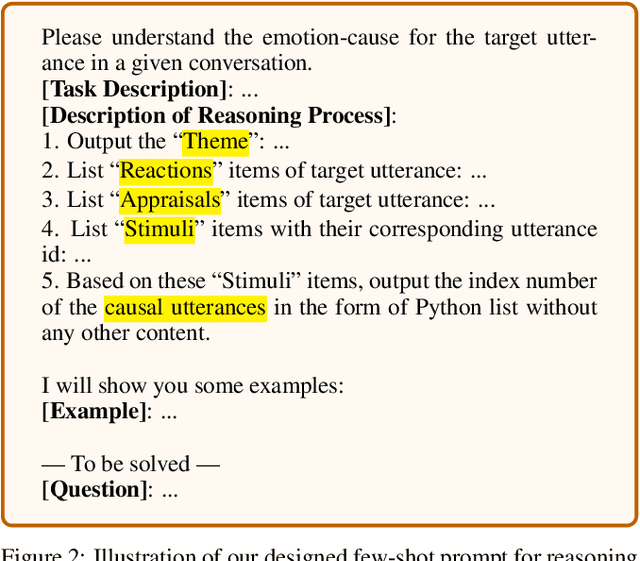
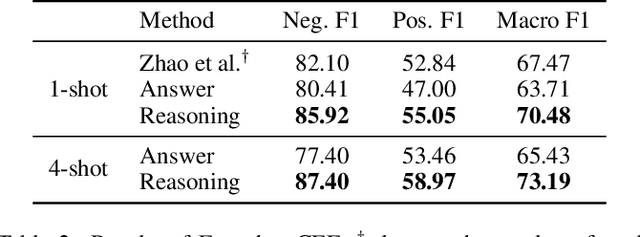
Understanding the process of emotion generation is crucial for analyzing the causes behind emotions. Causal Emotion Entailment (CEE), an emotion-understanding task, aims to identify the causal utterances in a conversation that stimulate the emotions expressed in a target utterance. However, current works in CEE mainly focus on modeling semantic and emotional interactions in conversations, neglecting the exploration of the emotion-generation process. This hinders the models from deeply understanding emotions, restricting their ability to produce explainable predictions. In this work, inspired by the emotion generation process of "stimulus-appraisal-emotion" in the cognitive appraisal theory, we introduce a step-by-step reasoning method, Emotion-Cause Reasoning Chain (ECR-Chain), to infer the stimulus from the target emotional expressions in conversations. Specifically, we first introduce the ECR-Chain to ChatGPT via few-shot prompting, which significantly improves its performance on the CEE task. We further propose an automated construction process to utilize ChatGPT in building an ECR-Chain set, which can enhance the reasoning abilities of smaller models through supervised training and assist the Vicuna-7B model in achieving state-of-the-art CEE performance. Moreover, our methods can enable these generative language models to effectively perform emotion-cause reasoning in an explainable manner. Our code, data and more details are at https://github.com/hzp3517/ECR-Chain.
Multi-modal Emotion Estimation for in-the-wild Videos
Mar 31, 2022
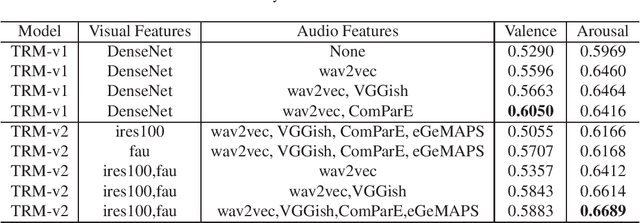
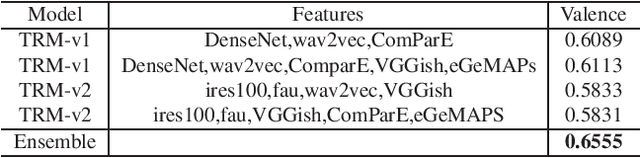
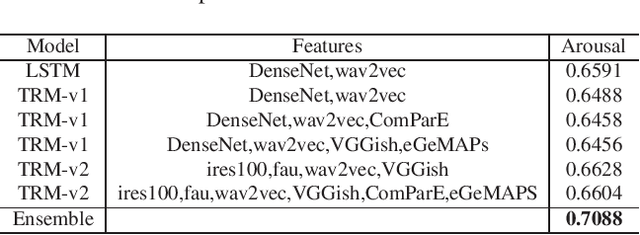
In this paper, we briefly introduce our submission to the Valence-Arousal Estimation Challenge of the 3rd Affective Behavior Analysis in-the-wild (ABAW) competition. Our method utilizes the multi-modal information, i.e., the visual and audio information, and employs a temporal encoder to model the temporal context in the videos. Besides, a smooth processor is applied to get more reasonable predictions, and a model ensemble strategy is used to improve the performance of our proposed method. The experiment results show that our method achieves 65.55% ccc for valence and 70.88% ccc for arousal on the validation set of the Aff-Wild2 dataset, which prove the effectiveness of our proposed method.