 Add to Chrome
 Add to Firefox
 Add to Edge
JoyVoice: Long-Context Conditioning for Anthropomorphic Multi-Speaker Conversational Synthesis
Dec 22, 2025
Large speech generation models are evolving from single-speaker, short sentence synthesis to multi-speaker, long conversation geneartion. Current long-form speech generation models are predominately constrained to dyadic, turn-based interactions. To address this, we introduce JoyVoice, a novel anthropomorphic foundation model designed for flexible, boundary-free synthesis of up to eight speakers. Unlike conventional cascaded systems, JoyVoice employs a unified E2E-Transformer-DiT architecture that utilizes autoregressive hidden representations directly for diffusion inputs, enabling holistic end-to-end optimization. We further propose a MM-Tokenizer operating at a low bitrate of 12.5 Hz, which integrates multitask semantic and MMSE losses to effectively model both semantic and acoustic information. Additionally, the model incorporates robust text front-end processing via large-scale data perturbation. Experiments show that JoyVoice achieves state-of-the-art results in multilingual generation (Chinese, English, Japanese, Korean) and zero-shot voice cloning. JoyVoice achieves top-tier results on both the Seed-TTS-Eval Benchmark and multi-speaker long-form conversational voice cloning tasks, demonstrating superior audio quality and generalization. It achieves significant improvements in prosodic continuity for long-form speech, rhythm richness in multi-speaker conversations, paralinguistic naturalness, besides superior intelligibility. We encourage readers to listen to the demo at https://jea-speech.github.io/JoyVoice

FunASR: A Fundamental End-to-End Speech Recognition Toolkit
May 18, 2023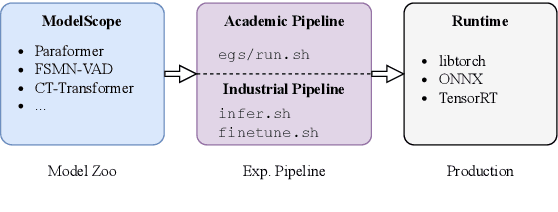
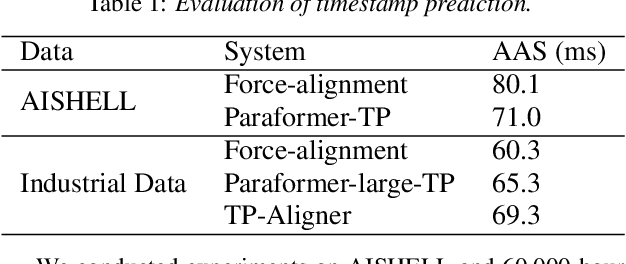
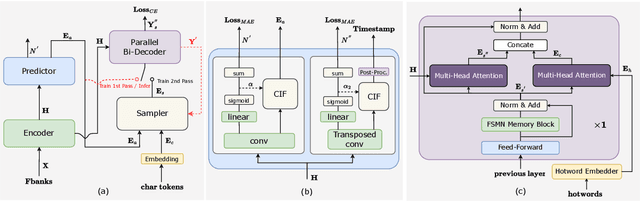
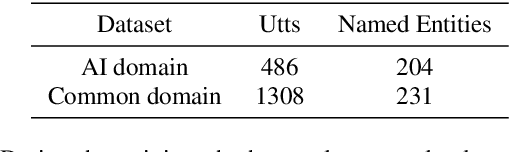
This paper introduces FunASR, an open-source speech recognition toolkit designed to bridge the gap between academic research and industrial applications. FunASR offers models trained on large-scale industrial corpora and the ability to deploy them in applications. The toolkit's flagship model, Paraformer, is a non-autoregressive end-to-end speech recognition model that has been trained on a manually annotated Mandarin speech recognition dataset that contains 60,000 hours of speech. To improve the performance of Paraformer, we have added timestamp prediction and hotword customization capabilities to the standard Paraformer backbone. In addition, to facilitate model deployment, we have open-sourced a voice activity detection model based on the Feedforward Sequential Memory Network (FSMN-VAD) and a text post-processing punctuation model based on the controllable time-delay Transformer (CT-Transformer), both of which were trained on industrial corpora. These functional modules provide a solid foundation for building high-precision long audio speech recognition services. Compared to other models trained on open datasets, Paraformer demonstrates superior performance.
Hybrid CTC-Attention based End-to-End Speech Recognition using Subword Units
Sep 06, 2018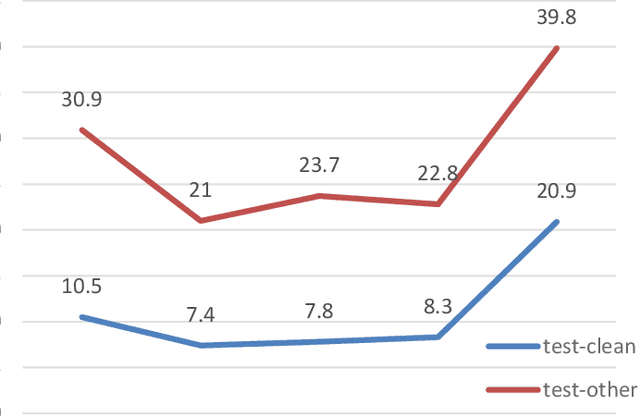
In this paper, we present an end-to-end automatic speech recognition system, which successfully employs subword units in a hybrid CTC-Attention based system. The subword units are obtained by the byte-pair encoding (BPE) compression algorithm. Compared to using words as modeling units, using characters or subword units does not suffer from the out-of-vocabulary (OOV) problem. Furthermore, using subword units further offers a capability in modeling longer context than using characters. We evaluate different systems over the LibriSpeech 1000h dataset. The subword-based hybrid CTC-Attention system obtains 6.8% word error rate (WER) on the test_clean subset without any dictionary or external language model. This represents a significant improvement (a 12.8% WER relative reduction) over the character-based hybrid CTC-Attention system.